Regression testing embedding model upgrades for SEO
A newer embedding model can improve benchmarks and still destabilise important clusters or URL mappings. Learn how to regression-test model upgrades before changing production.

Farky Rafiq
Founder of ClusterIQ
You have turned 1,500 keywords from Ahrefs, Semrush or Search Console into a content plan. Then an embedding model upgrade changes the groups and suggested URLs. Is the new plan better, or just different?
Embedding models improve quickly, but newer does not automatically mean better. An upgrade changes the vector space: the numerical representation used to compare meaning. That can change neighbour rankings, score distributions, graph connections, cluster membership and URL mappings without any other code changing.
ClusterIQ needs evidence-based upgrades, not silent rewrites of users’ work.
Freeze a representative regression corpus
Keep a fixed test collection of keywords and pages representing real work:
- head terms and long-tail queries;
- product codes, brands and entities;
- queries where intent changes;
- several languages, where relevant;
- short and long pages;
- known difficult mappings.
Encode the same collection with both models. This makes comparisons repeatable and saves rebuilding test cases for every upgrade.
Compare score distributions first
Check how cosine similarity or dot-product scores are distributed before reusing old cut-offs. A threshold of 0.78 can mean something completely different in the new vector space.
Rerun threshold calibration as part of the upgrade, rather than assuming yesterday’s “strong match” still means the same thing.
Measure nearest-neighbour changes
For benchmark queries, compare the closest matches:
- the top-ranked neighbour;
- overlap among the top ten;
- whether entity distinctions survive;
- known positive and negative pairs.
Large movement is not automatically bad. It highlights where downstream groups and page decisions are likely to change.
Worked example: a model that improves paraphrases and loses model numbers
Suppose a candidate improves semantic paraphrase benchmarks by 8%, but starts grouping “Series 6” and “Series 8” product queries more aggressively. The surrounding wording outweighs the model-number distinction.
That may be acceptable for editorial clustering, yet a serious regression for ecommerce page mapping. Judge the types of failure, not just the headline score.
Compare cluster partitions
Run the same clustering configuration on both sets of embeddings. Compare:
- ARI and NMI;
- cluster lineage, showing which groups split or merge;
- movement of high-value queries;
- the outlier rate.
ARI and NMI measure overall structural change. Local lineage shows what moved, helping you identify which content briefs need reviewing.
Rebuild approximate indexes
Never mix vectors from different models in one approximate nearest-neighbour (ANN) index. Matching dimensions do not make their spaces compatible.
Build a separate index, benchmark recall to check how many relevant neighbours it retrieves, and leave the production index intact during comparison.
Compare page-mapping accuracy separately
Better keyword-to-keyword similarity does not guarantee better keyword-to-page retrieval.
Use a fixed set of human-approved cluster-to-URL mappings. Compare retrieval recall and top-ranked pages to check whether the candidate still finds the right destination, not merely plausible wording.
Test multilingual and domain slices independently
A healthy average can hide a poor result for one language or industry. Report quality separately by market, language, page type, query length, entity density, and commercial versus informational tasks.
This shows who benefits and who might face extra corrections.
Run dual versions before migration where possible
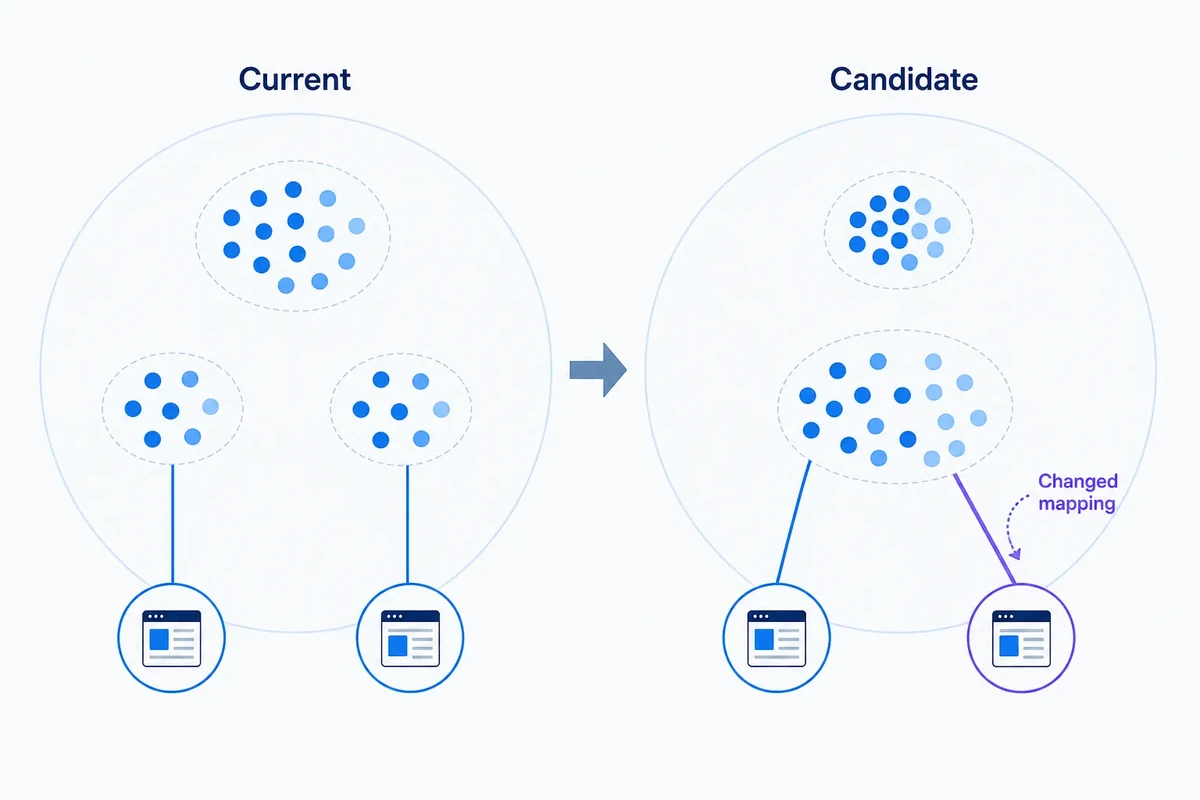
ClusterIQ can generate a candidate model run without overwriting the current analysis. Practitioners can inspect new splits and merges, changed representative queries, changed URL mappings and new high-confidence opportunities.
The upgrade becomes a proposal to review, rather than an automatic migration of an approved plan.
Carry forward human overrides carefully
An old override may still express valid business logic. Carry it forward as a human decision, not proof that the candidate independently reached the same assignment.
Keep the relationship between the model’s output and the approved state explicit.
Define release gates before testing
Agree the acceptance rules before seeing results. They might require:
- no material regression in high-consequence benchmark groups;
- retrieval recall above an agreed minimum;
- review of large splits and merges;
- stable mapping for protected URLs;
- a documented reason for every accepted regression.
This prevents moving the goalposts to suit a promising candidate.
Do not chase benchmark averages endlessly
A 0.5% gain on a general embedding benchmark may make no practical difference to ClusterIQ. Prefer improvements to errors users actually encounter and workflows that cost them time.
Version the entire semantic stack
The model name is not enough. Record the model revision, prompt or task prefix, normalisation, dimension, chunking, similarity function and index configuration.
These details make the upgrade reproducible, rather than a result nobody can recreate.
Keep rollback possible
If production problems appear, users should retain their previous analysis. Preserve prior vectors, or the ability to regenerate them from a pinned model version and source snapshot.
Practitioner principle: an embedding upgrade changes the evidence layer. Treat it as a versioned analytical migration, not a library update.
ClusterIQ Conclusion
Regression testing stops upgrades silently rewriting topic and page relationships. Compare scores, neighbours, cluster partitions, URL mappings and failure types, then give practitioners a controlled route to adoption when the evidence supports it.
Turning this evidence into an SEO decision
An analytical result should not trigger an irreversible site change. First establish what changed, how confident the evidence is and which decision it affects. Strong signals may justify automatic candidate generation; weak or conflicting signals should enter review.
Review representative queries, entities, page type, existing URL ownership and contradictory first-party evidence. You might approve or adjust a group, improve a page, create an asset, consolidate overlap or change nothing. Keep these outcomes separate: analysis is not automatically an instruction to generate content.
Keep the evidence visible afterwards. ClusterIQ can store proposed and approved decisions with override reasons. Those differences provide valuable feedback on methodological reliability and where business context still matters.
Sources and further reading
Farky Rafiq
Founder of ClusterIQ
I've worked in digital marketing since 2005 and founded Liquid Silver in 2011. These articles are where I share the methods, experiments and practical SEO thinking behind ClusterIQ.
Put the idea into practice with your own keyword data
ClusterIQ helps turn raw SEO exports into clean, structured working datasets you can inspect, refine, report on and take into the next stage of your workflow.
Keep reading
Soft clustering and confidence scores: handling ambiguous keywords honestly
Adding new keywords to existing clusters without rebuilding everything