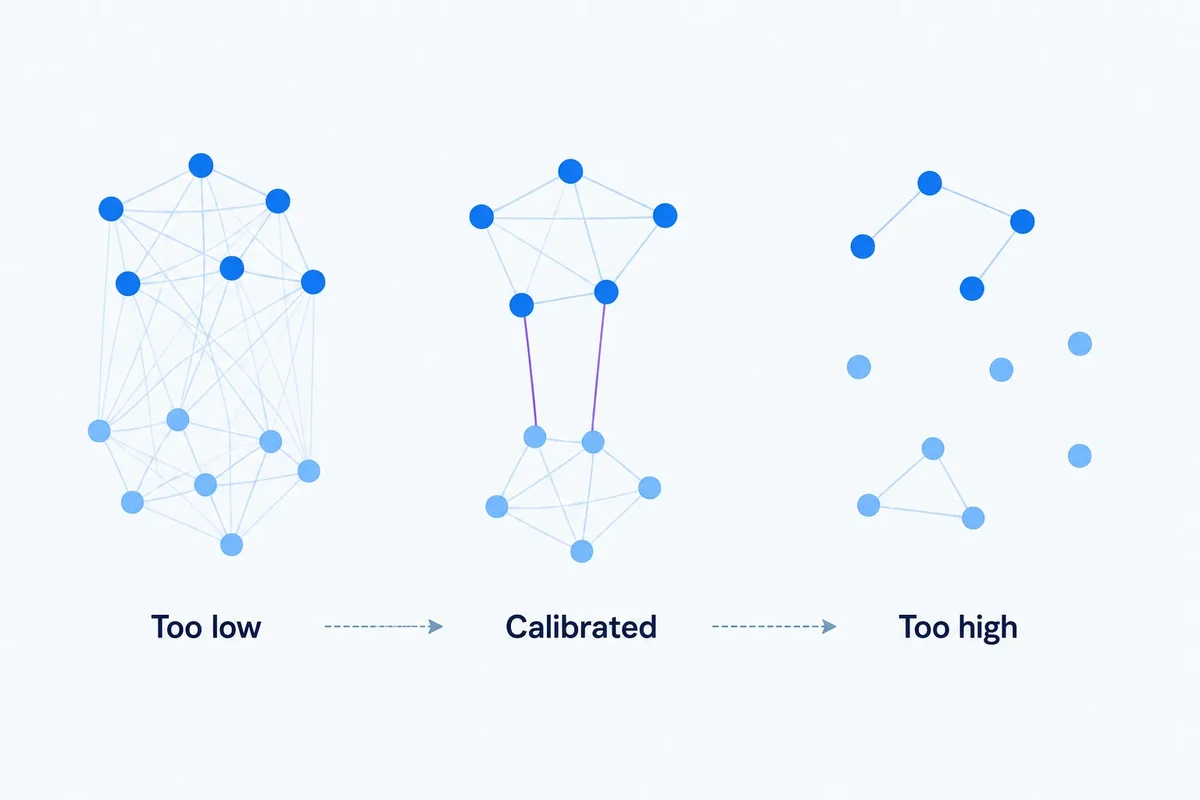
The resolution parameter in graph clustering: how one setting changes topic granularity
Community-detection resolution can turn one broad topic into several smaller groups. Learn what the parameter changes, why it is not a universal scale and how to calibrate it for SEO.

Farky Rafiq
Founder of ClusterIQ
When you are staring at a spreadsheet of three thousand keywords from Ahrefs or Search Console, the biggest challenge isn't just grouping them, it is deciding how specific those groups should be. This is the classic granularity problem in community detection.
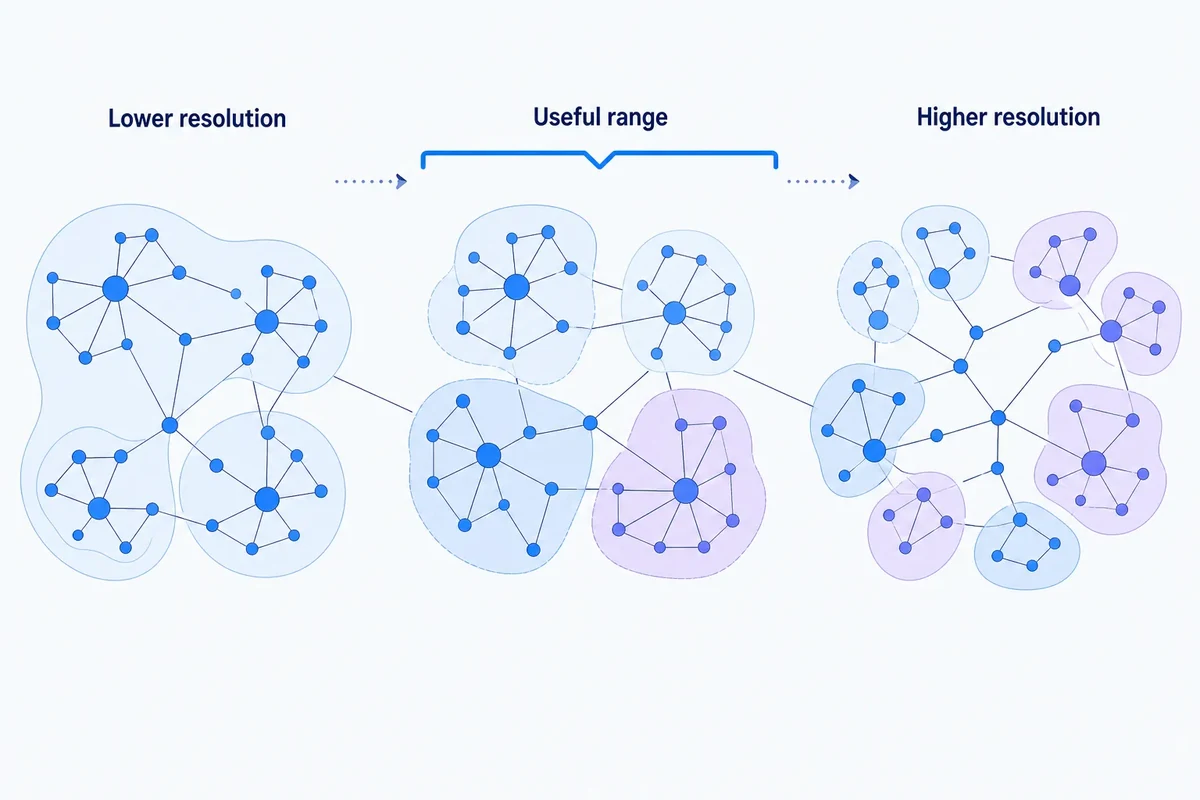
You can take a single keyword graph and partition it into a few broad themes or dozens of tiny, niche groups. Both results are mathematically valid. If you are using Louvain or Leiden algorithms, the resolution parameter is the primary dial you turn to control this level of detail.
For SEOs, resolution is a practical tool. The "correct" topic size depends entirely on what you are trying to achieve. A high-level content strategy might need broad thematic pillars, whereas a URL mapping project requires much tighter, operational groups to avoid keyword cannibalisation.
What resolution changes
In most modularity-based clustering, the resolution parameter dictates the scale at which communities are formed. According to the NetworkX Louvain documentation, values lower than 1.0 tend to encourage larger, more inclusive communities, while values above 1.0 favour smaller, more granular ones.
It is important to remember this is a general tendency rather than a precise rule. Setting the value to 2.0 does not guarantee you will get exactly twice as many clusters; the final result is always dictated by the underlying structure of your specific keyword graph.
Resolution is not a universal topic-depth slider
You cannot assume that a resolution of 1.2 on a graph for "insurance" will produce the same level of detail as 1.2 on a graph for "garden furniture".
Factors like how many keywords you have, how densely they are connected, the weight of the edges between them, and the natural topical variety all change the outcome. Because of this, ClusterIQ should save the resolution alongside the specific graph configuration. It is better to evaluate the resulting communities based on their utility rather than treating the parameter as a simple percentage slider.
Worked example: running shoes
Imagine you have a dataset of 1,500 keywords related to footwear. At a lower resolution, your graph might produce one massive "running shoes" community.
If you turn the resolution up, that large group might split into distinct, actionable clusters:
- trail running shoes;
- stability running shoes;
- racing shoes;
- beginner running shoes;
- running shoe sizing.
If you are building a top-level navigation menu, the broad group is perfect. However, if you are writing content briefs or planning new category pages, those narrower sub-groups are far more useful.
Do not tune resolution before validating the graph
A sophisticated resolution setting cannot fix a fundamentally broken edge model. If your graph connects unrelated keywords because of weak or noisy data, increasing the resolution might force them apart, but the underlying relationships remain misleading.
Before you start fiddling with resolution, ensure you have validated your edge pruning, thresholds, and connected components. Fix the foundation before you try to fine-tune the granularity.
Use a resolution sweep
A smart way to find the right setting is to run a "sweep" using several nearby values, such as 0.7, 0.9, 1.0, 1.2, and 1.5.
For every run, take note of:
- the total number of communities created;
- how the sizes of these groups are distributed;
- which keywords stay together regardless of the setting (the stable core);
- where major groups split or merge;
- any outliers that get left behind;
- how well the groups match your actual SEO tasks.
This process highlights where the meaningful structure of your market actually sits and where the data starts to become over-fragmented and messy.
Stable splits are more persuasive
If a broad community consistently breaks into the same three sub-groups across several different resolution settings, you can be confident those subtopics are real and significant. They deserve dedicated pages or sections.
Conversely, if a split only appears at one very specific value and vanishes the moment you nudge the dial, that boundary is fragile. This approach connects resolution testing directly to ClusterIQ's stability workflow.
Resolution should match the downstream unit
You don't have to pick just one setting. Different SEO deliverables can draw from different levels of the same graph.
ClusterIQ might utilise:
- broad communities for a high-level topic map;
- medium-sized communities for content planning and briefs;
- tight sub-clusters or intent groups for specific URL mapping;
- individual keyword neighbours for granular on-page evidence.
There is no rule saying one resolution must serve every single purpose.
Do not maximise community count
It is tempting to think that more clusters mean more precision, but this often leads to artificial fragmentation. A group is only useful if it has a distinct job to do. If you cannot give two neighbouring communities different descriptions or different page targets, your resolution is likely too high, creating distinctions that have no practical value.
Do not minimise community count either
On the other hand, overly broad communities can mask vital commercial intent. A single "bathrooms" cluster isn't helpful if your data clearly shows that customers search for baths, showers, toilets, and vanity units as separate needs. The "sweet spot" for granularity is where the groups are stable enough to be explained and specific enough to be acted upon.
Use hierarchical reporting
A robust way to present this data is to maintain several levels of hierarchy:
- macro topic;
- community;
- sub-community;
- keyword.
This allows ClusterIQ to show you the big picture while letting you drill down into the details, acknowledging that there isn't just one "correct" way to count clusters.
Resolution interacts with edge weight
Adjusting your graph weights can be just as impactful as changing the resolution. A model that uses multiple signals to strengthen shared entities might produce much clearer communities at a standard resolution than a graph based purely on semantic similarity.
When you are testing, try to keep your graph fixed so you can isolate exactly what the resolution parameter is doing.
Use human review at meaningful breakpoints
You don't need to manually check every single result. Focus your attention on the "breakpoints" where major communities split or where the total cluster count jumps significantly. These moments represent the points where the graph is offering a fundamentally different interpretation of your keyword landscape.
Practitioner principle: resolution controls how finely the graph is partitioned. It does not decide which level is right for the SEO task.
ClusterIQ Conclusion
The resolution parameter is one of the most powerful levers you have in graph-based keyword clustering. By using sweeps, checking for stability, and keeping your specific SEO goals in mind, you can find the most useful levels of granularity. The most effective approach in ClusterIQ is to preserve these multiple levels of meaning rather than forcing a single value to define your entire strategy.
Record useful resolution ranges, not one sacred value
If the core members of a community remain together from resolution 0.9 all the way through to 1.2, that range tells you something important about the strength of that topic. ClusterIQ can track where these stable cores persist and where the most meaningful splits occur.
This gives you a more realistic view of your data. Some topical boundaries are robust and reliable across many settings, while others are highly sensitive to configuration and should be treated with more caution before they influence your site architecture.
Sources and further reading
Farky Rafiq
Founder of ClusterIQ
I've worked in digital marketing since 2005 and founded Liquid Silver in 2011. These articles are where I share the methods, experiments and practical SEO thinking behind ClusterIQ.
Put the idea into practice with your own keyword data
ClusterIQ helps turn raw SEO exports into clean, structured working datasets you can inspect, refine, report on and take into the next stage of your workflow.
Keep reading
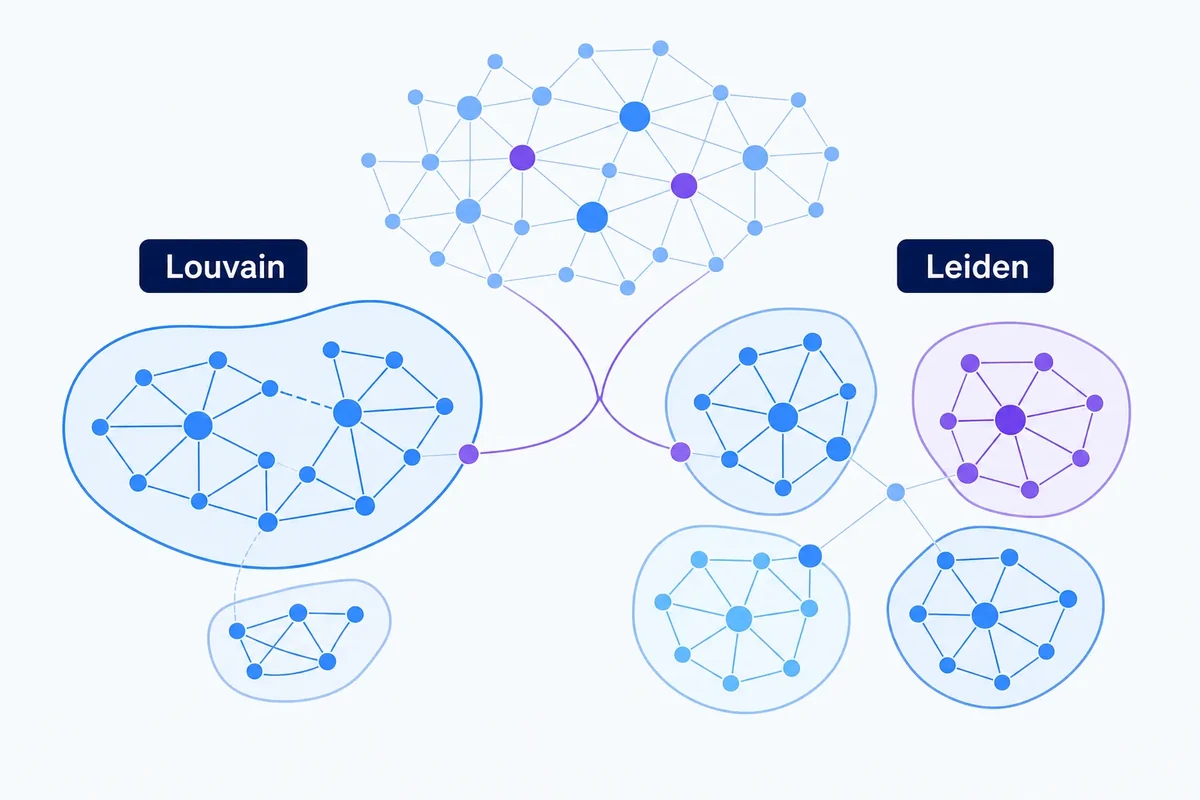
Louvain vs Leiden for keyword clustering: community detection compared
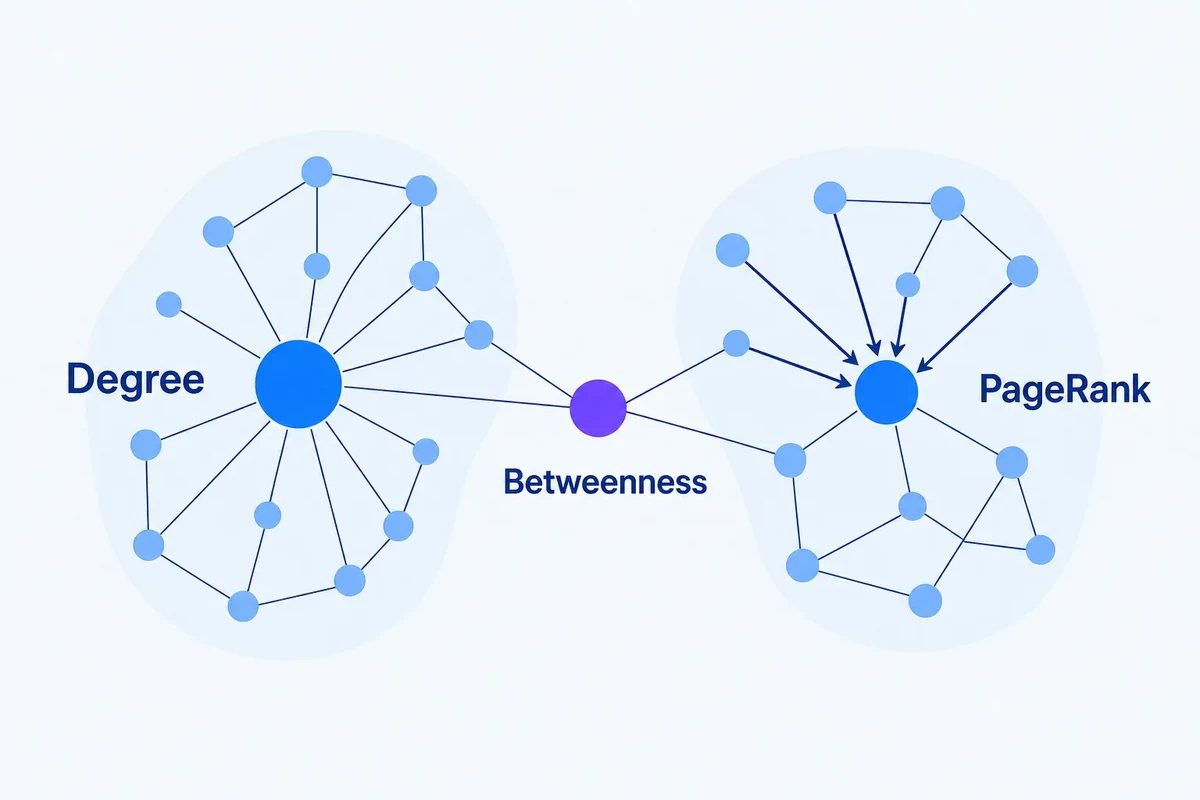
Graph centrality for SEO: finding hubs, bridges and misleadingly important keywords