Edge pruning in keyword graphs: removing weak relationships without breaking useful structure
Keyword graphs can become noisy when too many weak edges survive. Learn how thresholding, mutual neighbours and bridge review can simplify the graph without destroying real topics.

Farky Rafiq
Founder of ClusterIQ
When you are dealing with a few thousand keywords from Ahrefs or Search Console, a keyword graph can quickly become a mess. If every slight similarity between terms is treated as a connection, your map turns into a dense, unreadable blob. You might see "best CRM software" linked to "how to bake bread" just because they both contain the word "how" or "best" in a messy dataset.
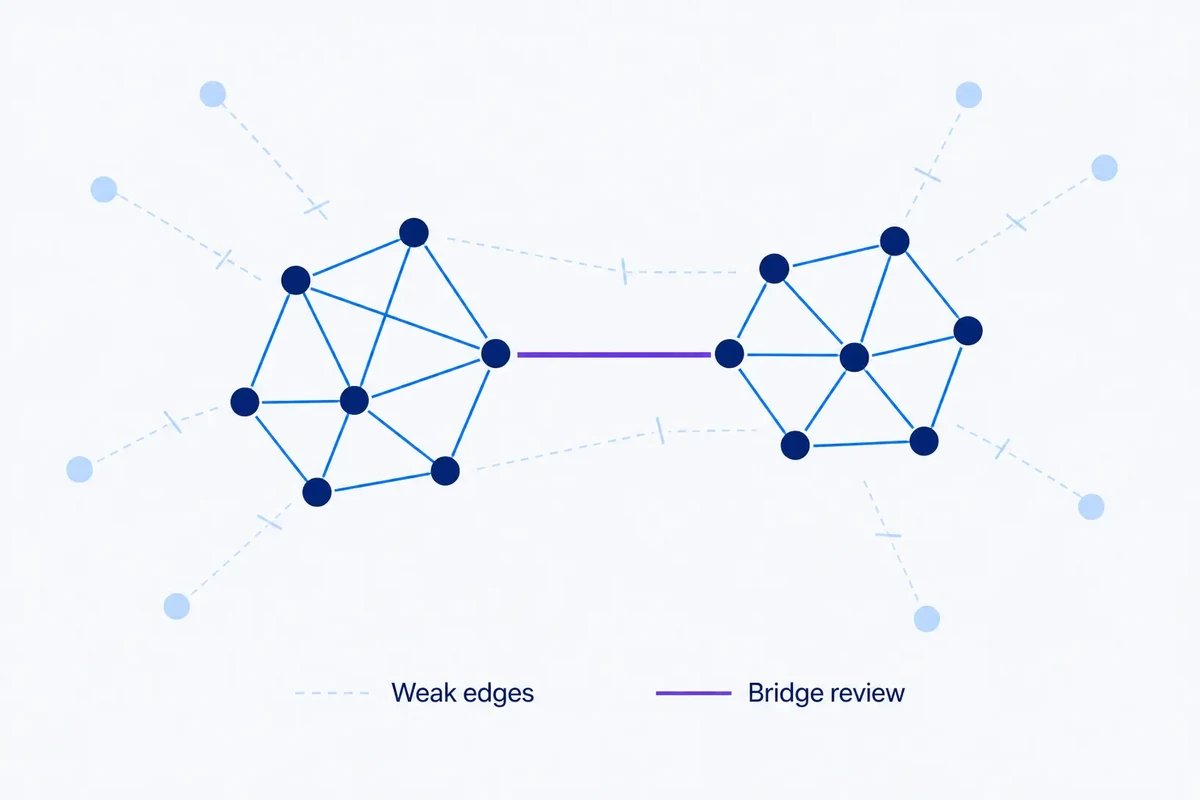
Weak semantic links and generic modifiers create thousands of these "edges" (the lines connecting keywords). Edge pruning is the process of stripping away these low-quality connections. The goal is to clear the noise without accidentally cutting the bridges that hold your topical structure together.
Pruning is part of modelling
It is important to remember that an edge isn't an objective fact; it is a decision made by your clustering rules. When you prune, you aren't just tidying up a visualisation, you are changing the underlying model of your data. ClusterIQ should ideally keep a record of the original evidence so you can see exactly why a connection was kept or binned.
Similarity floors are the simplest rule
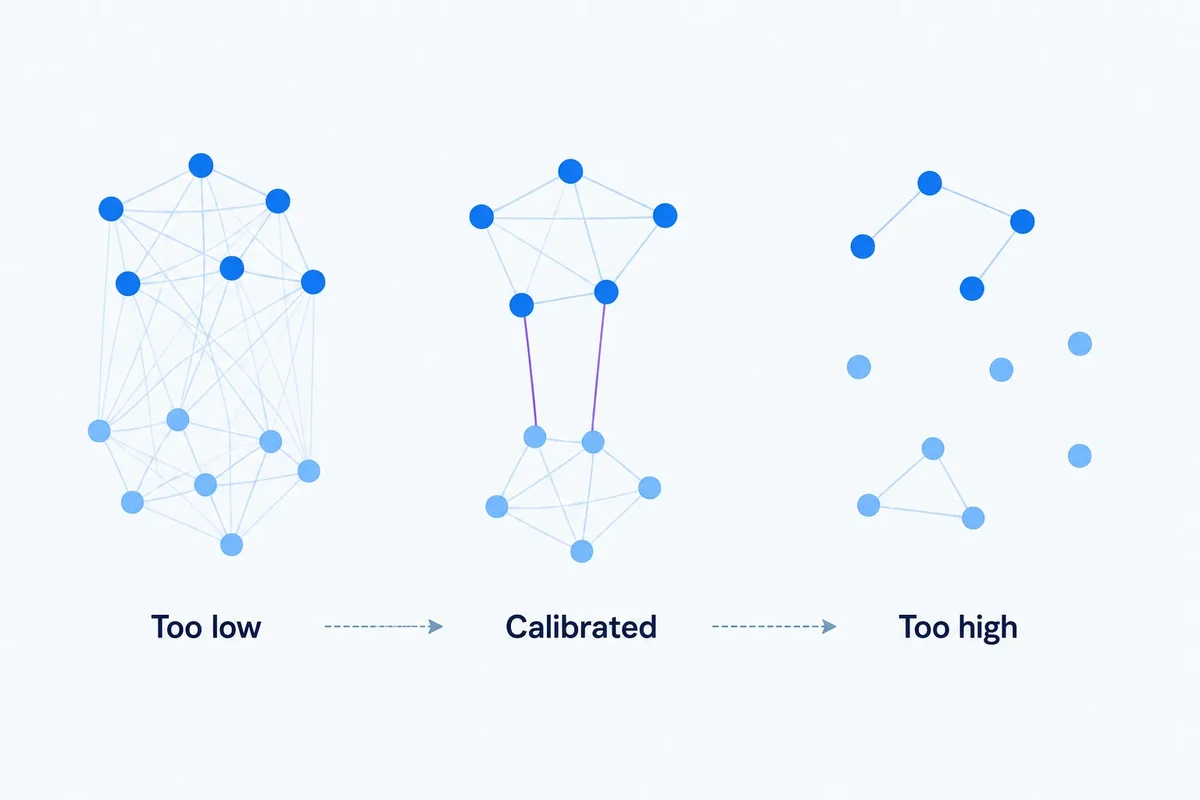
The most basic approach is to set a minimum similarity score. If two keywords aren't similar enough, the link is dropped. While this cleans up obvious junk, a single global threshold can be blunt. A niche technical topic might lose all its connections and disappear, while a broad commercial category stays cluttered. This is why threshold calibration is a vital step before you start cutting.
Top-k controls degree, not quality
You might decide to only keep the ten strongest neighbours for any given keyword. This keeps the graph size manageable, but it doesn't guarantee those ten links are actually good. For a very obscure query, even its best neighbour might be a reach. A better approach is a hybrid: look for the top candidates, but still discard them if they fall below a certain quality floor.
Mutual neighbours create a conservative graph
A "mutual" rule means a link only stays if both keywords "agree" they are top neighbours of each other. This is great for cleaning up one-sided relationships and making clusters tighter. However, it can lead to fragmentation. A specific long-tail query might point to a broad head term as its best match, but that head term has thousands of better matches and won't point back. Use mutuality as a helpful signal rather than a rigid law.
Prune generic bridges carefully
Phrases like "best software" or "free tool" often act as bridges between totally different topics because they share "task" language. Before you delete these, check if the bridge is useful. Sometimes these links reveal a genuine user journey or a parent category. Other times, they are just distractions caused by generic modifiers having too much weight.
Worked example: one edge joins two commercial topics
Picture a graph where your "CRM" keywords and "Project Management" keywords are mostly separate. Suddenly, the query "best business software" appears, linking both groups into one giant cluster. Removing that single bridge might make your content plan much clearer. But if you also have five other queries comparing CRM and PM tools, that connection is likely real. The right move comes from looking at the whole bridge set, not just deleting the weakest link automatically.
Use component changes as a diagnostic
After you prune, look at your connected components. If a tiny tweak to your settings causes your graph to shatter into hundreds of tiny islands, your model is too fragile. If you remove thousands of weak edges and the main topical hubs stay stable, you have successfully removed redundancy rather than vital structure.
Weighted graphs support more nuanced pruning
In a sophisticated setup, an edge isn't just one number. It can be a mix of semantic meaning, shared entities, and SERP overlap. Instead of one magic threshold, ClusterIQ can use smarter rules: keep a link if the SERP overlap is huge, even if the text is different; or reject a link if the two keywords represent conflicting entities. This is far more practical for building accurate page-level briefs.
Pruning should improve review, not only speed
While fewer edges make the math faster, the real win is for the human doing the work. You want to be able to look at a cluster and understand why those keywords are together without filtering through hundreds of meaningless relationships.
Track what pruning removes
Good QA is essential. You should know what percentage of edges were cut, which important keywords became "islands" with no neighbours, and how stable the clusters remained. These metrics ensure that pruning in ClusterIQ is a transparent process rather than a hidden black box.
Do not prune after seeing the answer you want
It is tempting to keep moving the slider until the graph looks like the site navigation you already had in mind. That is just forcing the data to fit your bias. Define your rules, test them, and keep them consistent. ClusterIQ's reproducibility principles ensure that your pruning settings are saved as part of the project record.
Review edge loss by topic importance
Losing a connection in a low-priority research cluster isn't a big deal. Losing the link that connects your highest-converting product page to its supporting sub-topics is a problem. Use business value to guide your manual checks, but don't let it override the data entirely.
Practitioner principle: pruning should remove weak evidence, not inconvenient evidence.
ClusterIQ Conclusion
Edge pruning is a necessity for making sense of large-scale keyword data, but every cut changes your results. By using similarity floors, mutual rules, and weighted signals, you can clear the fog. Always validate the resulting structure to ensure you are building your SEO strategy on solid ground rather than noise.
Sources and further reading
Farky Rafiq
Founder of ClusterIQ
I've worked in digital marketing since 2005 and founded Liquid Silver in 2011. These articles are where I share the methods, experiments and practical SEO thinking behind ClusterIQ.
Put the idea into practice with your own keyword data
ClusterIQ helps turn raw SEO exports into clean, structured working datasets you can inspect, refine, report on and take into the next stage of your workflow.
Keep reading

Connected components in keyword graphs: finding islands before community detection
Graph centrality for SEO: finding hubs, bridges and misleadingly important keywords