Connected components in keyword graphs: finding islands before community detection
Connected components reveal which parts of a keyword graph can reach one another before any clustering algorithm runs. Learn why giant components and isolated islands are valuable diagnostics.

Farky Rafiq
Founder of ClusterIQ
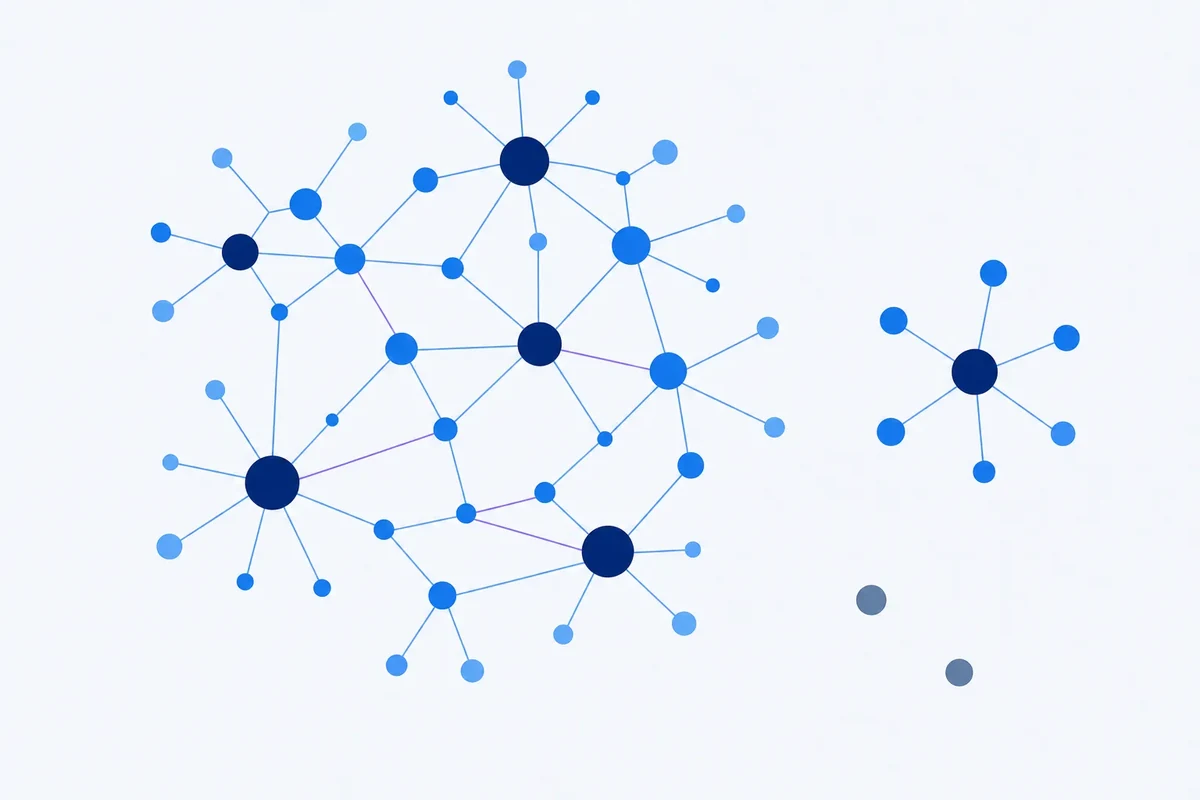
Before we dive into complex algorithms like Louvain or Leiden to group our data, there is a much simpler question we should ask: which keywords are actually linked to one another?
In graph theory, a connected component is essentially a group of nodes where every single node can reach every other node by following a path. When we look at a keyword graph, these components reveal the natural islands formed by our settings before we even start the process of community detection.
Why components matter before clustering
Community detection is great at splitting a large network into smaller, manageable groups. However, it cannot tell you if those groups should have been part of the same network to begin with.
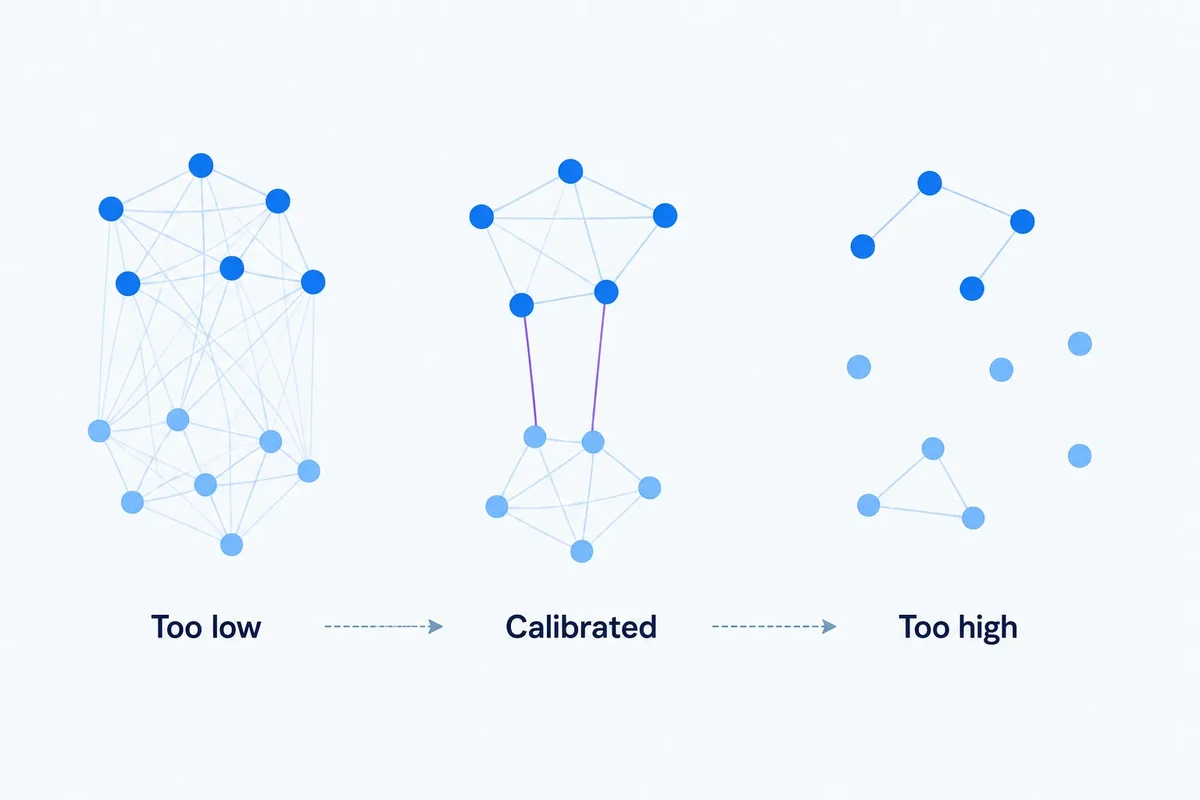
If you find that 95% of your keywords from a Search Console export end up in one massive component, your settings might be too loose. Conversely, if half your queries are sitting all alone as isolated dots, your rules might be too strict, or perhaps your dataset is full of very specific, unrelated niche terms. ClusterIQ highlights this structure early on so you can judge if the network actually makes sense for your project.
What creates a connected component
The shape of these islands depends entirely on how you define the edges between keywords. If you create a link only when two terms share a high similarity score, changing that threshold will naturally merge or split these islands. If you use a rule that forces every keyword to find its nearest neighbours, you might end up connecting topics that really have no business being together.
This makes checking components a perfect way to test kNN versus threshold graph construction.
The giant component problem
Seeing one giant component isn't always a mistake. If you are mapping out a broad industry, you will naturally have chains of related concepts that link large parts of the map together. The real trick is looking at how those connections happen.
You should keep an eye out for:
- Bridge nodes that act as the only link between two major topic families.
- The very weakest links that are barely holding large regions together.
- Generic words like "best", "buy", or "online" that act as glue for unrelated terms.
- High-degree nodes that are connected to everything because of broad similarity.
If you spot a few weak or generic links joining two distinct topics, pruning them can make your final clusters much easier to work with.
Small components can be valuable
A tiny island of just eight specialist queries might represent a perfect niche content opportunity. Some systems that look for high density might ignore these small groups as noise, but a graph component view shows they are actually strongly related to each other, even if they are isolated from the rest of the pack. This is incredibly useful when you are hunting for outliers and niche opportunities.
Isolated nodes deserve inspection
An isolated node is a keyword that has no links at all. There are a few reasons this happens:
- The keyword is genuinely irrelevant to the rest of the set.
- It is a brand new product or entity the model doesn't recognise yet.
- Your similarity threshold is set too high.
- The initial search for neighbours missed it.
- The text was messed up during cleaning or preprocessing.
- The query is truly unique.
ClusterIQ treats these as items for review rather than just dismissing them. You need to know if a term is alone because of the math or because of the market.
Worked example: a mixed SEO dataset
Think about a typical export containing terms for technical SEO, content strategy, PPC, and analytics. A well-tuned graph might show one large SEO island with various internal communities. If PPC ends up as its own separate island, that usually makes sense.
However, if "Google Ads conversion tracking" is linked to "keyword clustering" only because they both share generic bridge terms like "marketing tool" or "best software", you need to decide if those links are actually helpful for your content plan.
Components can improve computational efficiency
From a practical standpoint, we can run clustering algorithms on each island individually. This makes processing large datasets much faster and prevents unrelated topics from interfering with each other during the optimisation process. For those handling thousands of keywords, this is a massive time-saver.
Track component structure across runs
If a tiny tweak to your settings causes ten separate islands to suddenly collapse into one giant mass, you know your graph is very sensitive at that point. It is worth keeping track of:
- The total number of islands.
- The size of the largest island.
- How many keywords are totally isolated.
- Which major topics moved from one island to another.
This adds a vital layer of quality control to your cluster stability testing.
Components can support topic hierarchy
You can think of components as your top-level subject areas. The communities inside them are your subtopics, and the clusters within those are your specific page-level groups. While you shouldn't just copy this blindly into a site map, it provides a fantastic evidence-based starting point for your architecture.
How ClusterIQ should present components
You don't need to be a data scientist to use this. ClusterIQ translates these technical concepts into plain English signals like:
- Major connected topic regions.
- Isolated topic groups.
- Unconnected queries.
- Weak bridges between topics.
Practitioner principle: before you worry about how to split your keywords into groups, check if the way they are connected makes sense in the first place.
ClusterIQ Conclusion
Connected components are a simple but powerful tool for anyone working with keyword data. They show you the natural islands and isolated terms in your data before the clustering process begins. By using them to validate your rules, you can ensure your final content briefs and reports are built on a solid foundation.
Sources and further reading
Farky Rafiq
Founder of ClusterIQ
I've worked in digital marketing since 2005 and founded Liquid Silver in 2011. These articles are where I share the methods, experiments and practical SEO thinking behind ClusterIQ.
Put the idea into practice with your own keyword data
ClusterIQ helps turn raw SEO exports into clean, structured working datasets you can inspect, refine, report on and take into the next stage of your workflow.
Keep reading
Edge pruning in keyword graphs: removing weak relationships without breaking useful structure
Graph centrality for SEO: finding hubs, bridges and misleadingly important keywords