Active learning for SEO: using human review where it teaches the clustering system the most
Active learning selects the examples where human labels are most informative. Learn how ClusterIQ could use uncertainty and disagreement to improve review efficiency without automating judgement away.

Farky Rafiq
Founder of ClusterIQ
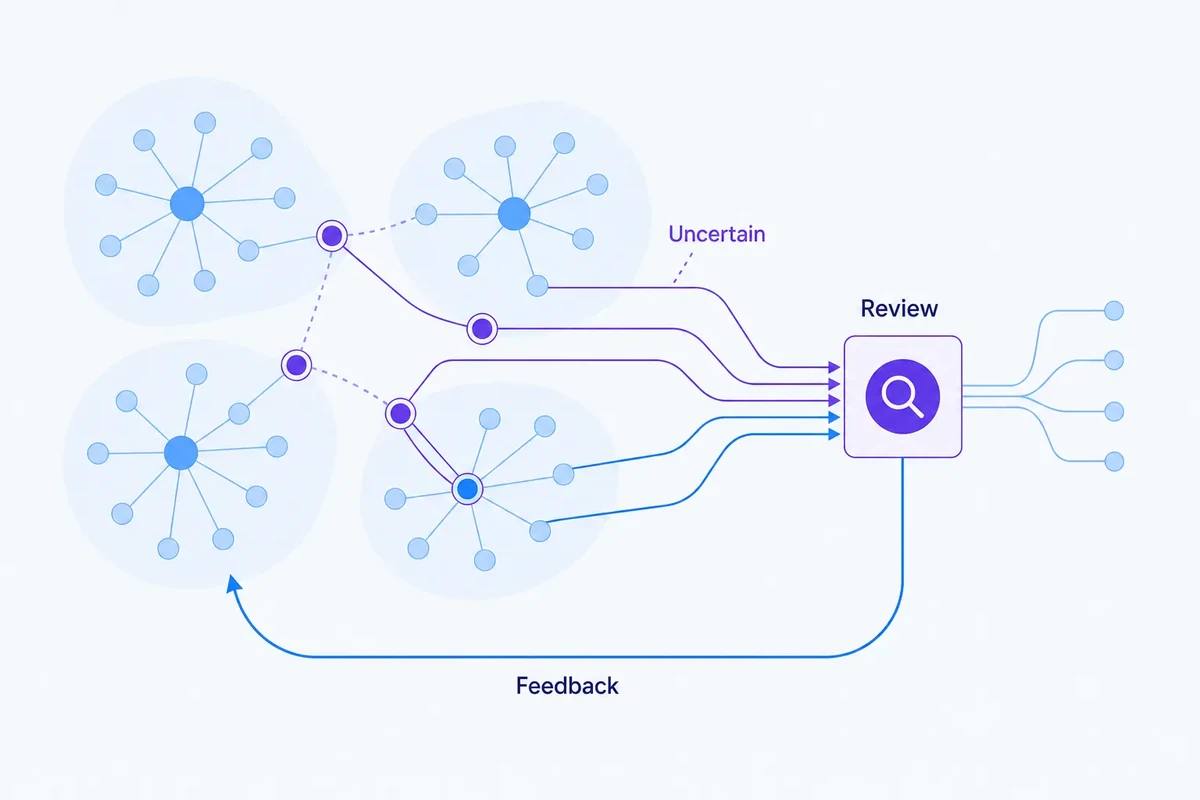
Human review is a precious resource, yet it is often wasted when every keyword in a dataset receives the same level of scrutiny. In a typical SEO project, most cluster assignments are straightforward. The real value of a practitioner's expertise is found at the edges: those tricky low-confidence mappings, model disagreements, or entity conflicts where a single wrong decision could fundamentally change a page's strategy.
Active learning is a machine-learning approach that flips the script. Instead of reviewing data in a random order, the system identifies and selects the specific examples where a human label will teach the model the most. It is about working smarter by focusing on the queries that actually challenge the system.
What active learning changes
If you have a queue of 1,000 keywords to annotate, a standard process might just give you the first 1,000 in the list. Active learning asks which of those examples will provide the greatest leap in accuracy for the rest of the dataset. The system might prioritise keywords based on:
- High levels of uncertainty in the initial pass;
- A very small margin between two potential clusters;
- Direct disagreement between different internal models;
- Underrepresented types of errors;
- High business consequence or commercial value.
ClusterIQ uses these signals to ensure your time is spent where it has the biggest impact on the final output.
Uncertainty sampling is the simplest pattern
When a model is almost indifferent between two or three different labels, that keyword is far more informative than one where the model is 99% certain. In the context of SEO keyword clustering, this uncertain set often includes:
- Bridge queries that sit between two distinct topics;
- Keywords with mixed search intent;
- Ambiguity between a brand name and a general category;
- Location-based conflicts;
- Cases where the same topic might justify two different pages.
Disagreement sampling can be even stronger
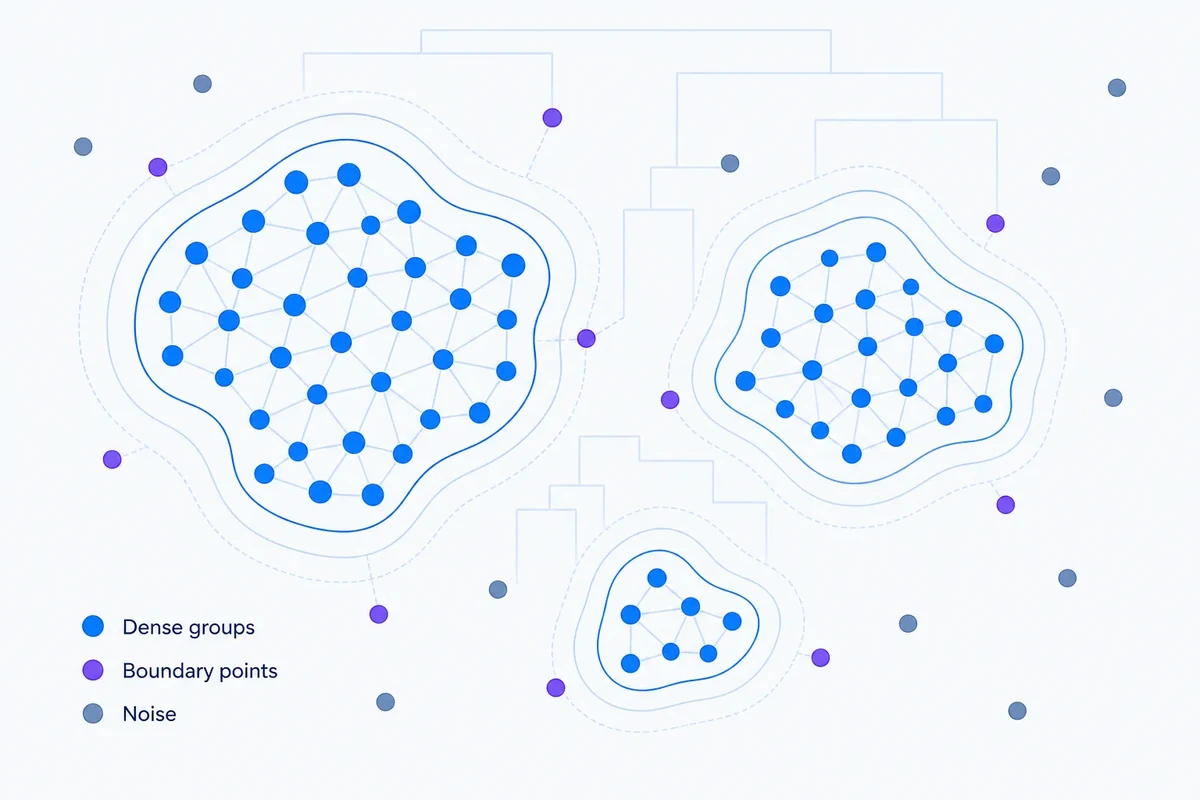
Sometimes different algorithms see the world differently. If a density-based model like HDBSCAN, a network-based model like Leiden, and a page-type classifier all disagree on where a keyword belongs, it reveals a flaw in the underlying assumptions. ClusterIQ prioritises these cases because your decision helps the system understand which signal should take precedence for that specific SEO task.
Worked example: 50,000 queries, 300 review slots
No SEO team has the time to manually verify 50,000 keyword assignments. However, reviewing a targeted sample is entirely doable. Instead of a random slice, ClusterIQ might select:
- 100 low-confidence memberships to clarify boundaries;
- 75 entity conflicts to resolve naming issues;
- 50 model disagreements to refine logic;
- 50 high-value query mappings to protect core revenue;
- 25 new failure patterns to catch emerging trends.
These 300 targeted decisions create a much richer and more effective evaluation set than 300 random keywords ever could.
Human labels should not immediately rewrite production
It is important to treat a human label as evidence rather than an absolute command that bypasses all logic. Before a manual correction changes global behaviour, ClusterIQ evaluates whether that correction is a general rule, specific to an industry, unique to a workspace, or just a temporary fix. This follows the same governance principles we apply to practitioner overrides.
Use review reasons, not only final labels
A binary "yes" or "no" on a cluster assignment is helpful, but the "why" is better. If a practitioner notes they are separating keywords because the "product model differs," that reason becomes a powerful data point. It can be transformed into an entity feature, a hard business rule, or a new explanation within the interface to help other team members.
Active learning can reduce annotation bias
Randomly selected benchmarks are often skewed because easy cases are naturally more common. An active queue deliberately brings difficult cases to the surface. This makes the ClusterIQ benchmark far more representative of the actual risks you face in production, rather than just confirming what the model already knows.
Do not focus only on uncertainty
There is a risk in being too focused on the strange edge cases. If the system only shows you the weirdest queries, the benchmark can become unrepresentative of the whole. We maintain a healthy balance of easy controls, uncertain cases, and high-consequence keywords to keep the model grounded.
Business consequence belongs in the queue
A query that controls a major product category is more important than a highly uncertain query with zero search volume. ClusterIQ combines technical uncertainty with business importance. This ensures that the most commercially significant clusters are always accurate, even if the model was relatively confident about them to begin with.
Measure how much the review changes the model
After you have labelled a batch of keywords, we look at the results. We check for benchmark improvements, a reduction in repeated overrides, and whether the overall uncertainty in the dataset has actually fallen. If the same errors keep appearing, it suggests the model needs a change in its architecture or features rather than just more human labels.
Use active learning for page mapping too
This approach isn't just for grouping keywords. ClusterIQ can also flag uncertain cluster-to-URL mappings or conflicts where two different pages seem to be competing for the same cluster. Expert review here strengthens the mapping benchmark, ensuring your content plan is as robust as your keyword research.
Keep reviewer agreement visible
Sometimes, even two experienced SEOs won't agree on a keyword's intent. Monitoring inter-annotator agreement helps us distinguish between a weakness in the model and a query that is genuinely, fundamentally ambiguous.
Do not optimise the system to mimic every reviewer
The goal isn't to build a model that blindly copies one person's habits. We use active learning to find robust, repeatable decision rules. This allows the system to handle the heavy lifting while exposing the specific contexts where human judgement remains essential.
Practitioner principle: human review creates the most value when it is concentrated on cases where the evidence is uncertain, conflicting or consequential.
ClusterIQ Conclusion
Active learning makes the process of managing large-scale keyword data far more efficient. By being deliberate about which cases require human eyes, we can improve benchmarks and surface better rules without pretending that human expertise can be entirely automated out of the workflow.
Data provenance matters as much as the method
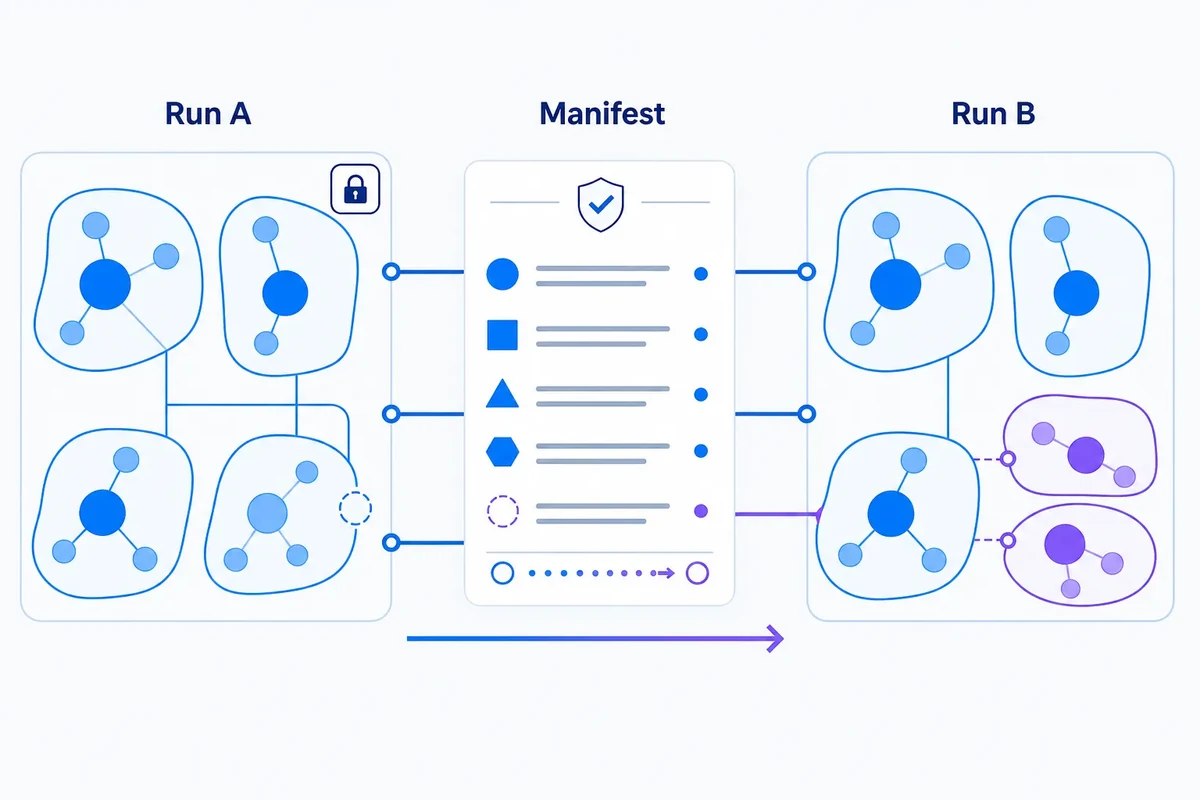
For any analysis to be reliable, ClusterIQ must be able to trace the origins of the data. This means keeping track of the source dataset, the specific market, language, and the versions of the models used. Without this provenance, it is impossible to tell if a change in your results is due to a shift in user behaviour or just a change in how the data was processed.
This is vital when working at scale. Your corpus might include Search Console data, third-party estimates, and manual business rules all at once. Each source should be attributable. When you refresh an analysis, ClusterIQ can show you what changed in the data versus what changed in the model, making your reporting and testing much more dependable.
Sources and further reading
Farky Rafiq
Founder of ClusterIQ
I've worked in digital marketing since 2005 and founded Liquid Silver in 2011. These articles are where I share the methods, experiments and practical SEO thinking behind ClusterIQ.
Put the idea into practice with your own keyword data
ClusterIQ helps turn raw SEO exports into clean, structured working datasets you can inspect, refine, report on and take into the next stage of your workflow.
Keep reading

Spectral clustering for SEO: when graph structure matters more than compact geometry
Reproducible keyword clustering: how to make every run explainable