Spectral clustering for SEO: when graph structure matters more than compact geometry
Spectral clustering uses the eigenstructure of a similarity graph rather than relying on compact centroids. Learn when that can help keyword analysis and where the method becomes fragile.

Farky Rafiq
Founder of ClusterIQ
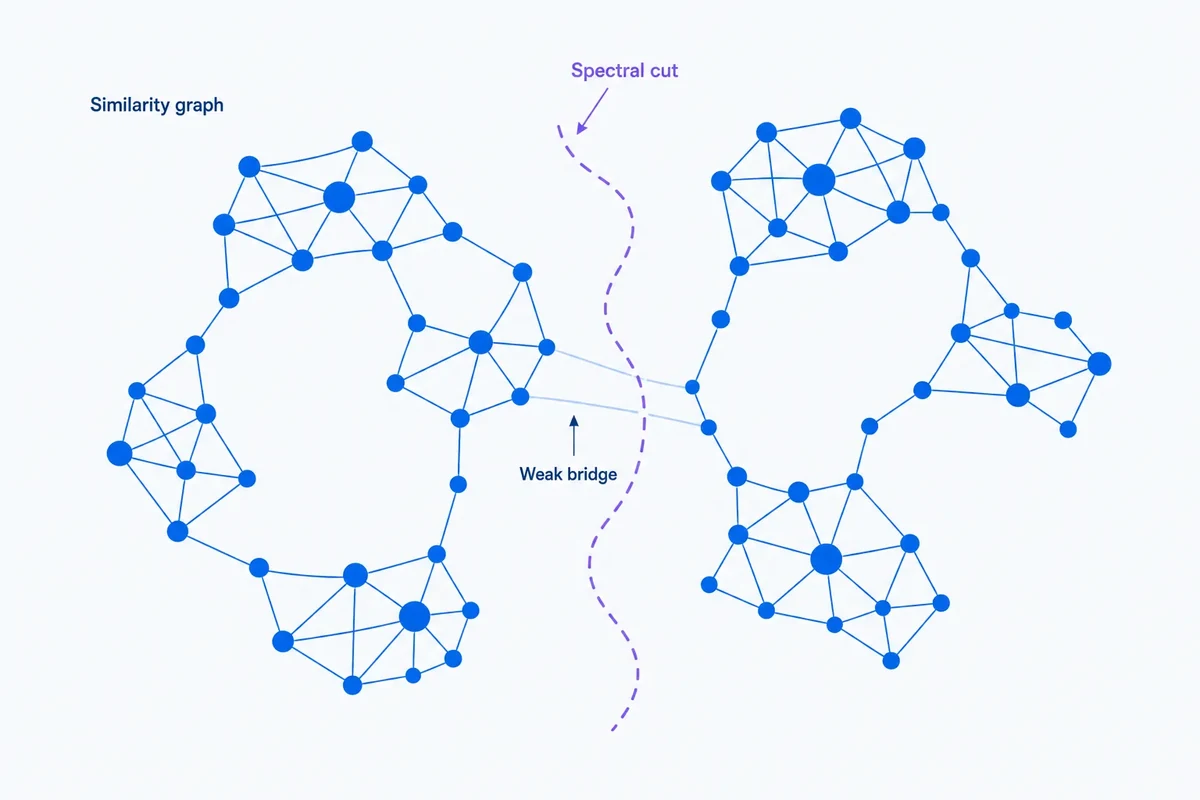
Spectral clustering is a powerful technique for when the shape of your data matters more than whether keywords form neat, round bubbles around a central point. Instead of just looking at where keywords sit in a coordinate system, this method builds a similarity graph, uses some clever linear algebra to simplify that graph, and then finds the clusters within that new representation.
For SEOs, this is a naturally attractive approach because our data is rarely just a list of points. Keywords are connected by shared intent, overlapping SERPs, and semantic meaning. However, it can be a double-edged sword: if the underlying graph is messy, the clusters will be too.
The graph comes first
Spectral clustering cannot fix a bad dataset. If your initial graph connects "buy running shoes" to "dog walking services" because of a processing error, the algorithm will faithfully group them together. The decisions you make about similarity thresholds, how many neighbours each keyword should have, and how you weight those connections are the most important parts of the process.
This is why ClusterIQ's kNN versus threshold analysis is so important. You need to get the foundations right before you start worrying about the advanced mathematics of the clustering itself.
Capturing complex shapes
Most of us are familiar with K-means, which tries to find the "middle" of a group. This works well if your topics are compact and distinct. But keyword topics often look more like long, winding chains or interconnected webs. Spectral clustering excels here because it looks at connectivity. It can follow a trail of related queries through several sub-topics that a centroid-based method might accidentally split in half.
Affinity defines the problem
When using tools like Scikit-learn, you can build your "affinity" (how keywords relate) in different ways. In a ClusterIQ workflow, we often use a precomputed weighted graph. This is much easier to explain to a client or a manager because we can show exactly why two keywords are linked, whether it is because they share 70% of the same URLs in Google or because they contain the same core entities.
A practical example: topics in vector space
Imagine you have a few thousand keywords from Ahrefs or Search Console covering "content marketing". You might have a tight cluster for "content clustering" and another for "topic modelling". Nearby, you have a long tail of implementation queries about specific tools and technical methods.
A standard K-means approach might draw a circle that cuts right through your implementation queries just to keep the group "compact". A spectral method is more likely to follow the natural flow of the data, keeping the tool-specific queries together because they are all connected in a chain, even if the first and last keywords in that chain are quite far apart.
The number of clusters still matters
One downside is that standard spectral clustering usually asks you to tell it how many clusters you want upfront. This makes it a bit less "hands-off" than something like HDBSCAN, which tries to figure out the number of groups on its own. At ClusterIQ, we often use spectral clustering as a way to double-check our results when we already have a rough idea of how many page categories we are aiming for.
The risk of accidental bridges
If you force every keyword to have a certain number of neighbours, you can end up creating "bridges" between topics that should stay separate. A weak connection in a sparse area of your keyword map can pull two unrelated themes together. Using similarity floors or checking your connected components before running the spectral step can help prevent these messy mergers.
Eigenvectors are for computers, not clients
The technical "coordinates" that spectral clustering creates are incredibly useful for the machine, but they do not mean anything to a human. You cannot look at an eigenvector and say "this represents commercial intent". We make sure to keep the original evidence, like SERP overlap or lexical similarity, visible. You never want to be in a position where the only explanation for a content brief is "the algorithm said so".
Scale and practical limits
While spectral clustering is brilliant for a few thousand keywords, it gets very "heavy" as the list grows. The math involved is much more demanding than simpler methods. If you are dealing with a massive site migration involving hundreds of thousands of URLs, we might use more efficient graph methods or approximate versions of the spectral approach to keep things moving quickly.
Using it as a diagnostic tool
A great way to use this method is as a "sanity check". If you run your data through Leiden, HDBSCAN, and spectral clustering, and the same core topics appear every time, you can be very confident in your content plan. If spectral clustering produces a very different result, it is a signal to look closer at the graph and see if there is a hidden relationship you missed.
ClusterIQ Conclusion
Spectral clustering is a sophisticated way to look at keyword data when the relationships are complex. It is a fantastic alternative when traditional methods fail to capture the "flow" of a topic. However, the quality of the output is entirely dependent on the quality of the graph you build at the start. Use it as a diagnostic tool and a way to handle non-traditional data shapes, but always keep your human SEO expertise close to the underlying data.
Sources and further reading
Farky Rafiq
Founder of ClusterIQ
I've worked in digital marketing since 2005 and founded Liquid Silver in 2011. These articles are where I share the methods, experiments and practical SEO thinking behind ClusterIQ.
Put the idea into practice with your own keyword data
ClusterIQ helps turn raw SEO exports into clean, structured working datasets you can inspect, refine, report on and take into the next stage of your workflow.
Keep reading
Active learning for SEO: using human review where it teaches the clustering system the most
Reproducible keyword clustering: how to make every run explainable