Caching SEO embeddings: when reuse improves speed and when stale vectors become a data problem
Embedding reuse can save substantial compute, but cached vectors become wrong when text, models or preprocessing change. Learn how to make semantic caching safe and reproducible.

Farky Rafiq
Founder of ClusterIQ
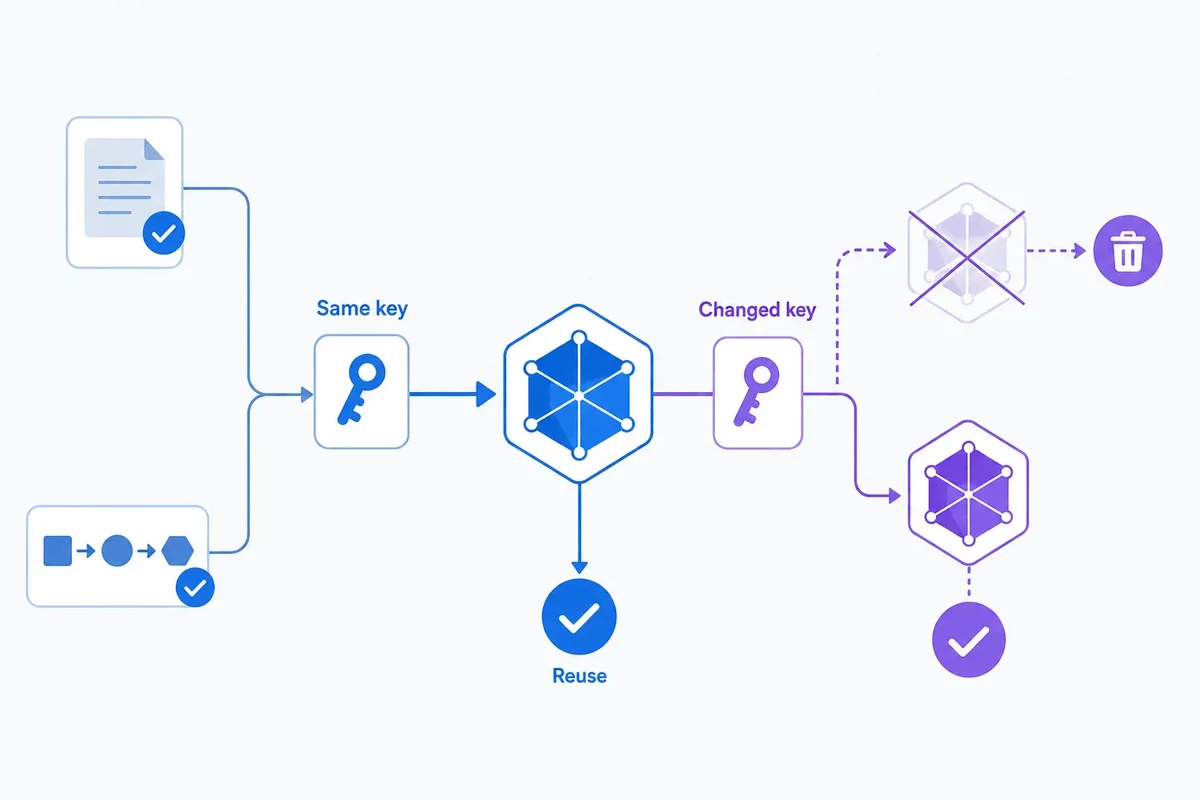
If you import 2,000 keywords from Ahrefs, adjust your clustering settings and rerun the analysis, you should not need to pay for the same preparation twice. Embeddings, the numerical representations used to compare meaning, are deterministic enough to reuse in many workflows.
Caching those vectors can make ClusterIQ faster. The catch is stale evidence: a vector from old text, an old model or different preprocessing can quietly enter a new run, leaving you with clusters you cannot explain.
Cache the representation, not just the text
A cache key identifies a stored vector. The keyword alone is not enough, because how you process it also affects the result. Useful components include:
- normalised input hash;
- embedding model and revision;
- task prompt or prefix;
- normalisation setting;
- dimension or truncation setting;
- preprocessing version.
If any component changes, normally treat the vector as a different artefact, rather than reusing it automatically.
Keyword embeddings are easy to cache
“Keyword clustering software” might appear in several Semrush imports and client workspaces. If the representation pipeline is identical, its semantic vector does not need regenerating.
ClusterIQ can reuse that vector while keeping each workspace’s metrics and page decisions separate. Reusing meaning does not mean sharing the whole keyword record.
Page embeddings need content-aware invalidation
A URL can stay the same while its page changes completely. It is therefore not a stable representation key.
Use a content hash or version based on the text actually embedded. When that text changes materially, generate a new vector even if the URL is unchanged.
Worked example: a page title update
Suppose ClusterIQ represents title, H1 and body fields separately. The body stays unchanged, but the H1 moves from “SEO Tools” to “Enterprise SEO Platform”.
A field-aware cache can reuse the body embedding and regenerate only the H1 vector. That saves computation without losing the new evidence about the page’s purpose, which may affect your keyword-to-page decisions.
Do not share cached vectors across incompatible models
Two models can both output 768 dimensions yet produce completely different vector spaces. Matching dimensions do not make their outputs compatible.
Pin the model identity in the cache key so vectors from incompatible models cannot be mixed accidentally.
Normalisation belongs in the cache identity
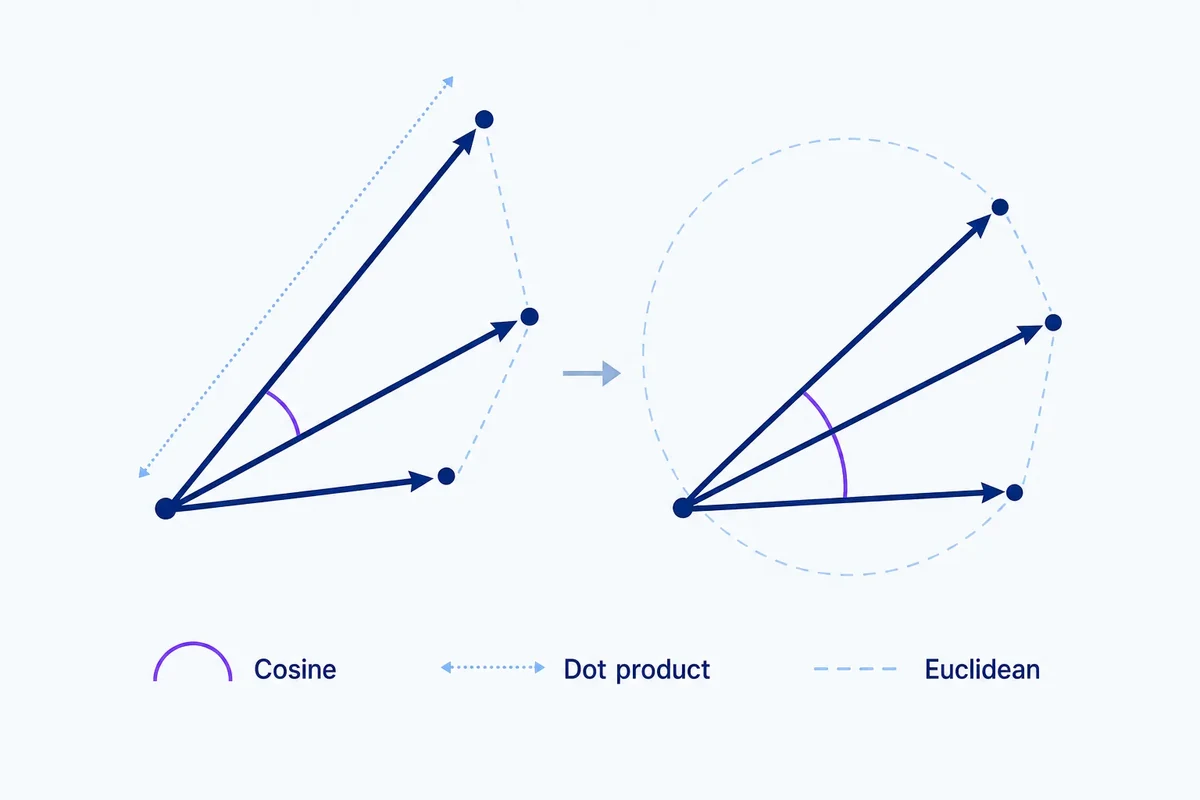
If ClusterIQ stores normalised vectors, record that state explicitly. An unnormalised vector in an index that uses inner product to calculate cosine similarity will produce incorrect scores.
Vector normalisation is part of the representation, not a display transformation.
Chunk caches need structure-aware keys
Long pages may be split into chunks for embedding. Each chunk’s cache key should include:
- page content version;
- heading path;
- chunking algorithm version;
- chunk text hash;
- embedding pipeline version.
If the chunking strategy changes, old vectors may no longer match the current representation, even where some wording remains unchanged.
Cache hits should be auditable
A cache hit means a stored vector was reused. During a ClusterIQ run, report:
- vectors reused;
- vectors generated;
- vectors invalidated;
- cache version;
- model version.
These details make time savings visible and help explain unexpected changes in a content plan or clustering report.
Do not let cache performance drive correctness
Regenerating millions of vectors can be expensive, but that is an operational problem, not an analytical reason to retain stale evidence.
When the model changes materially, schedule background regeneration or a staged migration rather than keeping unsuitable vectors simply to save processing time.
Workspace-specific features should stay outside the shared cache
Search volume, ranking URL, product availability and business priority may differ across workspaces for exactly the same query.
Cache the reusable semantic representation, not the enriched keyword record. A shared vector should not carry one client’s priorities into another client’s brief.
Use content-addressable storage principles
Make the exact input and pipeline version produce the same cache key. This makes reuse predictable and helps deduplicate storage across imports without merging the source observations themselves.
Cache invalidation can become a product event
A major embedding-model upgrade should create a new semantic version, rather than immediately deleting every previous vector.
ClusterIQ can keep old and new caches side by side during regression testing, allowing comparisons before committing to the change.
Monitor hit rates but do not maximise them blindly
A high hit rate is useful only with strict cache identities. If changed page text still produces hits because the key contains only the URL, that impressive number signals a bug.
Security and workspace isolation still apply
Reusable vectors must not expose private page content or customer-specific material across workspace boundaries.
Shared caching is safest for non-sensitive canonical keyword strings or explicitly permitted public content. Private workspace data needs appropriate isolation.
Where caching helps ClusterIQ most
The biggest practical opportunities include:
- rerunning clustering parameters;
- rebuilding graphs;
- testing alternative algorithms;
- reusing unchanged pages;
- adding incremental keyword imports.
Changing downstream analysis should not, by itself, require generating the vectors again.
Practitioner principle: reuse an embedding only when both the input and representation pipeline are unchanged. Speed is not worth silent semantic drift.
ClusterIQ Conclusion
Embedding caching can make ClusterIQ faster and cheaper without sacrificing analytical quality. The safeguard is strict, versioned invalidation: hash the represented content, pin the model and preprocessing, and record cache behaviour in the run manifest.
Data provenance matters as much as the method
ClusterIQ should be able to reconstruct the inputs behind an analysis. Retain the source dataset, market, language, preprocessing version, model or rule version and relevant date range. Otherwise, a processing change can look like a change in user behaviour.
This matters especially at scale, where Search Console observations, third-party keyword estimates, product data and approved business rules may support one topic model. They are not interchangeable metrics, and each source should remain attributable.
On refresh, ClusterIQ can report data changes separately from model changes. That distinction supports historical reporting, regression testing and practitioner review, without silently rewriting the interpretation of earlier SEO work.
Sources and further reading
Farky Rafiq
Founder of ClusterIQ
I've worked in digital marketing since 2005 and founded Liquid Silver in 2011. These articles are where I share the methods, experiments and practical SEO thinking behind ClusterIQ.
Put the idea into practice with your own keyword data
ClusterIQ helps turn raw SEO exports into clean, structured working datasets you can inspect, refine, report on and take into the next stage of your workflow.
Keep reading

Reproducible keyword clustering: how to make every run explainable
Cosine, dot product or Euclidean distance: choosing a similarity measure for keyword embeddings