MiniBatch K-means for SEO: trading a little precision for much faster keyword clustering
MiniBatch K-means updates centroids from small samples instead of the full dataset on every iteration. Learn where that speed helps SEO and what quality checks it needs.

Farky Rafiq
Founder of ClusterIQ
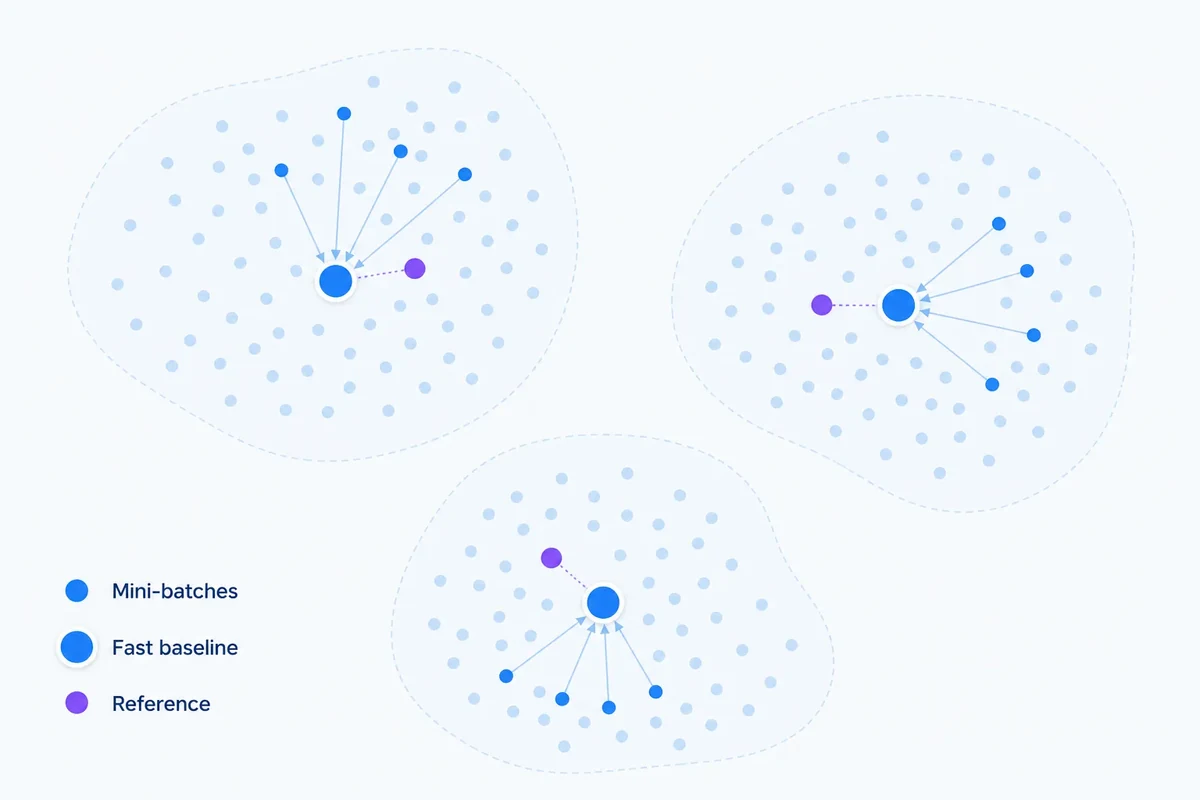
Standard K-means is a staple in the SEO toolkit because it is fast, predictable and easy to understand. When you are dealing with massive keyword datasets, MiniBatch K-means takes that efficiency further. Instead of processing every single data point at every step, it updates its cluster centres using small, random samples. This approach offers a significant speed boost, though it comes with a slight trade-off in precision.
For ClusterIQ, this makes MiniBatch K-means an excellent tool for building scalable baselines and handling quick keyword assignments, rather than acting as the final word on complex topic definitions.
What changes from ordinary K-means
In a standard K-means setup, the algorithm looks at every keyword in your list, assigns them to the nearest centre (centroid), and then recalculates those centres based on the entire group. It repeats this until the clusters stabilise.
MiniBatch K-means simplifies this by picking subsets of the data to update the centroids incrementally. This drastically lowers the memory and processing power required, which is a lifesaver when your keyword corpus runs into the hundreds of thousands of vectors.
Speed matters when clustering is exploratory
SEO professionals rarely get the perfect result on the first try. We often need to experiment with different settings to see what makes the most sense for a site map or a content plan. You might want to test:
- different numbers of clusters (the k value);
- various embedding models to see which captures intent better;
- new ways of cleaning or preprocessing the data;
- different geographic markets;
- fresh data exports from Search Console or Ahrefs.
When a method can generate a useful baseline in seconds rather than hours, it encourages this kind of healthy experimentation.
The algorithm still assumes centroid-shaped groups
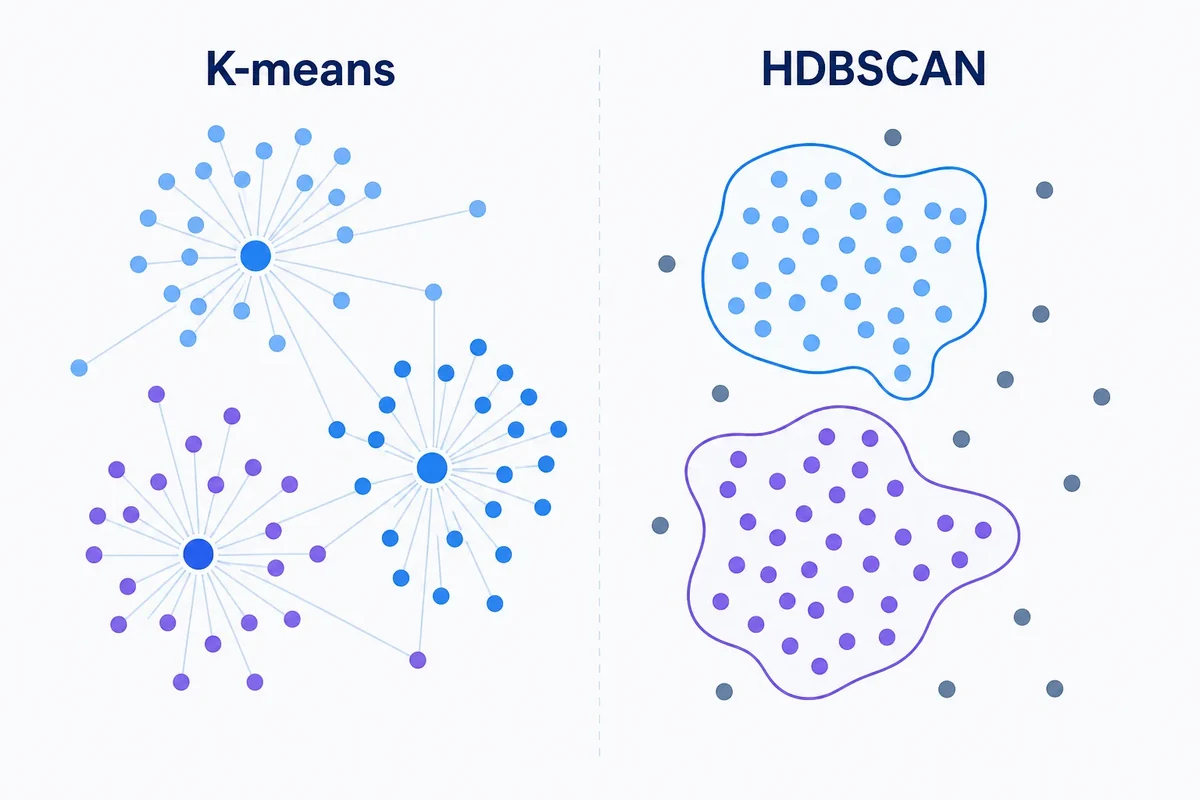
It is important to remember that MiniBatch K-means still follows the basic rules of its parent algorithm. It assumes that clusters are relatively compact and circular. It does not naturally handle "noise" (outlier keywords that do not belong anywhere) or complex hierarchical relationships between topics.
ClusterIQ's density versus centroid comparison is a great resource for understanding these conceptual boundaries.
Worked example: 500,000 queries
Consider an enterprise-level project with 500,000 normalised queries. If you were to run multiple full K-means tests to find the right structure, the computational costs and time delays would quickly add up. MiniBatch K-means allows you to quickly check if the data splits into logical broad categories at scales like 100, 250 or 500 clusters.
Once you have these broad partitions, you can then apply more intensive graph or density-based methods to specific subsets. This saves the heavy lifting for when you already know you are in the right ballpark.
Batch size affects the trade-off
The "batch size" is the number of keywords the algorithm looks at during each update. Larger batches behave more like standard K-means but take longer to process. Smaller batches are incredibly fast but can produce slightly "noisier" results. Finding the right balance depends on your hardware and how consistent you need the clusters to be across different runs.
Randomness needs to be recorded
Because this method uses random sampling, the results can vary slightly every time you run it. To ensure your SEO strategy is built on solid ground, ClusterIQ should record random seeds. This allows you to repeat experiments and verify that your high-value keyword groups are stable and not just a fluke of the sample.
This is a core part of reproducible keyword clustering, ensuring that your data science is as reliable as your technical SEO audits.
Evaluate membership changes, not only inertia
In technical terms, K-means uses "inertia" (the sum of squared distances) to measure success. While lower inertia usually means tighter clusters, it does not tell you if the clusters are actually useful for a human reader. When evaluating your results, look for:
- stable core keywords that stay together across runs;
- consistency in the entities or topics within a group;
- how well the clusters match your manual benchmarks;
- whether the keywords in a cluster all belong on the same page type;
- where your most important, high-volume queries end up.
MiniBatch K-means is useful for candidate assignment
Once you have established a solid set of broad categories, you can use MiniBatch K-means to quickly sort new keywords into them. This is perfect for ongoing projects where ClusterIQ might receive a fresh stream of search data every week. You can instantly see which existing "bucket" a new term falls into without re-running the entire analysis.
Do not force every new keyword into a centroid
A common pitfall with K-means is that it will force every keyword into a cluster, even if the keyword is completely irrelevant to your site. To avoid this, you should set a similarity threshold. If a new keyword is too far away from the nearest cluster centre, it should be kept in a "review" pile rather than being shoehorned into a group where it does not fit.
Use it as a coarse layer in a hierarchy
Think of MiniBatch K-means as a way to sort a massive pile of keywords into big boxes. Once you have those boxes, you can use more sophisticated tools like HDBSCAN or graph-based community detection to find the subtle nuances within each box. This hybrid approach gives you the best of both worlds: speed at scale and precision where it matters.
Compare against full K-means on a representative sample
If you are worried about losing too much precision, try a "spot check". Run both the MiniBatch and the full K-means algorithms on a smaller sample of your data. If the resulting clusters and page-level decisions are nearly identical, you can confidently use the faster MiniBatch version for your full dataset.
Where ClusterIQ can use it well
MiniBatch K-means shines in specific scenarios:
- creating fast initial baselines for new projects;
- exploring massive keyword sets to find broad themes;
- pre-partitioning data before deeper analysis;
- sorting new keywords into existing categories;
- checking how changes to your embedding models affect the overall data structure.
While speed is a massive advantage, it should never be the only reason to choose a clustering method. The goal is always a better SEO outcome, not just a faster one.
Practitioner principle: speed is valuable when it enables more testing. It is not evidence that the resulting groups are more correct.
ClusterIQ Conclusion
MiniBatch K-means provides a practical, high-speed way to organise large-scale vector data. Its real strength lies in its role as a scalable baseline or a first-pass sorting tool. However, the same rigorous checks for quality and stability must be applied before these clusters are used to inform site architecture or content investment.
How ClusterIQ would validate this before production use
Validation is not about whether the output looks "okay" once. It requires a controlled test. ClusterIQ would use a fixed set of queries and pages to compare the current method against the MiniBatch approach. We look specifically at the decisions that change: do important keywords move to more or less relevant pages? Does the grouping of key entities remain logical?
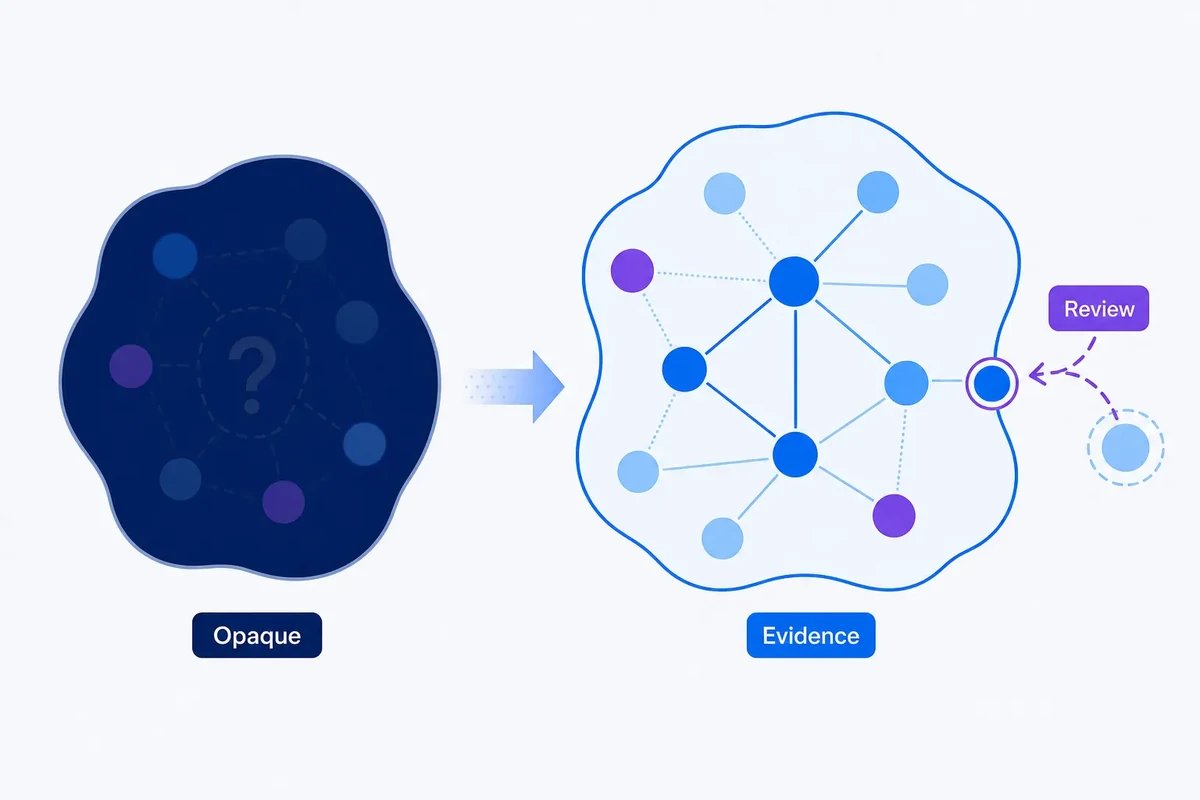
The evidence must remain layered. We look at the raw similarity scores, the resulting cluster membership, and finally, the actual SEO action recommended. If a faster method moves a high-value query to a less relevant page, it is not an improvement, regardless of the time saved. By keeping a record of these before-and-after examples, we ensure that every change to the system is a genuine step forward, backed by evidence rather than just a preference for faster processing.
Sources and further reading
Farky Rafiq
Founder of ClusterIQ
I've worked in digital marketing since 2005 and founded Liquid Silver in 2011. These articles are where I share the methods, experiments and practical SEO thinking behind ClusterIQ.
Put the idea into practice with your own keyword data
ClusterIQ helps turn raw SEO exports into clean, structured working datasets you can inspect, refine, report on and take into the next stage of your workflow.
Keep reading
Keyword clustering vs topic clustering: what’s the difference?
Density-based vs centroid-based keyword clustering: two different ideas of what a group is