Centroids vs medoids in keyword clustering: choosing a representative without inventing one
A centroid can summarise a cluster mathematically but may not correspond to a real keyword. A medoid is an observed member. Learn when each representation is more useful for SEO.

Farky Rafiq
Founder of ClusterIQ
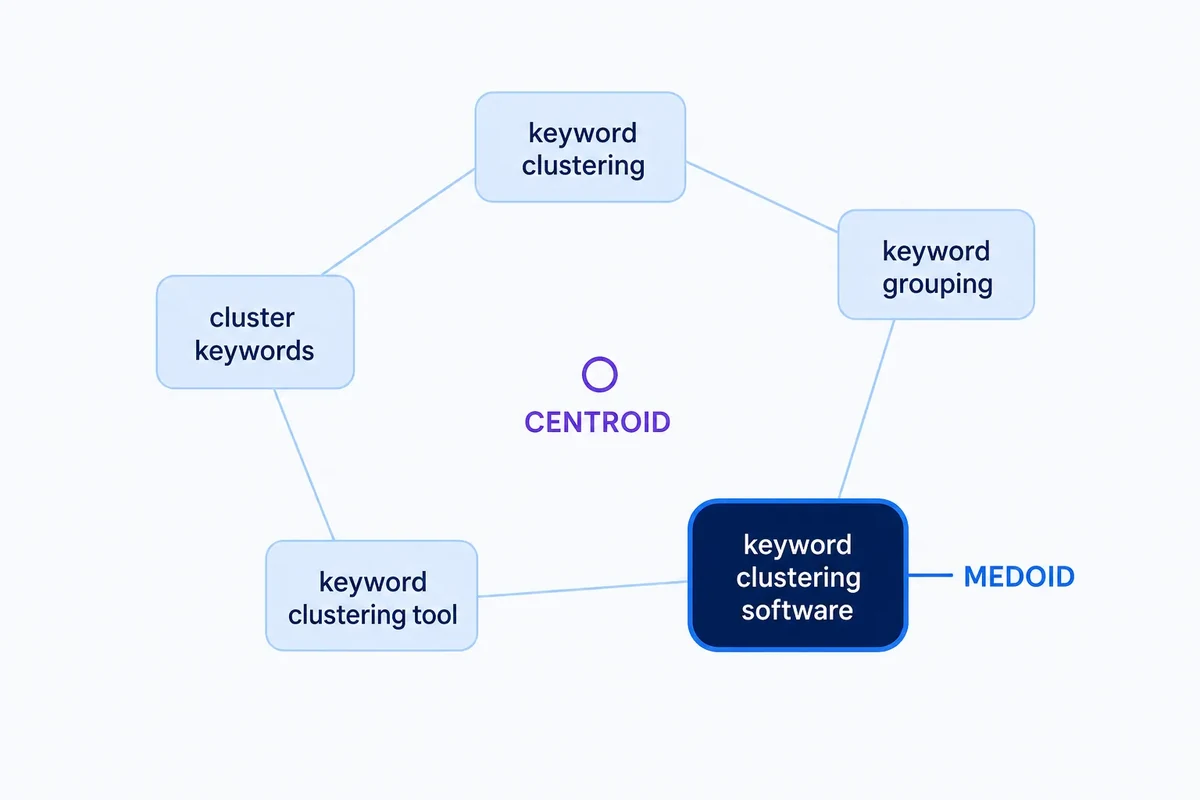
Every keyword cluster needs a way to describe its core. When you are staring at a spreadsheet of three thousand search terms exported from Ahrefs or Semrush, you need a quick way to understand what that group actually represents. In data science, that centre is often a "centroid", but for those of us building content plans, a "medoid" is usually more helpful. The difference matters because a centroid is a mathematical average that might not exist in the real world, whereas a medoid is a genuine query pulled directly from your data.
What a centroid is
A centroid is the arithmetic mean of all the data points in a cluster. If you are using K-means clustering, the algorithm uses these centroids to organise your keywords. It assigns every search term to its nearest centroid and then updates that centre point repeatedly to keep the group as tight as possible. When we work with keyword embeddings, you can think of the centroid as the average coordinate in a map of meanings.
The centroid may not be a real keyword
Imagine a cluster containing "keyword clustering software", "keyword grouping tool" and "semantic keyword platform". The mathematical average of these vectors might result in a point that does not correspond to any actual phrase. While this works perfectly for a computer, it is not very helpful for a marketer who needs a clear label for a content brief or a reporting dashboard. We need a representative that a human can actually read.
What a medoid is
A medoid is a specific member of the group that sits closest to the centre. It is the observation with the lowest average dissimilarity to everything else in the cluster. For SEO purposes, this is fantastic because the representative is a real search term. It comes with its own search volume, ranking data, and natural phrasing, making it much easier to explain to a client or a junior SEO why these keywords have been grouped together.
Centroids are efficient summaries
Centroids still have their place. They are excellent for quickly assigning new keywords to existing groups, comparing different clusters in a vector space, and tracking how a topic moves over time. ClusterIQ can handle these complex calculations using centroids in the background while showing you a real, human-readable query on the front end. You do not have to choose one over the other; they just serve different roles.
Medoids can be more intuitive around irregular groups
Centroids can be easily pulled off course by a few outlier keywords. Because a medoid must be an actual member of the group, the representative stays anchored to something a user really searched for. This does not mean medoids are always better, but they certainly have a massive advantage when it comes to making your data easy to interpret.
Worked example: naming a cluster
Let's say your highest-volume query is "clustering". That is a bit too broad for a page title. The query closest to the centroid might be "keyword clustering software", while a different labelling method identifies "keyword clustering tool" as the most unique phrase. A well-designed ClusterIQ interface shows you all this evidence separately:
- Cluster label: Keyword clustering software;
- Representative query: keyword clustering software;
- Highest-volume query: clustering;
- Distinctive terms: keyword, clustering, software, tool.
This gives you a much clearer picture than trying to force a single keyword to represent the entire group.
The representative depends on the distance metric
The keyword chosen as a medoid can change depending on how you measure the "distance" between terms. A medoid calculated using cosine distance might be different from one using Euclidean distance. It is vital to keep your metrics consistent. Our guide on Cosine, dot product and Euclidean distance explains how these technical choices impact which keywords end up as neighbours.
Do not confuse representative with priority
Just because a query is at the centre of a cluster does not mean it is your most important target. The central keyword might have low search volume or poor commercial intent. Use the representative query to understand what the group is about, but use your actual business data, like conversion potential or current rankings, to decide which pages to build first.
Multiple exemplars are often better than one
When you have a large cluster of a few hundred keywords, one single phrase rarely tells the whole story. It is often better to look at three to five "exemplars" from the core of the group. This helps you spot if the intent is mixed or if the cluster covers a broader range of sub-topics than you first thought. Using centrality scores helps us pick the best examples to show you.
Cluster labels and representatives should be editable
Sometimes the maths gives you "shower cubicles" as the medoid, but your client uses the term "shower enclosures". A practical tool like ClusterIQ should keep the mathematical representative and the human-approved label separate. This allows you to use the language your organisation understands without losing the underlying data evidence.
Use the centre for drift monitoring
If the centroid of a cluster starts moving over several months, it is a sign that the search landscape is changing. If the medoid changes too, you have a clear signal that the core of the topic has shifted. When both move significantly, it is time to check if your content still matches the current search intent.
When a representative query is misleading
Some clusters are "multi-modal", meaning they have two or three distinct sub-groups huddled under one broad topic. In these cases, a single medoid sitting in the middle might not describe either side very well. Instead of pretending one phrase fits all, ClusterIQ should highlight these sub-clusters or provide multiple examples to give you the full context.
Practitioner principle: the mathematical centre is useful for modelling. The human representative is useful for understanding. A good system does not force them to be the same thing.
ClusterIQ Conclusion
Centroids and medoids are both essential for managing keyword data at scale. Use centroids for the heavy lifting of numerical analysis and medoids to make your findings clear to your team and clients. By balancing these two approaches, ClusterIQ ensures your SEO strategy is both data-driven and easy to put into practice.
Sources and further reading
Farky Rafiq
Founder of ClusterIQ
I've worked in digital marketing since 2005 and founded Liquid Silver in 2011. These articles are where I share the methods, experiments and practical SEO thinking behind ClusterIQ.
Put the idea into practice with your own keyword data
ClusterIQ helps turn raw SEO exports into clean, structured working datasets you can inspect, refine, report on and take into the next stage of your workflow.
Keep reading
Keyword deduplication vs clustering: why they should stay separate
Keyword preprocessing before clustering: clean the data without erasing intent