Consensus clustering for SEO: finding structure that survives several models
Consensus clustering looks for groups that persist across different runs or algorithms. Learn how it can make keyword clusters more robust without turning agreement into false certainty.

Farky Rafiq
Founder of ClusterIQ
Every clustering method arrives at a result based on its own specific logic. K-means, for example, prefers neat, circular groups around a central point. HDBSCAN searches for areas of high density, while Leiden looks for communities within a network. Hierarchical clustering relies on how you link data points together. When several very different methods all agree that a specific group of keywords belongs together, that consensus is incredibly valuable evidence for an SEO.
Consensus clustering formalises this by combining multiple different partitions or repeated runs into a single, more stable view. It helps us identify which keywords truly belong together regardless of the mathematical lens we use.
What consensus clustering means
Instead of asking a single clustering run to provide the final, definitive answer, we build several different versions and track how often each pair of keywords appears in the same group. This process creates what is known as a co-association or consensus matrix.
If a pair of keywords appears together in nine out of ten different runs, we have much stronger evidence of their relationship than if they only co-occur once. It moves us away from "guessing" based on one model and towards a statistical certainty.
Consensus is not majority vote on labels
It is important to remember that cluster numbers are arbitrary. One algorithm might call a group "Cluster 5" while another calls it "Cluster 82", and they might produce different total numbers of groups. The real value lies in the relationships between the individual keywords:
- How often are these two specific queries grouped together?
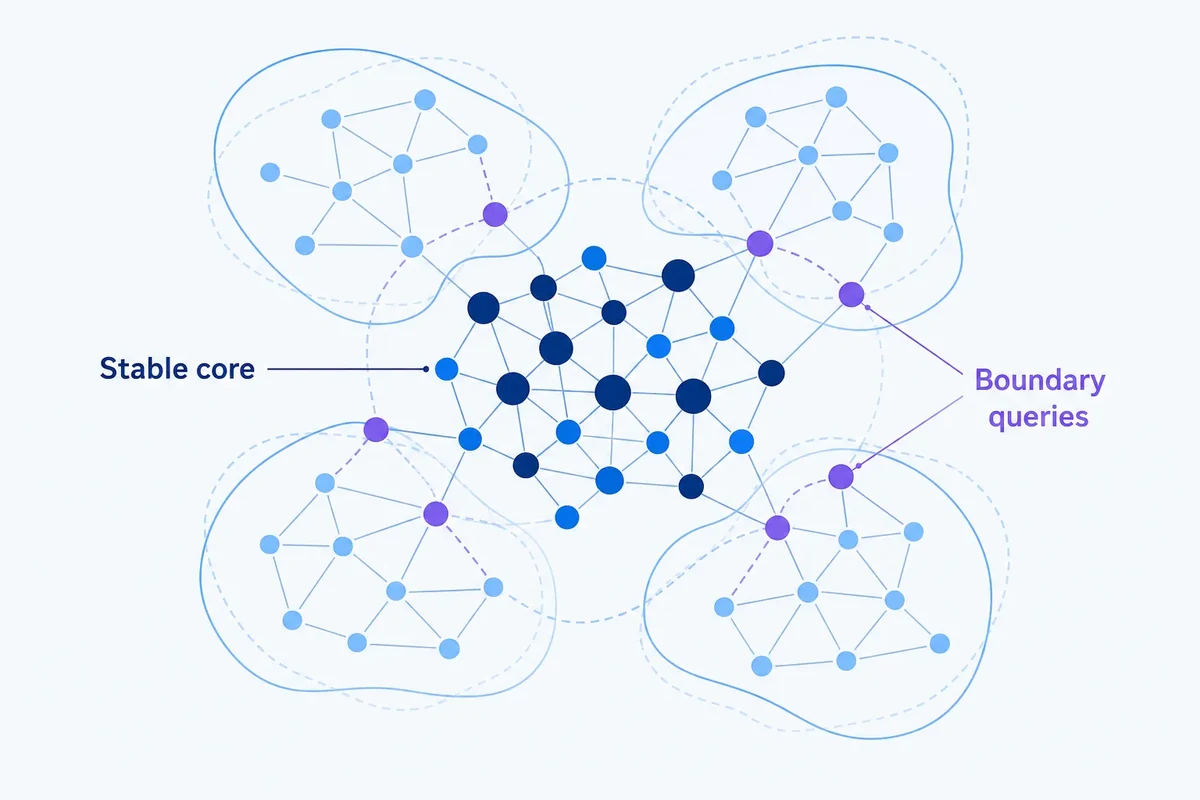
- Which groups remain as stable, consistent cores across every test?
- Which boundary queries constantly move between different groups?
Why this suits keyword clustering
SEO data is notoriously messy. It contains ambiguity, multiple levels of intent, and noisy language. A stable core of keywords is often more useful for a content plan than one perfectly crisp, but potentially fragile, partition. ClusterIQ can identify a solid topic core while highlighting that certain modifiers or "bridge" queries remain uncertain and require a human eye.
Worked example: four competing models
Imagine ClusterIQ runs four different models on a dataset:
- HDBSCAN;
- Leiden on a weighted graph;
- Agglomerative clustering;
- K-means as a baseline.
Across these models, 120 keywords related to "keyword clustering software" stay together every single time. However, another 25 queries involving pricing and comparisons move between neighbouring groups depending on the algorithm. The stable 120 keywords form a highly persuasive topic core for a main landing page. The 25 movable queries are flagged for review rather than being buried inside whichever model happened to run last.
Repeated runs of one model can also form consensus
You do not always need different algorithms to find a consensus. You can achieve similar results by varying the parameters of a single model, such as:
- The random seed;
- The similarity threshold;
- The resolution or granularity;
- The minimum cluster size;
- The embedding model used;
- The data sample itself.
This approach is a core part of ClusterIQ's cluster stability workflow.
Build a co-association matrix carefully
For every pair of keywords in your list, you calculate the fraction of runs in which they belong to the same group. For small sets of a few hundred keywords, this is simple. For large corpora of thousands of keywords, a full matrix can be computationally expensive. In those cases, it is better to store only meaningful neighbour pairs or calculate consensus within specific candidate regions.
Noise needs a rule
If two keywords are both labelled as "noise" (unclustered) in a run, it does not mean they belong together. ClusterIQ avoids counting shared noise as a positive association. Noise simply means the model wasn't confident enough to assign them anywhere; it does not turn "miscellaneous" into a coherent topic.
Stable cores can seed later assignment
Once you have identified a high-consensus core, you can use it as a foundation. New or ambiguous queries can be compared against the established representatives and entities of that core. This creates a safer, more conservative workflow:
- Identify the stable core keywords;
- Protect that core membership to ensure consistency;
- Review any uncertain additions as a separate task.
Consensus can hide shared bias
Agreement between models is less impressive if every model is fed the same flawed data. If four different algorithms all use the same embedding model that has an underlying entity error, they will all repeat that error. To counter this, use diverse evidence like lexical signals, SERP data, and human benchmarks to challenge the semantic representation.
Do not optimise for maximum consensus
Very broad clusters often look stable because almost every model will group them together at a high level. The real question is whether the stable group exists at the right granularity for your SEO task. A broad consensus around "bathrooms" is not specific enough to help you design category pages for baths, showers, and taps.
Consensus supports explainability
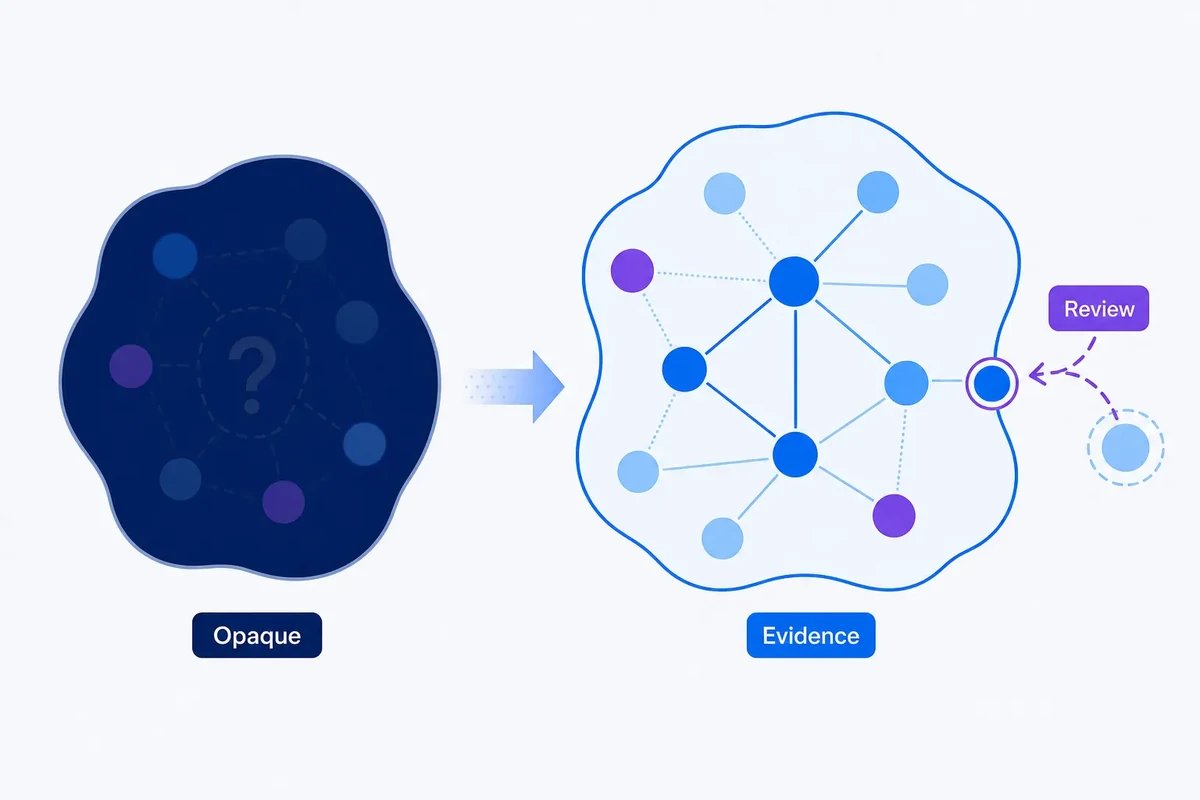
A ClusterIQ explanation provides clarity by stating: "This query belongs to a stable core that persisted across four algorithms and five parameter settings. Three neighbouring queries remain unstable and have been excluded for manual review." This is far more useful for a client or stakeholder than a single, opaque confidence score.
Track consensus across versions
When you upgrade a model or change your settings, it should not silently destroy your stable topic cores. By comparing a new run against your historical consensus, you can spot if previously stable relationships have broken. This allows you to inspect the "why" before you accept changes that might impact your site structure.
Use it where mistakes are expensive
Consensus clustering is most valuable when the stakes are high, such as:
- Making high-value site taxonomy decisions;
- Mapping URLs during a site migration;
- Large-scale page consolidation projects;
- Automating cluster-to-URL assignments;
- Setting quality gates for major reporting releases.
For quick, exploratory keyword research, the extra computation might not be necessary.
Consensus can support hierarchical outputs
Stable broad groups and stable narrow groups can exist at the same time. ClusterIQ can preserve these different levels of consensus rather than forcing you into one final, flat list. This aligns perfectly with how we build topic maps and site taxonomies.
Practitioner principle: agreement across reasonable models is evidence of stability. It is not proof that the shared assumption behind those models is correct.
ClusterIQ Conclusion
Consensus clustering provides a way to find keyword relationships that survive changes in math and parameters. By separating stable topic cores from uncertain boundaries, it makes high-consequence SEO decisions much more defensible and reliable.
Turning this evidence into an SEO decision
In ClusterIQ, an analytical result should never lead directly to an irreversible change on a website. Instead, the data should tell you what changed, how confident the evidence is, and which page is affected. A strong, stable signal might justify an automated suggestion, while a weak or conflicting signal should trigger a manual review state.
A practical review involves looking at representative queries, entities, and existing URL ownership. The final action might be to approve the group, adjust the cluster, or perhaps consolidate overlapping pages. By keeping the analysis separate from the implementation, we ensure that the tool informs the strategy rather than just generating blind instructions.
This evidence remains visible even after you act. ClusterIQ stores the proposed decision and any manual overrides. Over time, these records become a feedback loop, showing exactly where the automated methodology is most reliable and where human business context is still essential.
Sources and further reading
Farky Rafiq
Founder of ClusterIQ
I've worked in digital marketing since 2005 and founded Liquid Silver in 2011. These articles are where I share the methods, experiments and practical SEO thinking behind ClusterIQ.
Put the idea into practice with your own keyword data
ClusterIQ helps turn raw SEO exports into clean, structured working datasets you can inspect, refine, report on and take into the next stage of your workflow.
Keep reading
Keyword clustering vs topic clustering: what’s the difference?
Cluster stability for SEO: how to tell whether a topic survives small changes