Late-interaction retrieval for SEO: when one vector per page is not enough
Late-interaction models keep token-level vectors and compare them at query time, preserving detail that a single page embedding can lose. Learn where that helps SEO retrieval.

Farky Rafiq
Founder of ClusterIQ
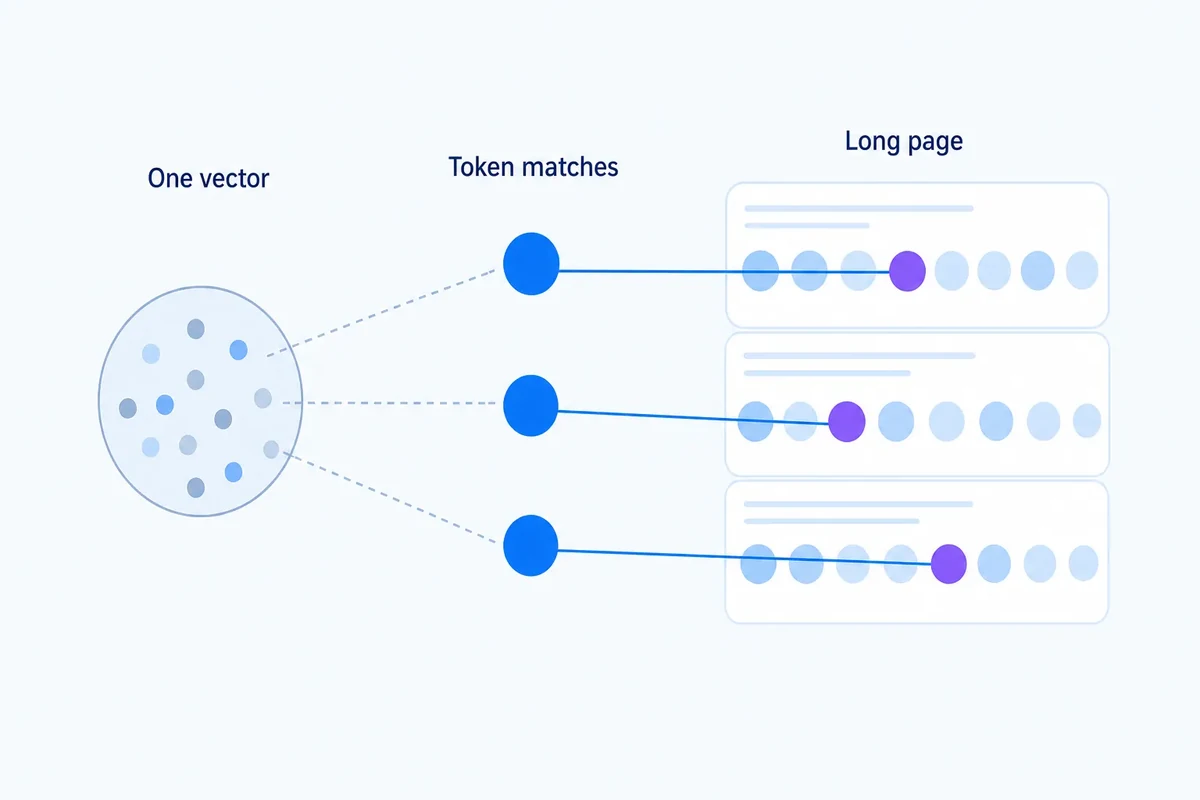
A single dense vector compresses an entire text into one numerical representation. While this is highly efficient, it can be far too aggressive when dealing with long pages that cover several entities, distinct sections, and various user tasks. Late-interaction retrieval offers a more nuanced approach by keeping multiple token-level vectors for each document and delaying part of the matching process until the query is actually made. The ColBERT-style MaxSim scoring method is the most prominent example of this technique.
For ClusterIQ, this approach creates a valuable middle ground. It sits between the low-cost speed of bi-encoder retrieval and the high-precision, but computationally expensive, full cross-encoder scoring.
Why one vector can lose local detail
Imagine you are looking at a 2,000-word category guide. This single page might cover product selection, sizing, installation, maintenance, and several different brands. A standard pooled embedding has to summarise every one of those distinct signals into a single point in vector space.
If a user searches for a specific phrase like 800mm shower screen installation, that query might match the installation section of your guide very strongly. However, in a single-vector model, that signal is often diluted by the thousands of other words on the page. The specific relevance gets lost in the average.
Late interaction keeps token-level representations
Rather than collapsing a document into one summary vector, a multi-vector encoder produces a set of vectors for individual tokens or passages. When it comes time to score a query, each query token can search for its strongest match among all the document-token vectors. These individual matches are then combined to create a final score.
This method preserves a much finer level of lexical and semantic alignment than a global vector ever could. It ensures that specific details are not smoothed away during the embedding process.
MaxSim is the core intuition
In ColBERT-style scoring, we use a mechanism called MaxSim. Each token in a search query looks for the maximum similarity among all the available document token vectors. If a query contains the term installation, the system can find and reward the most relevant installation-related language within a long page, even if that specific concept is not the dominant theme of the entire document.
Why this can help SEO page matching
Mapping clusters to URLs often involves comparing short query strings or cluster labels against very long pages. Late interaction is particularly helpful when:
- Crucial keywords only appear in one specific section.
- The exact matching of entities is vital for relevance.
- Long-form pages serve multiple subtopics simultaneously.
- Global pooling methods lose the decisive phrase that indicates intent.
Worked example: two pages with similar global meaning
Suppose Page A and Page B are both broadly about keyword clustering. Page A includes a highly technical section on HDBSCAN parameter tuning, while Page B focuses on graph community detection. A single embedding might place both pages very close to a query like HDBSCAN min cluster size because they share the same general neighborhood of machine learning SEO.
However, a late-interaction model can reward Page A much more strongly. It recognizes that several specific tokens in the query align directly with the technical section in Page A, whereas Page B lacks those specific token-level matches.
This is still retrieval, not the SEO decision
It is important to remember that a high late-interaction score simply means the page contains strong evidence of a match. It does not automatically determine if the page type, the user intent, or the business role of that URL is appropriate for your strategy. ClusterIQ should always combine this retrieval data with broader URL-mapping confidence evidence to make the final call.
The cost is more storage
Moving away from a one-document, one-vector model has practical implications. A single page might now be represented by dozens or even hundreds of token vectors. This naturally leads to an increase in index size, memory requirements, retrieval complexity, and overall operational costs. The extra detail provided by this method must be justified by a measurable improvement in the quality of your page retrieval.
Scoring is more expensive than dense dot product
A standard dense bi-encoder is incredibly cheap because it only compares one query vector to one page vector. Late interaction requires many more token-level comparisons. While this is more intensive, it is still generally more affordable than running a full cross-encoder across every single candidate page, primarily because the document representations can be precomputed and stored.
Use it as a reranking or high-value layer
ClusterIQ does not need to use late interaction for every single search. A more efficient and practical architecture looks like this:
- Retrieve the top 50 pages using standard dense or sparse search methods.
- Rerank those specific candidates using late interaction.
- Apply additional layers of evidence, such as page-type, entities, and Search Console data.
- Route any remaining ambiguous mappings for manual practitioner review.
Tokenisation and document length matter
Multi-vector models are still bound by maximum sequence lengths and specific tokenisation rules. If you are dealing with exceptionally long pages, you may still need to use chunking or hierarchical pooling. It is vital to record your truncation and pooling settings so that your retrieval results remain reproducible over time.
Learned token importance can improve explanation
One of the most useful opportunities here is the ability to show exactly which query terms matched which phrases on a page. This gives ClusterIQ a concrete way to explain its decisions, moving beyond a single similarity score. A user can see that a mapping was chosen because of specific entity, feature, or task-based language found within the content.
Do not present token matches as Google's mechanism
We must be clear: late-interaction retrieval is a ClusterIQ analysis method. It is a tool for us to understand content relationships. It does not mean that Google uses this exact token-level scoring architecture for its own rankings. We should always keep our modelling methods separate from speculative claims about the inner workings of search engines.
Evaluate against known page mappings
To find the right balance, you should compare the performance of different methods, including dense bi-encoder recall, sparse retrieval, late-interaction reranking, and cross-encoder reranking, against human-approved page targets. The most effective SEO workflows often use different methods at different stages of the pipeline.
Where ClusterIQ could benefit most
This method is most compelling when you are dealing with long, information-rich pages and high-stakes mapping tasks. For very short keyword-to-keyword similarity checks, a single high-quality sentence embedding is often enough to capture the necessary detail.
Practitioner principle: one vector is efficient because it compresses. Late interaction is useful when the detail lost in that compression changes the page you would choose.
ClusterIQ Conclusion
Late-interaction retrieval provides ClusterIQ with a more granular lens for matching clusters to long-form content. The additional storage and computing power required should be earned through better performance on complex cases where standard embeddings fail to capture specific entities or section-level relevance.
Data provenance matters as much as the method
ClusterIQ must be able to reconstruct the logic behind every analysis. This requires retaining the source dataset, the specific market and language, preprocessing versions, and the date ranges used. Without this provenance, a change in your mapping results could be mistaken for a shift in user behaviour, when the cause was actually a change in the data source or a processing rule.
This is especially critical at scale. A single corpus might contain Search Console data, third-party keyword estimates, and manual business rules. These sources should not be treated as interchangeable. By keeping each source attributable, ClusterIQ can report what changed in the data versus what changed in the model. This distinction makes historical reporting and regression testing much more reliable for the practitioner.
Sources and further reading
Farky Rafiq
Founder of ClusterIQ
I've worked in digital marketing since 2005 and founded Liquid Silver in 2011. These articles are where I share the methods, experiments and practical SEO thinking behind ClusterIQ.
Put the idea into practice with your own keyword data
ClusterIQ helps turn raw SEO exports into clean, structured working datasets you can inspect, refine, report on and take into the next stage of your workflow.
Keep reading
Sparse encoders for SEO: learned lexical retrieval between TF-IDF and dense embeddings
Adding new keywords to existing clusters without rebuilding everything