Sparse encoders for SEO: learned lexical retrieval between TF-IDF and dense embeddings
Sparse encoders produce learned lexical representations that retain interpretable token dimensions. Learn how they differ from TF-IDF and dense embeddings in SEO retrieval.

Farky Rafiq
Founder of ClusterIQ
You have 1,500 keywords from Ahrefs, Semrush or Search Console and need to match them to existing pages. Broad topic matches help, but overlooking a product code or technical term can send you towards the wrong URL.
Sparse encoders offer a middle ground between lexical methods such as TF-IDF and dense semantic embeddings. They learn which terms deserve weight, potentially giving ClusterIQ richer matching while retaining much of sparse retrieval’s explainability and inverted-index efficiency.
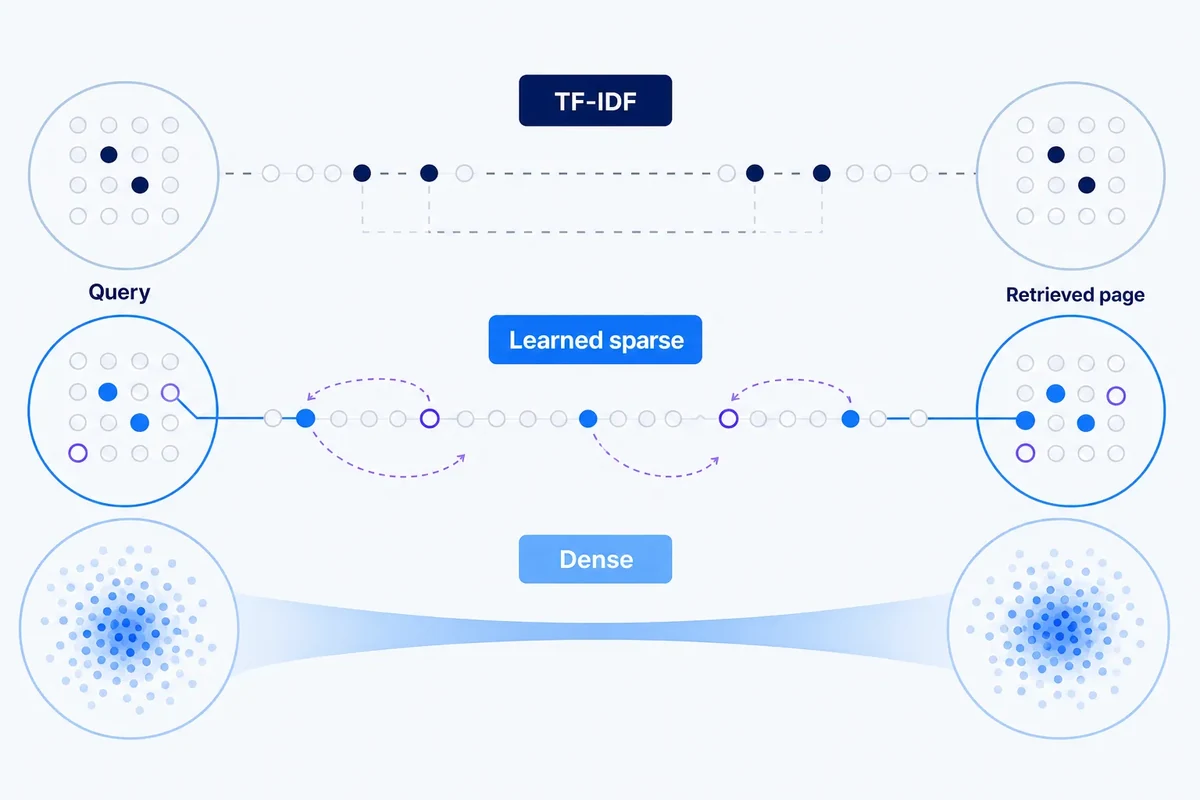
What makes a representation sparse
A dense embedding represents text through hundreds or thousands of non-zero numerical dimensions. Individual dimensions rarely have an obvious meaning.
A sparse representation has many dimensions, but most are zero. In learned sparse models, the smaller active subset can correspond to vocabulary tokens or learned lexical concepts, making the evidence easier to inspect.
How this differs from TF-IDF
TF-IDF weights terms using their occurrence in documents and their frequency across the document collection. A learned sparse encoder instead uses a neural model to expand or reweight lexical evidence.
That can connect a query with a page even when the exact query term is missing, while staying closer to lexical matching than a dense embedding.
Why this matters for SEO
Your content plan needs semantic flexibility without losing commercially important detail. Relevant signals include:
- product model names;
- industry acronyms;
- sizes and dimensions;
- brand terminology;
- specific technical concepts.
A sparse neural representation can preserve these more explicitly than a fully dense semantic space. That matters when similar-looking keywords require different pages or briefs.
Worked example: page retrieval
Suppose ClusterIQ needs to find existing pages for the query cluster “keyword clustering software”. A dense model may favour pages about semantic grouping and topic modelling because their broad meanings overlap.
A sparse encoder can place more weight on “keyword”, “clustering” and “software”, helping the candidate list retain the exact task language. A hybrid system can combine both signals, giving the marketer a more useful shortlist to review.
Sparse encoders can support inverted-index infrastructure
Sparse representations can be stored and retrieved through sparse-vector capabilities in search engines such as Elasticsearch. This can be attractive for organisations already running mature lexical search infrastructure, rather than starting again with a different retrieval stack.
Learned expansion needs explainability
A model may activate related tokens absent from the original text. Those expansions should be inspectable during debugging.
Practitioners do not need every weight on screen, but ClusterIQ should be able to distinguish a relationship based on exact terms from one based on learned expansion or dense semantic similarity.
Sparse and dense signals are complementary
Dense embeddings are strong at broad paraphrase and conceptual similarity. Sparse encoders can be stronger where lexical precision matters.
ClusterIQ's hybrid retrieval workflow can treat learned sparse retrieval as another candidate source, not an automatic replacement for either existing method.
Do not assume neural means better
TF-IDF is fast, transparent and often surprisingly strong. A sparse neural encoder adds model complexity, inference cost and versioning requirements.
Before adopting one, benchmark the failures you actually need to fix. Extra complexity is worthwhile only if it improves useful outcomes.
Evaluate retrieval separately from clustering
Sparse encoders usually work at the retrieval or relationship-scoring layer. Test that layer first:
- Candidate recall: does retrieval find the relevant options?
- Top-neighbour precision: are the closest matches genuinely useful?
- Exact-modifier preservation: do important sizes, codes and qualifiers survive?
- Page-mapping performance: does it improve results against a benchmark?
Only then check whether the improved candidate graph, the network of potential relationships, produces better clusters.
Vocabulary and language coverage matter
A model trained mainly on English may struggle with multilingual ecommerce queries, product codes or local terminology. ClusterIQ should test sparse models market by market, just as carefully as dense embedding models.
Query and document encoders can differ
Some architectures use different computational paths or weighting behaviour for queries and documents. That can suit the differences between a short search query and a long page.
Record the model configuration so query-to-page retrieval remains reproducible.
Long documents still need a strategy
Pages exceeding a model’s maximum sequence length can be truncated, leaving useful evidence out. Long guides and ecommerce pages may need chunking or section-level representations.
This connects directly to ClusterIQ's long-page embedding workflow.
Where sparse encoders could fit in ClusterIQ
Potential roles include:
- retrieving candidate pages;
- finding neighbouring keywords;
- providing lexical evidence for graph edges, the connections between items;
- explaining distinctive terms;
- supporting hybrid retrieval alongside dense embeddings.
Keep the evidence channels separate
When combining sparse and dense scores, retain both values and the combination rule. A single “relevance” score should not hide why two items are related, especially when reviewing page recommendations or reporting an override.
Practitioner principle: sparse neural retrieval is useful when you want learned lexical flexibility without losing the exact-language evidence SEO often depends on.
ClusterIQ Conclusion
Sparse encoders broaden the choice beyond TF-IDF versus dense embeddings. For ClusterIQ, they offer a potential transparent lexical-semantic signal where benchmarks show better candidate quality, particularly for technical and product-heavy datasets.
Turning this evidence into an SEO decision
An analytical result should not jump straight to an irreversible site change. First establish what changed, how confident the evidence is and which user or page decision it affects. Strong evidence may justify automatic candidate generation; weak or conflicting evidence should trigger review.
Review representative queries, entities, page type, existing URL ownership and contradictory first-party evidence. Then decide whether to approve or adjust the group, improve an existing page, create a new asset, consolidate overlap or leave the site unchanged. Analysis should inform a content brief, not automatically become an instruction to produce content.
The evidence should remain visible afterwards. Recording the proposed decision, approved decision and override reason would give ClusterIQ valuable feedback about methodological reliability and where business context still matters.
Sources and further reading
Farky Rafiq
Founder of ClusterIQ
I've worked in digital marketing since 2005 and founded Liquid Silver in 2011. These articles are where I share the methods, experiments and practical SEO thinking behind ClusterIQ.
Put the idea into practice with your own keyword data
ClusterIQ helps turn raw SEO exports into clean, structured working datasets you can inspect, refine, report on and take into the next stage of your workflow.
Keep reading
Late-interaction retrieval for SEO: when one vector per page is not enough
Adding new keywords to existing clusters without rebuilding everything