Character n-grams for SEO: handling misspellings, model codes and messy keyword data
Character n-grams compare fragments of words rather than whole tokens. Learn why they are useful for misspellings, product codes and noisy SEO data alongside semantic embeddings.

Farky Rafiq
Founder of ClusterIQ
Export 1,500 keywords from Ahrefs, Semrush or Search Console and you will probably find misspellings, joined words, hyphenation, abbreviations and inconsistent product codes. Checking every variation by hand takes time that could go into a content plan or brief.
Matching whole words works well with tidy text. Character n-grams offer another way to spot related strings when that matching breaks. For ClusterIQ, they provide supporting evidence from spelling and structure, complementing semantic embeddings rather than replacing their ability to represent meaning.
What a character n-gram is
A character n-gram is a short sequence of characters. For “clustering”, 4-grams include “clus”, “lust” and “uste”, continuing through the word.
Two strings can share many of these fragments despite a typo or a change in word form. That makes them useful candidates for closer checking.
Why misspellings are a strong use case
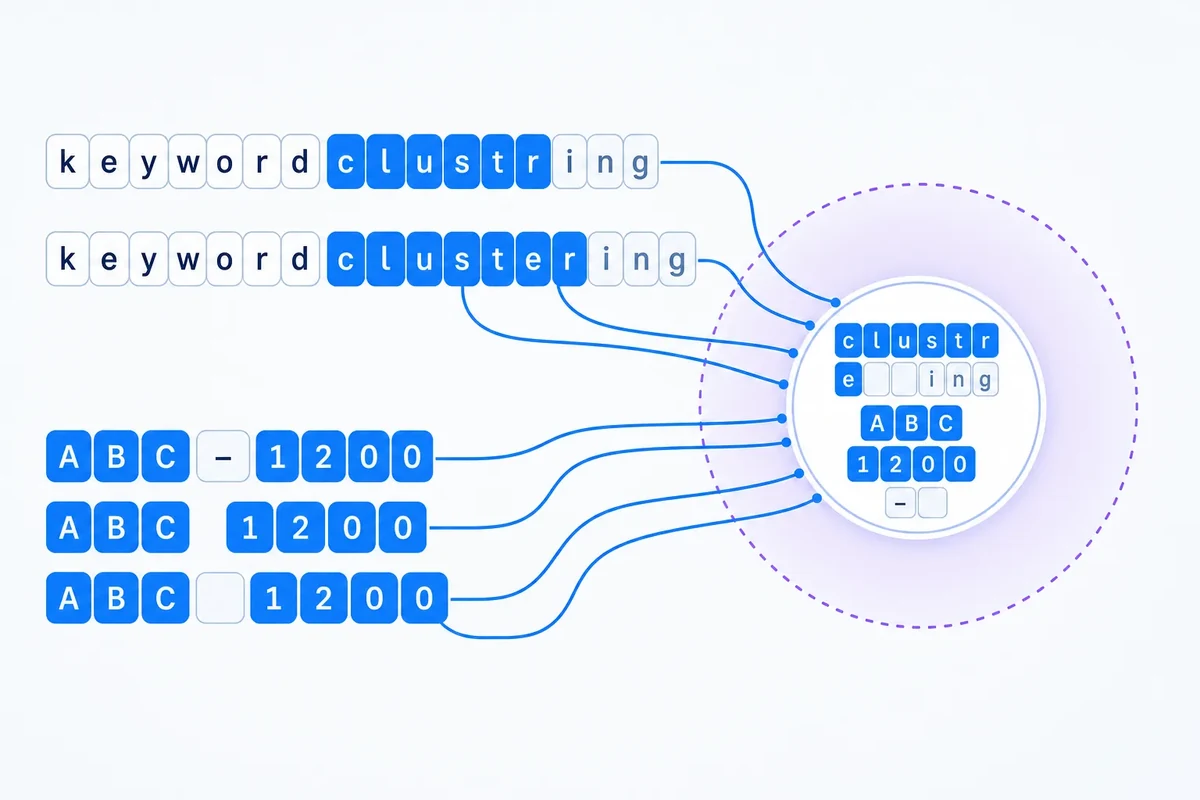
“Keyword clustring” and “keyword clustering” contain different whole-word tokens, but most of their local character sequences match.
Character features can help a retrieval stage find likely equivalents before semantic clustering. They add tolerance to exact matching or sparse retrieval, which compares explicit features such as words or fragments.
Product codes benefit from subword evidence
These queries can refer to the same product:
- ABC-1200;
- ABC1200;
- ABC 1200.
Tokenisation, the process of splitting text into units, may handle each differently. Character features preserve shared structure, making it easier to check whether normalising them to one form is justified.
Worked example: catalogue terminology
A bathroom keyword export contains “wall-hung”, “wall hung” and “wallhung”. Their character n-gram similarity remains high across the forms.
ClusterIQ can use this as spelling-based evidence while retaining each raw query and separately extracting the mounting-style attribute. For a category-page brief, that helps distinguish formatting differences from genuinely different product requirements.
Character features are not semantic
“Installation” and “insulation” share substantial character structure but describe different concepts. Grouping them on spelling alone could produce a muddled brief or the wrong page recommendation.
Character similarity should therefore support a decision, not become the final clustering criterion.
Use TF-IDF weighting on character n-grams
Scikit-learn’s TfidfVectorizer supports character analysers and configurable n-gram ranges. TF-IDF weighting reduces the influence of very common fragments so distinctive sequences contribute more. Not every shared fragment deserves equal weight.
The n-gram range matters
Short fragments tolerate spelling variation better, but also create more accidental matches. Longer fragments are more precise and less forgiving.
Ranges such as 3–5 or 3–6 characters are common starting points for testing. ClusterIQ should benchmark the actual errors in the data rather than assume one range suits every export.
Character n-grams can help duplicate detection
Before semantic clustering, character features can flag likely technical variants of one query. Additional rules around numbers, entities and exact normalisation should inform the final duplicate decision.
A matching code prefix, for example, should not automatically erase a different model number. Deduplication remains separate from clustering.
They can support hybrid retrieval
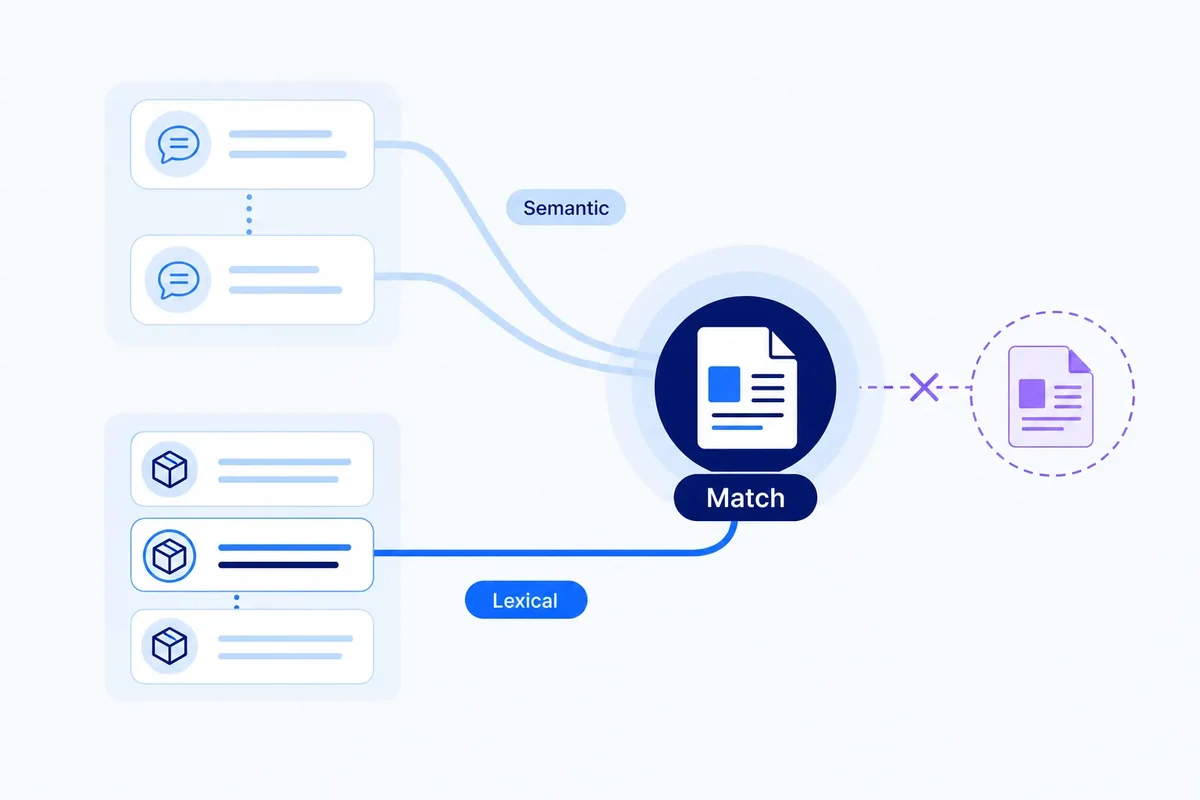
A strong hybrid approach builds a shortlist of possible matches from several sources:
- dense semantic neighbours, based on meaning;
- word-level lexical neighbours, based on shared words;
- character n-gram neighbours;
- entity-compatible candidates.
ClusterIQ can keep these signals separate. Disagreement is useful evidence: similar spelling without compatible meaning deserves scrutiny.
Do not let misspellings become canonical labels
A typo is a valid observation, not necessarily suitable wording for a cluster label or page. Use the correct spelling or business-approved language in plans and reports, while preserving the original query underneath.
Language and script affect usefulness
Character features behave differently across languages and writing systems. They can be especially useful where words have many grammatical forms, but evaluation should remain specific to the market.
Model codes need custom boundaries
Generic tokenisation can split hyphens and digits unpredictably. For product-heavy datasets, ClusterIQ can explicitly preserve alphanumeric sequences and test character features around them, rather than rely on generic word boundaries.
Use errors to tune the lexical layer
Review the actual mistakes:
- false duplicate candidates;
- missed spelling variants;
- model-code confusion;
- language-specific failures.
Adjust normalisation and n-gram ranges when that evidence supports a change, not simply because another setting is available.
Do not expose this complexity by default
Practitioners usually need to know that a spelling or model-code variant was recognised, not inspect thousands of fragments. The normal interface should explain the practical reason, with technical detail available in advanced explanations.
Practitioner principle: character n-grams preserve local form. Use them to handle messy strings reliably, not to infer meaning from spelling alone.
ClusterIQ Conclusion
Character n-grams are a useful defensive feature for real-world keyword data. ClusterIQ can use them for misspellings, formatting variants and product codes, while semantic embeddings and entity features supply broader meaning for reliable clustering.
How this fits the wider ClusterIQ workflow
This method belongs within a wider evidence chain: clean source data, preserve lexical and entity features, establish semantic relationships, test the structure, then connect groups to pages, internal links or roadmap actions. Separate stages make recommendations easier to explain and safer to revise.
Practitioners should be able to challenge a result without becoming data scientists. Show the strongest supporting evidence, the main conflicting signal and the consequence of accepting the recommendation. Keep parameters and scores available for deeper investigation.
After implementation, the same topic ID can be monitored through Search Console, crawl data, inventory or other relevant sources. That connects approved actions to changes in ownership, coverage or usability over time, rather than treating the initial grouping as the finished job.
Sources and further reading
Farky Rafiq
Founder of ClusterIQ
I've worked in digital marketing since 2005 and founded Liquid Silver in 2011. These articles are where I share the methods, experiments and practical SEO thinking behind ClusterIQ.
Put the idea into practice with your own keyword data
ClusterIQ helps turn raw SEO exports into clean, structured working datasets you can inspect, refine, report on and take into the next stage of your workflow.
Keep reading
How to name keyword clusters without letting the label distort the data
Keyword clustering vs topic clustering: what’s the difference?