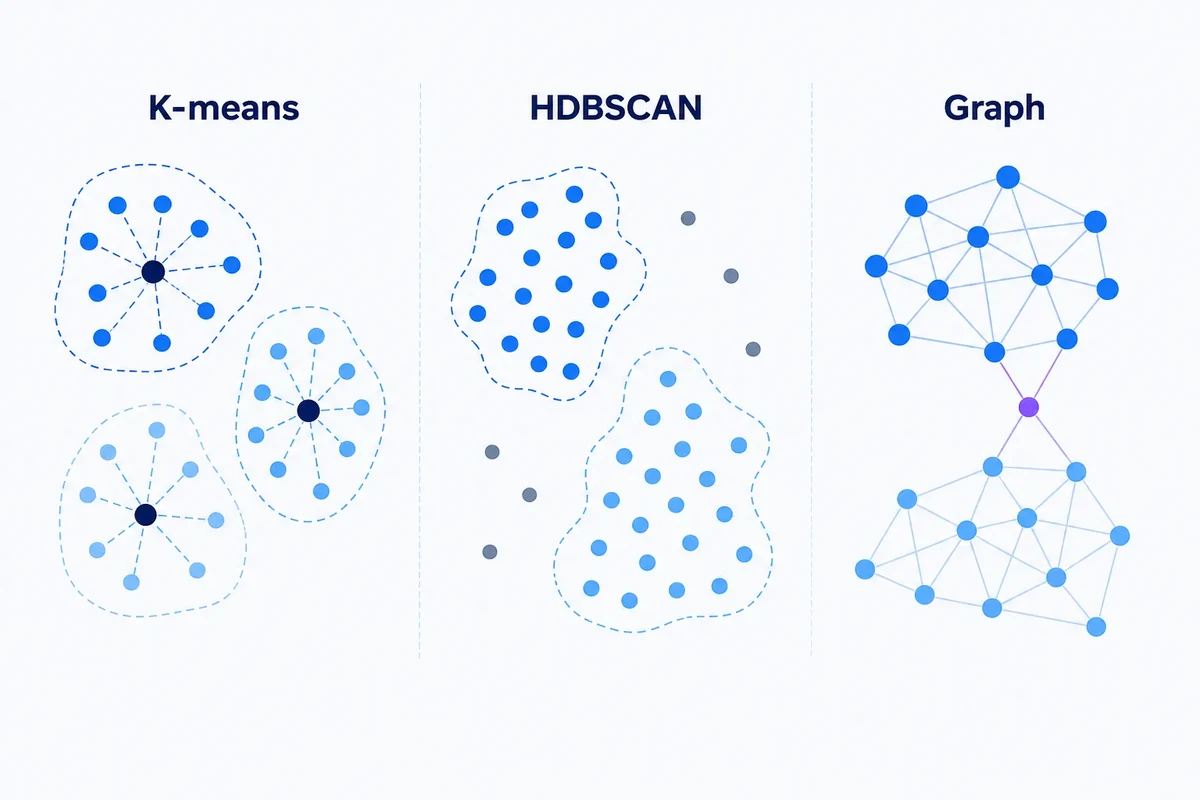
Bridge nodes and articulation points in keyword graphs: where topics depend on a few connections
Some keywords hold separate regions of a graph together. Learn how bridge nodes and articulation points expose fragile topical connections, ambiguous queries and useful navigation concepts.

Farky Rafiq
Founder of ClusterIQ
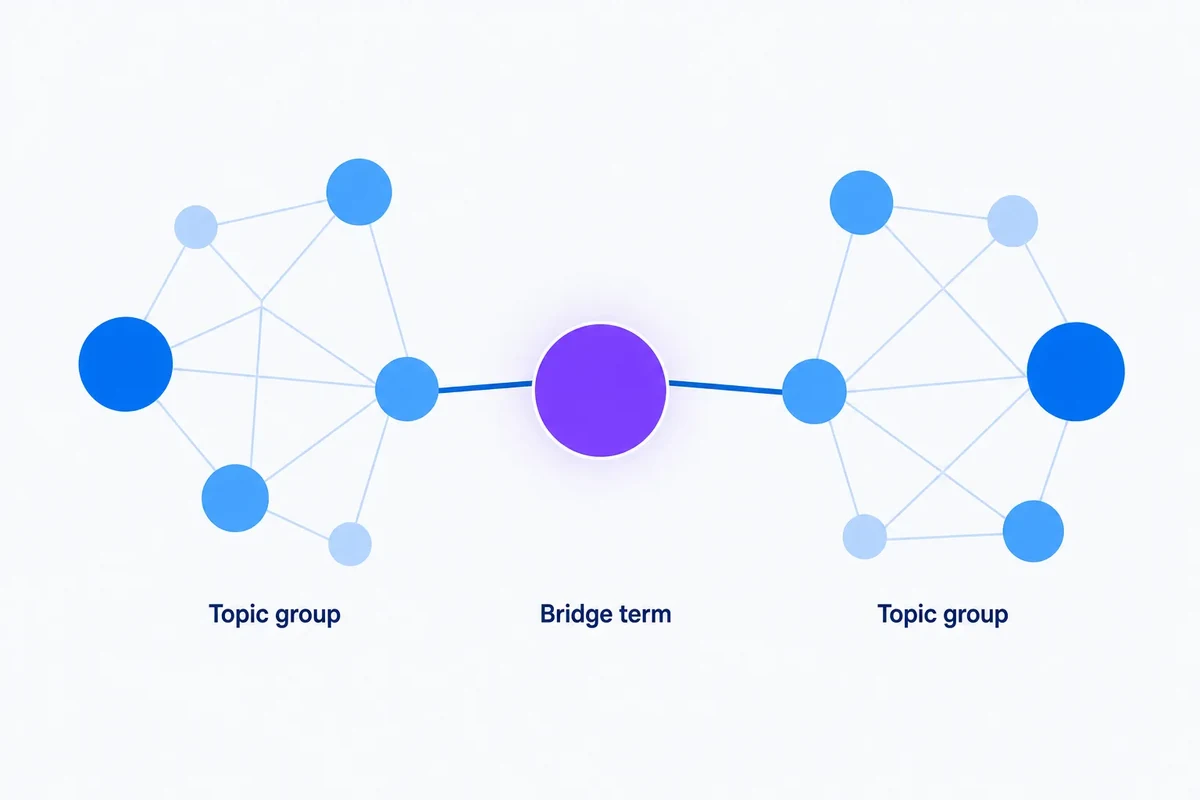
When you are looking at a spreadsheet of two thousand keywords from Ahrefs or Search Console, some terms clearly belong in a specific bucket. Others seem to sit right on the fence, pulling different topics together. In graph theory, we have specific ways to identify these "load-bearing" terms.
We look for bridge nodes and articulation points. These are the keywords that act as the glue for your topical map. Identifying them helps you spot where your content plan might be leaning on a single fragile connection, or where one page needs to serve as a vital gateway between two different categories.
What an articulation point is
In a keyword graph, an articulation point is a specific term that, if removed, would cause a cluster to split into two or more entirely separate pieces. It is the sole point of contact between different groups of keywords.
It is important to remember that being an articulation point is a structural trait, not a commercial one. A keyword might be technically critical to how your graph is held together without necessarily being a high-volume "money" term that requires its own landing page.
Bridge nodes are a broader idea
Not every useful connection is a formal articulation point. Sometimes, a keyword connects two communities very strongly, even if other minor paths exist between them. These are bridge nodes.
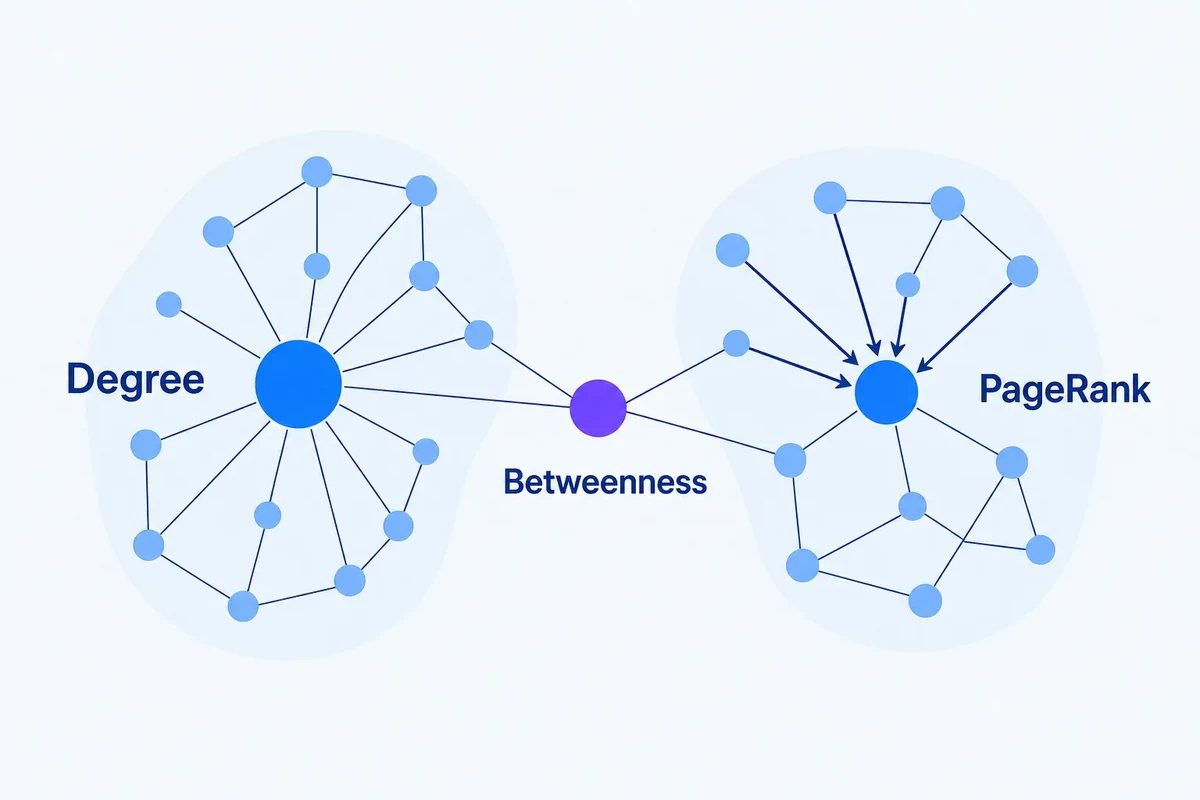
Terms with high betweenness, those that sit on the shortest path between many other keywords, or those with "soft membership" in multiple groups all fall into this category. Our ClusterIQ's graph centrality guide explains these different ways of measuring a keyword's position in the network.
Why bridge terms matter in keyword research
When you spot a bridge term in your data, it usually signals one of several practical SEO scenarios:
- A broad parent concept that umbrellas several niches.
- A product that fits logically into two different categories.
- An ambiguous query where the intent could go either way.
- A comparison term where users are looking to move from one topic to another.
- A generic phrase that has accidentally linked two unrelated topics.
The graph tells you that a relationship exists; your expertise tells you what that relationship actually means for your site architecture.
Worked example: shower baths
If you are mapping out a bathroom retailer's site, you might have one cluster for "baths" and another for "showers". A term like "shower bath" or "bath shower screen" will naturally act as a bridge between them.
This is a commercially valid connection. The products physically combine both concepts, so the link is real. However, a very generic term like "bathroom products" might also try to bridge these groups. In that case, the connection is too broad to be useful for specific page-level clustering and might need to be handled differently in your content plan.
Articulation points can expose fragile graphs
If two large topic families are held together by just one marginal keyword, your topical model is fragile. It is worth checking the edges around that articulation point to ensure the data is solid.
Ask yourself: do the search results actually support this link? Is the relationship backed up by real entities? If the connection feels forced or messy, edge pruning can help clean up the model so your clusters are more distinct and actionable.
Bridge nodes can inform content architecture
Legitimate bridge concepts are gold for internal linking and navigation. If a keyword connects two specialised areas, it is a prime candidate for a hub page, a comprehensive guide, or a comparison tool that helps users navigate your site.
You should always validate these opportunities against actual user needs rather than just following the graph metrics blindly.
Do not turn articulation into a ranking factor
An articulation point is a feature of the specific graph we have built in ClusterIQ. If you change your settings or your data source, the articulation points might shift. It is an analytical tool to help you understand your data, not a signal that Google uses to rank a page. Use it to inform your strategy, not as a metric to chase.
Compare formal articulation with high betweenness
In very dense keyword sets, formal articulation points are rare because there are usually multiple ways to connect topics. This is where betweenness centrality is more useful, as it identifies the "busy" nodes that facilitate the most traffic between regions.
ClusterIQ looks at several factors to give you the full picture:
- Articulation points: terms that are structurally essential.
- High betweenness: terms that frequently link different regions.
- Cross-community membership: terms that are semantically mixed.
- Human review: your final call on what the SEO implementation looks like.
Use bridge behaviour in stability testing
A keyword that only acts as a bridge under very specific settings might just be a fluke in the data. We look for "persistent" bridges, terms that remain influential across different graph configurations. These are the ones that truly define the boundaries of your topical map.
Bridge terms are useful review priorities
When you are reviewing a large keyword export, don't spend time on the keywords buried deep inside a clear cluster. Focus your manual review on the bridges and articulation points. These are the areas where the model is making complex decisions about where one topic ends and another begins.
How ClusterIQ can make this usable
We don't just give you a list of numbers. ClusterIQ aims to provide context, such as: "This query connects two otherwise separate topic groups. Review whether it represents a genuine parent, comparison or ambiguous term."
This turns abstract graph theory into a practical workflow for building better site structures.
Practitioner principle: a bridge is a reason to investigate a relationship, not a reason to force two topics together.
ClusterIQ Conclusion
Bridge nodes and articulation points highlight the critical junctions in your keyword data. They reveal where your topics overlap, where your site architecture needs a hub, and where your data might be slightly messy. By focusing on these high-leverage terms, you can build more robust content plans and avoid the pitfalls of over-simplified clustering.
Sources and further reading
Farky Rafiq
Founder of ClusterIQ
I've worked in digital marketing since 2005 and founded Liquid Silver in 2011. These articles are where I share the methods, experiments and practical SEO thinking behind ClusterIQ.
Put the idea into practice with your own keyword data
ClusterIQ helps turn raw SEO exports into clean, structured working datasets you can inspect, refine, report on and take into the next stage of your workflow.
Keep reading
Graph centrality for SEO: finding hubs, bridges and misleadingly important keywords
How to choose a similarity threshold for keyword clustering