Content templates from keyword clusters: scaling structure without making every article sound the same
Templates can improve editorial consistency and speed, but they can also create repetitive pages. Learn how ClusterIQ can separate repeatable evidence requirements from variable storytelling.

Farky Rafiq
Founder of ClusterIQ
You have grouped 1,200 keywords from Ahrefs, Semrush or Search Console and now need a workable content plan. Templates save time by giving writers a reliable starting point, rather than making them reinvent the production process for every page.
The trouble starts when that starting point becomes a script: the same argument, examples and section rhythm everywhere. ClusterIQ can use clusters to define repeatable evidence requirements while letting the topic shape each article.
Template the questions, not the prose
A useful template asks writers to establish:
- what problem the topic solves;
- what evidence or method supports the explanation;
- where the method fails;
- what a practitioner should do next;
- how ClusterIQ applies the concept.
These are quality checks, not compulsory headings. The answers and their order should change with the reader’s needs.
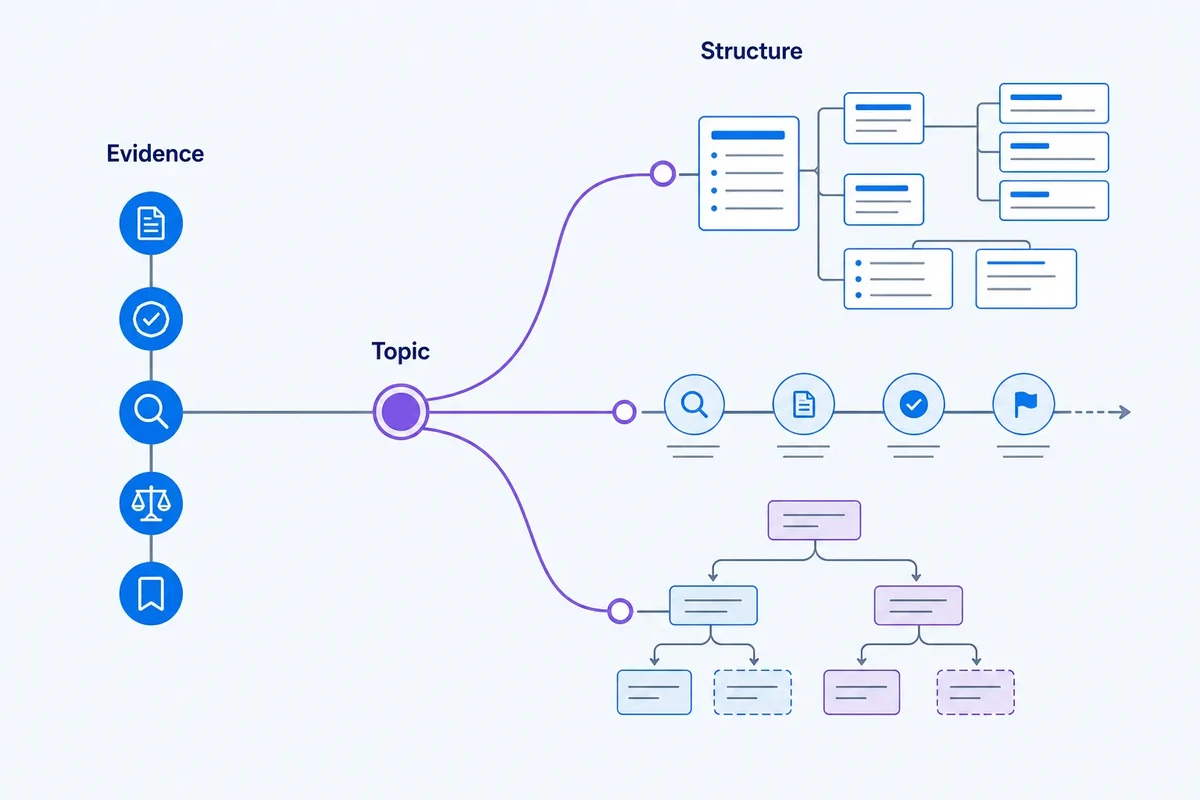
Cluster type can influence the template
Different topics need different routes through the explanation:
- algorithm articles: assumptions, parameters, worked examples and limitations;
- technical SEO articles: diagnostic signals, implementation and quality assurance (QA);
- strategy articles: decision frameworks, alternatives and governance;
- product-method articles: supporting evidence, workflow and practitioner control.
This gives the brief useful structure without prescribing every paragraph.
Worked example: two related methods
An HDBSCAN article and a Search Console aggregation article should not share a section list simply because both came from the ClusterIQ content engine.
HDBSCAN needs an explanation of density and parameters. Search Console needs aggregation, privacy and dimensionality context: which dimensions are included affects how data is grouped and interpreted. The shared requirement is rigour, not identical prose.
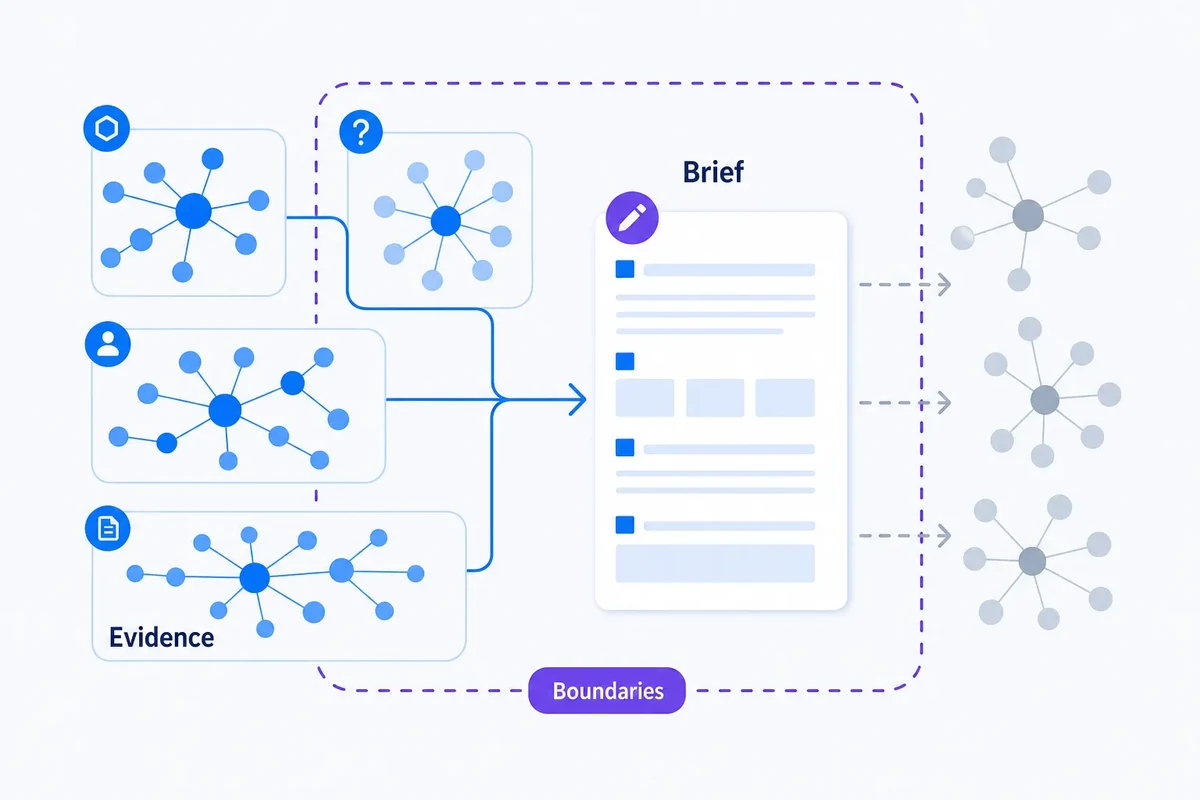
Use the cluster brief as the variable layer
The template sets the standard; the brief explains what makes this page necessary. Include:
- the page’s distinct job and primary question;
- related existing articles;
- relevant entities;
- required sources;
- a worked example;
- ClusterIQ product relevance;
- topics explicitly out of scope.
For a content plan covering several hundred keywords, these boundaries help writers understand which page owns each question before drafting begins.
Do not enforce a fixed word count
A narrow technical distinction may be complete at 900 words; a comprehensive methodology may need 1,800. Set minimum quality criteria rather than padding every page to the same target.
Repeated phrases are a QA signal
If every article ends with the same three sentences or repeats a practitioner principle verbatim, the template is leaking into the voice. ClusterIQ’s content QA can detect repeated sentence patterns across the corpus, meaning the whole article collection.
Examples should be topic-specific
Generic examples make scaled content feel generic. A graph article needs a graph-relevant example. Ecommerce examples should use product attributes or inventory; migration examples should address URL ownership. The example should help someone make the decision the article promises to explain.
Sources should follow the claim
Do not attach the same four sources to every article in a cluster family. A shared research pack can contain foundational papers and documentation, but each article should cite the primary source relevant to its method.
Internal links should follow genuine dependencies
A template can prompt links to a parent concept, a deeper method, a practical implementation article or a ClusterIQ workflow page. Choose the final links because they support the argument, not because the brief demands three internal links.
Use structured components for repeated utility
Some reusable elements make production easier without flattening the prose:
- definition boxes;
- method assumptions;
- QA checklists;
- source blocks;
- related-reading components;
- ClusterIQ calls to action.
Keep their structure consistent while changing their contents to suit the page.
Editorial voice can still be standardised
Oxford-style UK English, direct language, evidence-led claims, limited hype and clearly expressed uncertainty can all be consistent. None requires writers to repeat the same sentence patterns.
Template performance should be reviewed
Once enough pages exist to compare, check whether a particular structure repeatedly produces weaker engagement, unclear internal links or greater topic overlap. Templates are working hypotheses, not permanent rules.
Use ClusterIQ to detect template cannibalisation
If pages produced from one template begin clustering unusually close together, inspect them. Repeated structure and wording may be overpowering their distinct subject matter. Closeness is a reason to investigate, rather than proof that the pages should be combined.
Human editing should focus on the variable layer
Editors should spend less time checking whether sources and metadata exist and more time asking whether the distinction is clear, the example convincing and the contribution unique. They should also check whether the ClusterIQ reference genuinely helps the reader.
Templates should evolve with the corpus
The first 20 ClusterIQ articles needed a different level of explanation from a mature 150-article corpus. As foundational concepts gain dedicated pages, newer articles can link to them rather than explain everything again.
Practitioner principle: standardise evidence and quality requirements. Let the topic decide the article’s shape.
ClusterIQ Conclusion
Templates can support scale without producing interchangeable content. ClusterIQ can use article-type requirements, distinct briefs and corpus-level QA to maintain editorial standards while allowing each topic its own structure and depth.
Use corpus-level QA to keep templates from converging
After dozens of pages, ClusterIQ can compare new drafts with the existing collection before publication. Look beyond titles: check repeated headings, unusually similar paragraph sequences, duplicated examples and overlap in intended query clusters.
If drafts share an argument and differ mostly in terminology, consider merging topics, rewriting briefs or publishing fewer pages. Harder paraphrasing will not fix an unclear page purpose.
This check matters more as the library grows. The first article on a concept has little cannibalisation risk; the hundredth must justify what it adds to the existing knowledge graph. That supports scalable editorial discipline, not just faster writing.
Sources and further reading
Farky Rafiq
Founder of ClusterIQ
I've worked in digital marketing since 2005 and founded Liquid Silver in 2011. These articles are where I share the methods, experiments and practical SEO thinking behind ClusterIQ.
Put the idea into practice with your own keyword data
ClusterIQ helps turn raw SEO exports into clean, structured working datasets you can inspect, refine, report on and take into the next stage of your workflow.
Keep reading
Content gap analysis with keyword clusters: finding missing coverage without manufacturing articles
Measuring topical coverage with clusters without inventing a fake authority score