Country and device SERP variance: when the same keyword should not share one global overlap score
Search results can differ by country and device. Learn how ClusterIQ keeps SERP-overlap evidence scoped so a UK desktop result does not define a mobile or international page decision.

Farky Rafiq
Founder of ClusterIQ
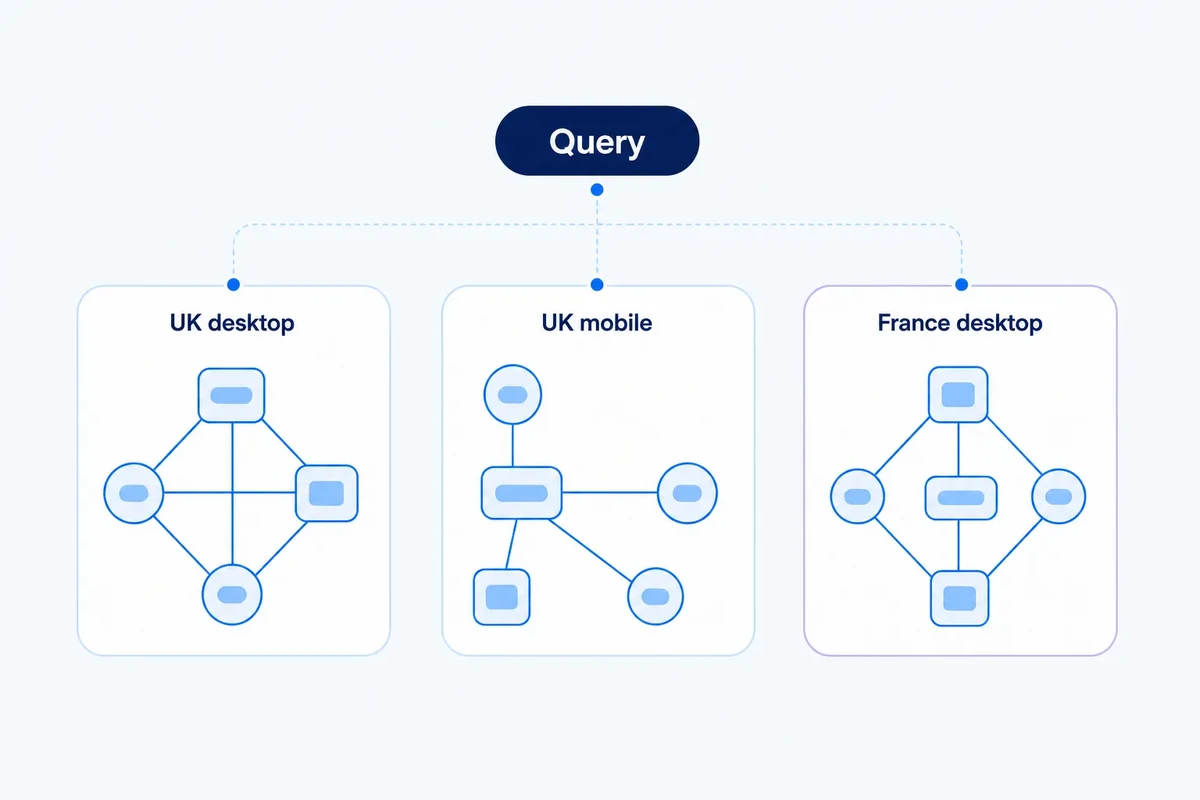
If you have ever exported a few thousand keywords from Ahrefs or Search Console to build a content plan, you have likely run into a frustrating hurdle. You might see two terms that seem identical, yet Google treats them differently depending on where the searcher is standing or what device they are holding. A SERP overlap score, which tells us how many URLs two keywords share, is only truly useful if we know the specific context of that search.
When we look at the same query across different countries or devices, we often see different URLs, varying page types, and unique local features. If we try to squash all these observations into a single global overlap value, we risk making the data look more stable than it actually is. For a tool like ClusterIQ to be effective, it needs to keep the country and device data firmly attached to the SERP observation, just as it treats market data for keywords.
Country changes the candidate ecosystem
It is easy to assume that a UK search result is a fair proxy for the US or France, but the ecosystem changes the moment you cross a border. Different markets involve different businesses, varying product availability, and unique local regulations. Even language preferences and local relevance shift significantly. A UK SERP is not a neutral baseline; it is a specific snapshot of a specific market.
Device can change result presentation and behaviour
We also have to consider the hardware. Mobile and desktop results frequently differ in their layout, the features Google chooses to show, and sometimes even the ranking order. If you are working on clusters where the mobile experience is the primary goal, preserving that device-specific evidence is vital for making the right page decisions.
Worked example: a local service query
Imagine you are looking at the term emergency plumber. If you search this in Salisbury and then in Manchester, you will see completely different local businesses and geographic contexts. While the words in the search bar are identical, the intent is hyper-local. In this scenario, trying to calculate one global set-overlap score would be entirely meaningless for your reporting or implementation.
International product queries can change page type
This variance also hits international e-commerce. A specific product might have a dedicated manufacturer page in one country, but in another, it might be sold almost exclusively through third-party retailers. This means the actual type of page Google prefers can change, even if the product itself is the same. Our guide on International ClusterIQ analysis explains how to keep local implementation separate from the broader global topic identity.
Store SERP context explicitly
To avoid comparing incompatible data, every snapshot should record the query, country, language, and device. We also need to track the date, time, result depth, and any normalisation rules used. This level of detail prevents us from accidentally comparing two snapshots that do not actually belong together.
Compare within market before comparing across markets
The best workflow is to establish how two queries relate within a single market first. Once you understand the relationship in the UK, you can repeat that analysis for Germany or France. Only after you have grasped these local relationships should you ask if the topic structure is consistent on a global scale.
Cross-market disagreement is useful information
If two keywords overlap heavily in one country but barely at all in another, that disagreement is a goldmine of information. It might reveal different page ecosystems, variations in how intent is interpreted, or even issues with translation and terminology. You should never average this disagreement away; the variance is the insight.
Device differences may need less weight than country
It is worth noting that for many queries, the overlap between mobile and desktop is high enough that you do not need separate clustering for each. It is best to measure the actual variance first. You should only introduce device-specific rules when they actually change your decisions about URLs or content briefs.
Search Console can validate local visibility
Google itself acknowledges that results vary based on time, place, and device. Search Console allows us to filter and compare this data directly. ClusterIQ can take that first-party data and combine it with external SERP observations without merging the metrics into a confusing mess.
Market-specific clusters can share one global ID
A smart way to organise this is to have a global concept that links to specific clusters for the UK, France, or Germany. This allows for local page mappings while maintaining a clear view of how the topics compare across the world.
Use variance to decide confidence
When a cluster shows a stable structure and consistent overlap across every country, you have very strong international evidence for your strategy. However, if the result types change radically by market, you need to make local page decisions, even if the overarching topic remains the same.
Do not overcomplicate small sites
If you are managing a site that only operates in the UK and gets mostly mobile traffic, you probably do not need a complex multi-context architecture. Only add this complexity when it materially changes the answer to your SEO problems.
Keep geographic and language effects separate
Remember that a French search in Canada is not the same as a French search in France. You must treat country, language, and script as separate fields to get an accurate picture.
Volatility should be measured inside each context
When looking at SERP volatility, keep the country and device constant. This ensures you are measuring actual changes over time rather than just seeing the differences between two different contexts. The core principle here is that a SERP relationship belongs to the specific environment where it was observed. Do not try to globalise local evidence by averaging it out.
ClusterIQ Conclusion
By using country and device context, we make our SERP evidence much more precise. ClusterIQ allows us to preserve these local relationships and use any disagreements to inform better international decisions, rather than pretending a single global score fits every searcher.
Use context variance to decide where one global model stops
We can quantify how often a pair of keywords maintains the same relationship across different markets. If the similarity and page types stay consistent, one global parent topic is fine. If they diverge, the system should branch into market-specific clusters. This helps international teams separate shared research from the practical work done by local SEOs. It also prevents unnecessary work; if mobile and desktop results are the same, we do not need to double our workload. Complexity should only exist when it helps us make a better decision.
Sources and further reading
Farky Rafiq
Founder of ClusterIQ
I've worked in digital marketing since 2005 and founded Liquid Silver in 2011. These articles are where I share the methods, experiments and practical SEO thinking behind ClusterIQ.
Put the idea into practice with your own keyword data
ClusterIQ helps turn raw SEO exports into clean, structured working datasets you can inspect, refine, report on and take into the next stage of your workflow.
Keep reading
SERP volatility in keyword clustering: when one search-result snapshot is not enough
Clustering internal site search queries: learning from what users ask after they arrive