SERP volatility in keyword clustering: when one search-result snapshot is not enough
SERP overlap can strengthen keyword clustering, but rankings change. Learn how repeated observations and volatility measures prevent one temporary result set from becoming a permanent page decision.

Farky Rafiq
Founder of ClusterIQ
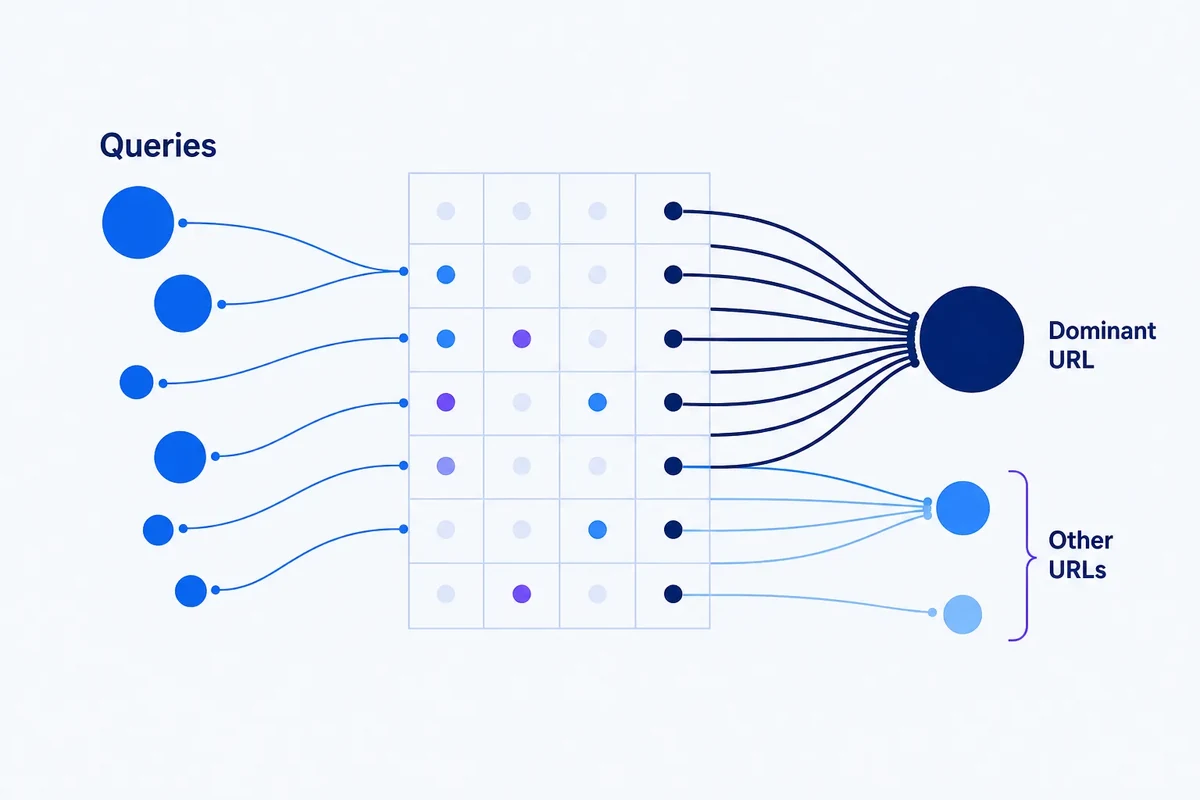
Keyword clustering relies heavily on SERP overlap because it provides real-world evidence of how search engines view semantic similarity. If two keywords share several ranking URLs, it is a strong signal they belong on the same page. However, the biggest weakness in this approach is time. A search result page is merely a snapshot of a system in constant motion.
If ClusterIQ were to treat a single data collection as a permanent truth, the resulting strategy could be skewed by temporary ranking shifts, fresh news content, local variations, or Google testing new layouts. Relying on one moment in time can lead to incorrect clustering decisions.
What volatility means here
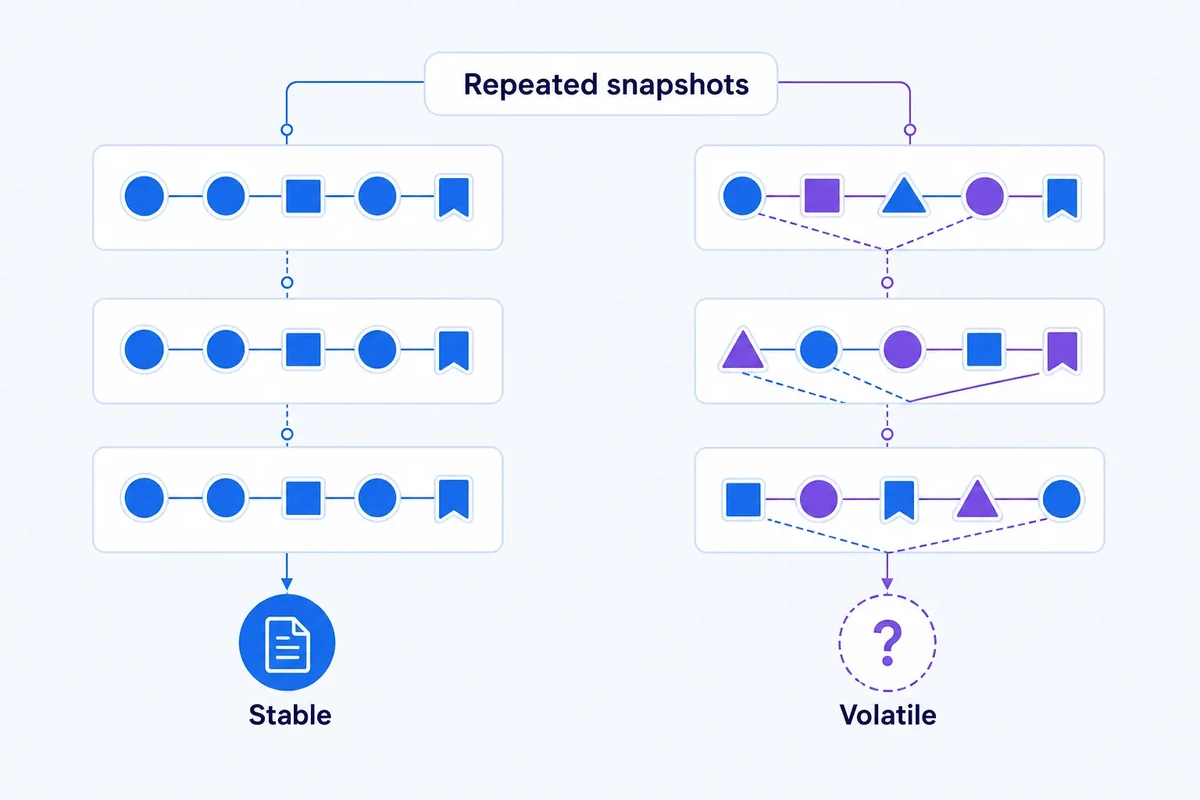
In this context, volatility is measured by comparing the ranking URLs for a specific query across multiple observations. If you pull a list of 1,000 keywords from Ahrefs or Semrush today and again in two weeks, the differences tell a story.
High stability means the same URLs and domains remain in the top positions. High volatility means the set of results or their order has changed significantly. We can measure this by looking at:
- URL set overlap;
- domain-level consistency;
- rank movement for specific pages;
- changes in the types of results shown;
- stability within the top 3 or top 10 positions.
Why stable overlap is stronger evidence
Imagine you are deciding whether to merge two content briefs. If two queries share six top-10 URLs across repeated observations over a month, that relationship is far more persuasive than seeing six shared URLs just once. ClusterIQ can distinguish between this repeated agreement and a one-off overlap caused by a temporary trend.
Worked example: a query during a product launch
Consider a new smartphone release. For a few days, the SERPs for related commercial queries might be flooded with news articles and hands-on reviews. A single snapshot might suggest these keywords belong on an editorial blog post. However, a month of observations would likely show the SERP returning to its stable state: product pages and category listings. Using longitudinal data prevents you from building a long-term content plan based on a short-term trend.
Jaccard can measure set stability
We can use Jaccard similarity to compare a query's URL set at two different points in time. ClusterIQ's Jaccard guide explains how this metric works for clustering, but here, the sets being compared are temporal snapshots of the same keyword. A low Jaccard score between two dates indicates high volatility.
Rank-weighted volatility adds detail
Two snapshots might contain the exact same ten URLs but in a completely different order. If your page-mapping decision depends on what is happening in the top three spots, you need rank-aware metrics. Tracking top-3 and top-5 overlap separately ensures that movement at the bottom of the first page doesn't distract you from stability at the top.
Result type can be more stable than individual URLs
Sometimes specific pages rotate frequently, but the intent remains fixed. The SERP might be consistently dominated by certain formats, such as:
- category pages;
- product detail pages;
- how-to guides;
- community forums;
- video carousels;
- local map packs.
If the page types remain stable even when the exact URLs change, you still have enough evidence to map your keywords to a specific template.
Use repeated observations selectively
Monitoring every SERP every day for thousands of keywords is expensive and creates data noise. It is better to prioritise your resources for:
- high-value clusters that drive significant revenue;
- ambiguous mappings where the intent isn't clear;
- queries that showed mixed results in the first crawl;
- terms critical for a site migration;
- sectors known for high volatility, like news or finance.
Market context still matters
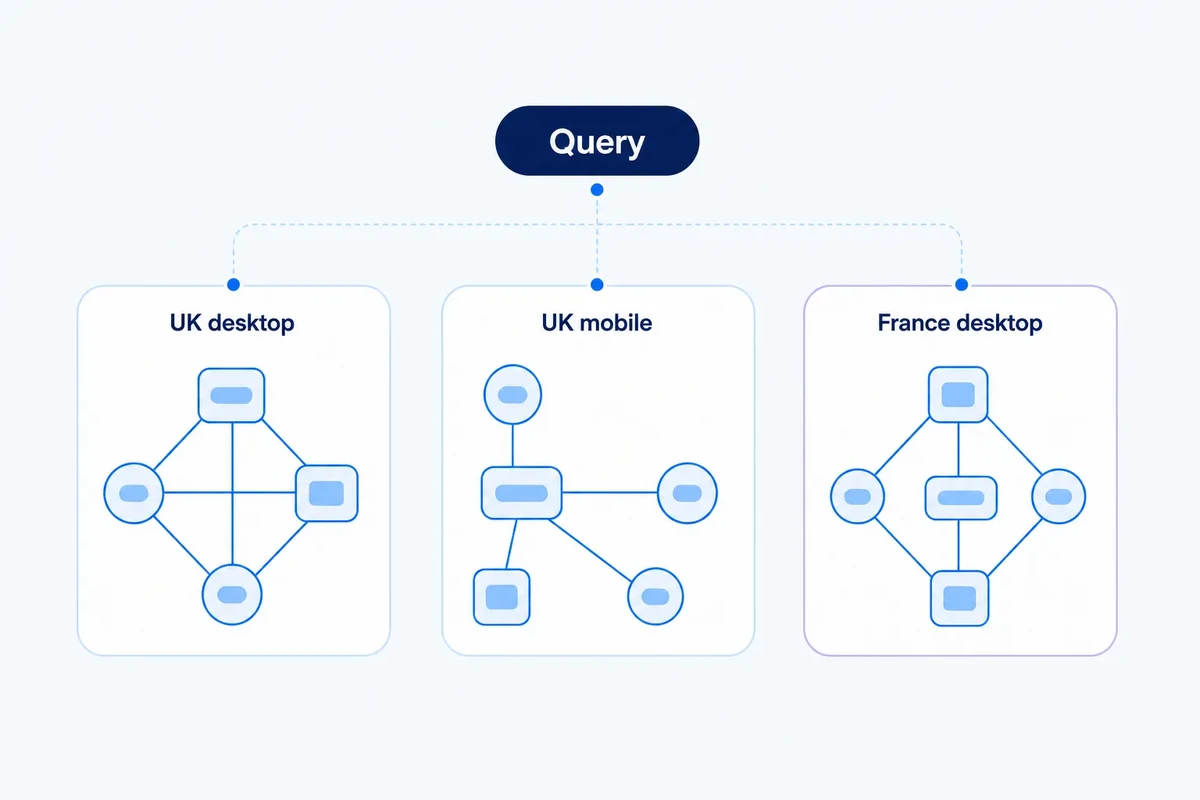
Volatility must be measured under consistent conditions. Ensure you are comparing the same country, language, and device type. If you change the geography between snapshots, you aren't measuring market volatility; you are looking at two different search contexts entirely.
Do not use volatility as a quality penalty automatically
A volatile SERP is not necessarily a "bad" keyword. It often indicates ambiguous intent, a rapidly changing market, or a high degree of personalisation. This is valuable intelligence for an SEO. It suggests that your content needs to be more flexible or that you should expect less predictable traffic from that specific term.
Cluster-level volatility is useful
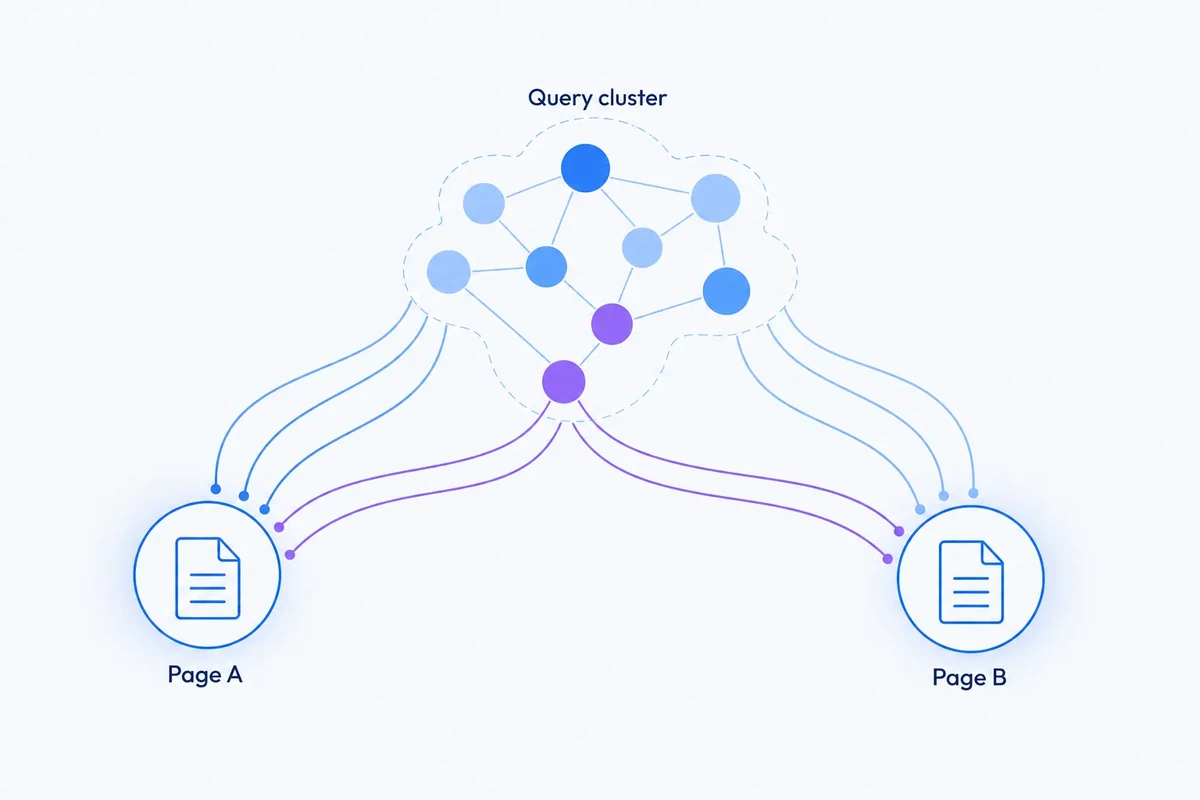
By aggregating data across all queries in a cluster, you can determine if a whole topic is stable. If a cluster shows consistently volatile SERPs, you should have lower confidence in your page-type assumptions and perhaps opt for a more diverse content approach.
Use volatility to decide when to recheck mappings
Stable clusters do not need constant monitoring. You can sample them less frequently, while volatile clusters should enter a more frequent refresh cycle. This approach ensures your data collection is proportional to your uncertainty.
Search Console provides another longitudinal view
While external tools show the whole market, Search Console shows how Google treats your specific site over time. Tracking which URL Google chooses to rank for a query can reveal ownership shifts. Ownership-change monitoring is a perfect complement to external volatility tracking.
Keep raw snapshots for audit
A volatility score is useful, but you should always be able to dig back into the raw data. Keeping records of collection dates, devices, and specific URL positions makes it possible to explain why a cluster changed or why a specific mapping was recommended during a stakeholder meeting.
Do not claim that stable SERPs prove one-page targeting
Shared results are evidence of the current retrieval environment, not a rule for your site architecture. Your business might have specific user experience needs or inventory constraints that require a different approach. Always combine SERP stability with semantic analysis and entity data.
Practitioner principle: one SERP snapshot can be useful. Repeated agreement tells you whether the relationship is stable enough to influence a lasting page decision.
ClusterIQ Conclusion
SERP volatility adds a vital time dimension to keyword clustering. By measuring the stability of URLs and page types over time, ClusterIQ helps SEOs distinguish between durable market patterns and temporary fluctuations. This leads to more confident mapping and more resilient content strategies.
Define a stability window around the decision
Different SEO tasks require different levels of certainty. A low-risk blog post might only need a single representative snapshot. However, if you are planning to consolidate two high-value category pages, you should demand evidence of stability over several weeks. ClusterIQ makes this clear by categorising relationships as "stable", "volatile", or "insufficient history".
Use stable reference queries
Within any large keyword set, some terms will naturally be more erratic. By identifying stable reference queries within a topic, you can determine if a shift in the SERP represents a total market change or just noise at the edges of the cluster.
Sources and further reading
Farky Rafiq
Founder of ClusterIQ
I've worked in digital marketing since 2005 and founded Liquid Silver in 2011. These articles are where I share the methods, experiments and practical SEO thinking behind ClusterIQ.
Put the idea into practice with your own keyword data
ClusterIQ helps turn raw SEO exports into clean, structured working datasets you can inspect, refine, report on and take into the next stage of your workflow.
Keep reading
Country and device SERP variance: when the same keyword should not share one global overlap score
Keyword cannibalisation: how clustering helps find overlap without inventing a problem