SEO opportunity scoring with keyword clusters: prioritise the work without inventing one magic number
Demand, visibility, business value, implementation effort and confidence all matter to prioritisation. Learn how ClusterIQ can combine them without hiding judgement in one score.

Farky Rafiq
Founder of ClusterIQ
You have exported 1,500 keywords from Ahrefs, Semrush or Search Console, grouped them into clusters, and now need a workable content plan. Which pages should the team tackle first?
One opportunity score makes sorting quick. But a weighted formula can hide subjective choices behind a precise-looking number. ClusterIQ can use scoring to organise work while keeping the evidence and assumptions visible.
Opportunity has several dimensions
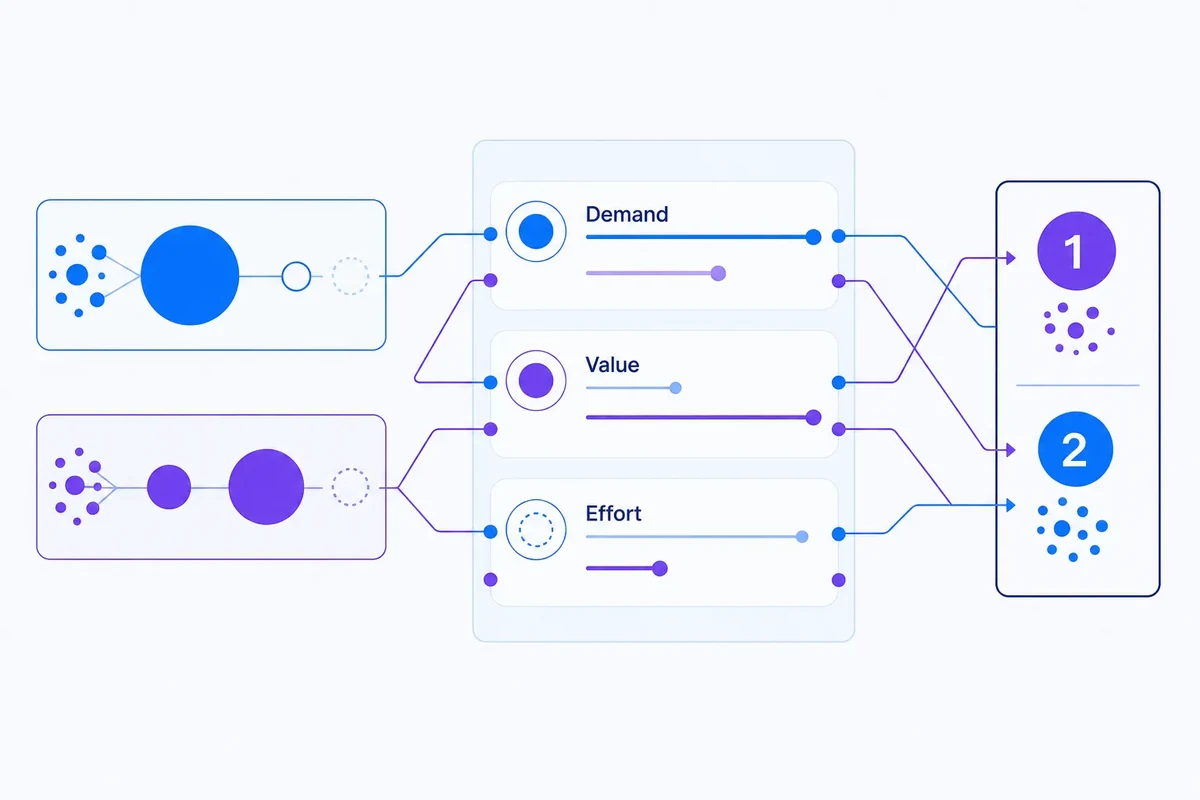
A useful cluster-level scorecard separates:
- search demand;
- current visibility gap;
- business value;
- page coverage;
- competitive difficulty;
- implementation effort;
- analytical confidence.
Each answers a different question. Keeping them visible helps turn a keyword list into page decisions, briefs and a delivery plan, rather than another spreadsheet to interpret.
Demand is not value
A popular informational topic may contribute less to the business than a smaller product cluster. Keep search demand and business contribution separate, so the business can decide how much each matters.
Visibility gap needs a baseline
A cluster the site already dominates usually offers less incremental search opportunity than an equally valuable one with weak coverage. Establish the starting point using current impressions, clicks, ranking distribution or which pages currently rank for the cluster.
Worked example: two competing opportunities
Cluster A has 100,000 monthly searches, low commercial value and already ranks on page one.
Cluster B has 20,000 searches, high product margin, weak visibility and an existing category page that can be improved quickly.
A volume-only list picks A. A multi-dimensional ClusterIQ view can make the case for B. The useful deliverable might be a category-page brief, not a new article, without claiming that one formula is universally correct.
Effort should be explicit
“Improve this cluster” could mean very different jobs:
- a copy update;
- internal links;
- a new template;
- engineering;
- product-feed work;
- legal approval;
- a migration.
Put delivery effort beside opportunity. A promising recommendation still needs a realistic route into the team's workload.
Confidence should influence how aggressively you prioritise
High potential with weak evidence may justify research first. Moderate potential backed by strong first-party evidence may be ready for implementation.
Confidence should describe the quality of that evidence, not merely knock down a score through an arbitrary multiplier.
Weights are business policy
Giving revenue potential twice the weight of raw search demand is a strategic choice. ClusterIQ should expose that choice and keep a version history, rather than presenting the result as something data science objectively decided.
Use scorecards before composite scores
Start with a view people can discuss:
- Demand: High
- Visibility gap: High
- Business value: Medium
- Effort: Low
- Confidence: High
A composite score, which combines these components, can provide the overall ranking. Keep the components alongside it so colleagues can challenge the reasoning.
Normalisation changes rankings
Search volume might range from 10 to 1,000,000, while effort uses a 1–5 scale. Before weighting them, you need compatible scales. This adjustment is called normalisation, and the method can materially change the ranking. Document it.
Outliers can dominate min-max scales
Min-max scaling places values between a minimum and maximum. One huge branded cluster can push every other demand score close to zero.
Log transforms, percentiles or capped scales may be more stable alternatives. These are still modelling choices, so validate them rather than assuming they solve the problem.
Use different views for different decisions
An editorial roadmap may favour low-effort content gaps. A technical roadmap may focus on valuable revenue clusters affected by indexation or canonical problems.
ClusterIQ can apply filters and views without changing the underlying opportunity data.
Do not let the score create filler
High demand does not automatically justify a new URL. If the topic has no distinct job for a page, do not commission an article just because it scores well. Content-gap and overlap checks remain requirements before publication.
Backtest prioritisation
Review completed cluster work. Did high-scoring recommendations produce stronger outcomes than lower-scoring ones? Comparing past priorities with results can expose weak assumptions in your weights.
Use score changes as explanations
If a cluster moves from priority 40 to priority 5, explain why. Higher demand, lost visibility, new inventory and lower implementation effort tell different stories. Showing the cause makes stakeholder reporting more useful.
Keep manual strategic overrides
A launch, brand initiative or regulatory requirement can outrank the model. Record the override and its reason. Do not edit the evidence to manufacture the score you wanted.
Practitioner principle: opportunity scoring organises evidence. Weights express business priorities, so keep them visible and open to challenge.
ClusterIQ Conclusion
Cluster-level scoring makes SEO roadmaps manageable without pretending one number contains the truth. ClusterIQ can combine demand, visibility, value, effort and confidence while preserving the components and strategic choices behind the ranking.
Use priority bands to avoid false separation between close scores
Scores of 73.4 and 72.9 may be effectively indistinguishable once uncertainty in demand, effort or value is considered. ClusterIQ can group opportunities into bands such as act now, validate next and monitor, with detailed sorting within each band.
Bands leave room for dependencies and team capacity without letting tiny modelling differences dictate delivery. When a score changes materially, the product should identify the component responsible: improved inventory is not the same story as collapsed organic visibility. The score should point back to evidence, not replace it.
Sources and further reading
Farky Rafiq
Founder of ClusterIQ
I've worked in digital marketing since 2005 and founded Liquid Silver in 2011. These articles are where I share the methods, experiments and practical SEO thinking behind ClusterIQ.
Put the idea into practice with your own keyword data
ClusterIQ helps turn raw SEO exports into clean, structured working datasets you can inspect, refine, report on and take into the next stage of your workflow.
Keep reading

Business value weighting in SEO clusters: keeping commercial priorities separate from the search model
Building an SEO roadmap from keyword clusters: moving from analysis to sequenced delivery