Refreshing old content with cluster drift and coverage evidence
Content refreshes are stronger when they respond to changing query structure, missing coverage and ownership rather than arbitrary age. Learn how clusters identify what actually changed.

Farky Rafiq
Founder of ClusterIQ
Simply noting that an article is twelve months old does not constitute a content refresh strategy. While age is a valid prompt to review a page, the more important question is whether the search intent, topic structure, or page ownership has shifted enough to warrant the effort. Instead of asking editors to update pages based on a fixed calendar date, ClusterIQ uses query clusters, coverage data, and drift analysis to identify exactly what has changed.
Look for change in the query footprint
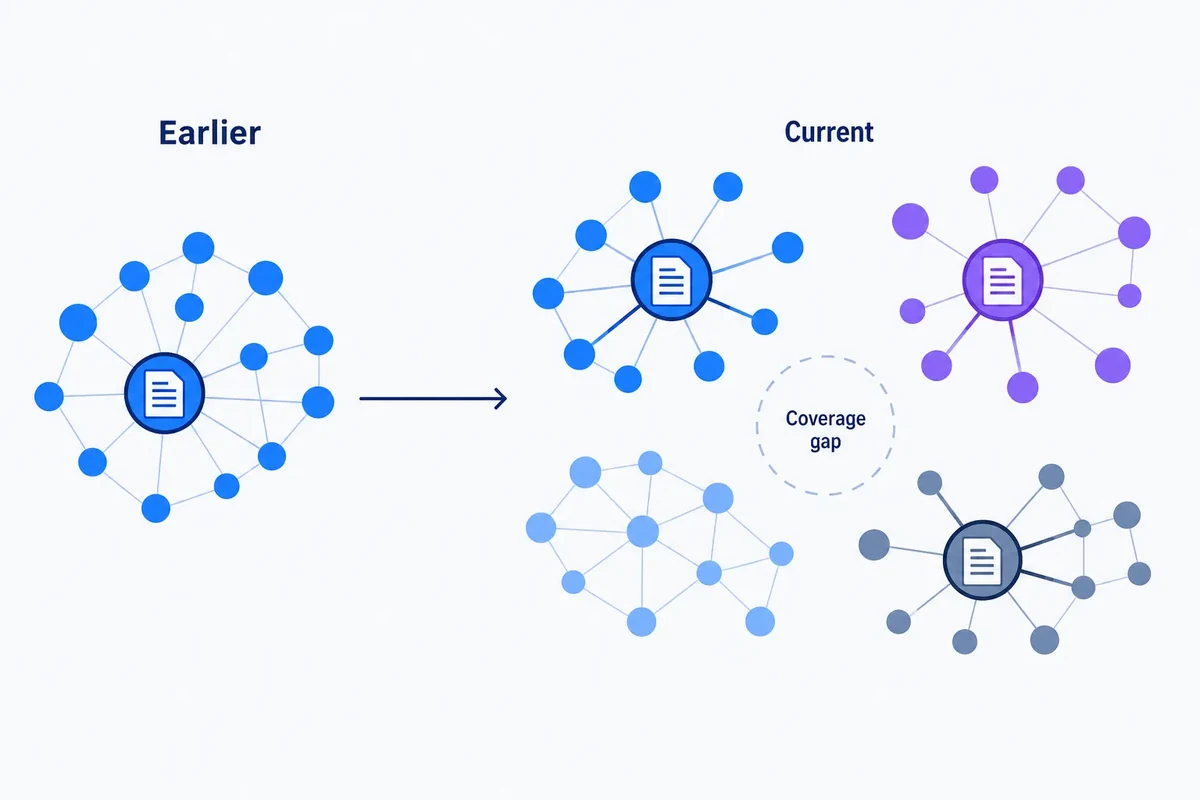
Start by comparing the clusters associated with a page across two different periods. When you pull a few thousand keywords from Search Console or Ahrefs, you can see if the footprint has evolved. Useful signals include new subclusters appearing, old ones disappearing, or the emergence of new terminology and entities. You might also notice changes in dominant modifiers or shifts in which URL Google prefers for specific terms. This data provides a concrete, evidence-led reason for a refresh rather than a guess.
Cluster drift can reveal a changing topic
Topics are rarely static. Over time, a single subject might split into several distinct subtopics or adopt entirely new language. Cluster drift allows you to see when the underlying structure of a topic has moved, rather than just observing a change in search volume. If the core topic remains stable, the page might only need a light touch. If the drift is significant, the page may no longer meet the user's primary need.
Coverage gaps can emerge inside an old page
A guide that was considered comprehensive two years ago might now be missing vital context. This could include new product categories, updated regulations, fresh terminology, or new user questions that have become common in the SERPs. ClusterIQ compares your current topic map against the sections your page actually covers, highlighting where you have fallen behind the current market consensus.
Worked example: an old technical guide
Consider a technical guide about keyword clustering written when basic embeddings were the standard. Today, the cluster landscape for that topic includes graph community detection, cross-encoder reranking, and cluster stability. A refresh shouldn't just involve changing the "last updated" date. Instead, you must decide if the guide needs new sections to cover these technical advancements, or if it should take on a narrower role now that you have published deeper, specialist articles on those specific subtopics.
Do not turn every refresh into expansion
It is a common mistake to assume a refresh always means adding more words. Sometimes a page has become too broad and unfocused. A successful refresh might involve removing outdated sections, linking out to newer specialist articles, or consolidating duplicated explanations. The goal is to clarify the page's core job. More words are not automatically more useful for the reader or the search engine.
Use Search Console ownership as a trigger
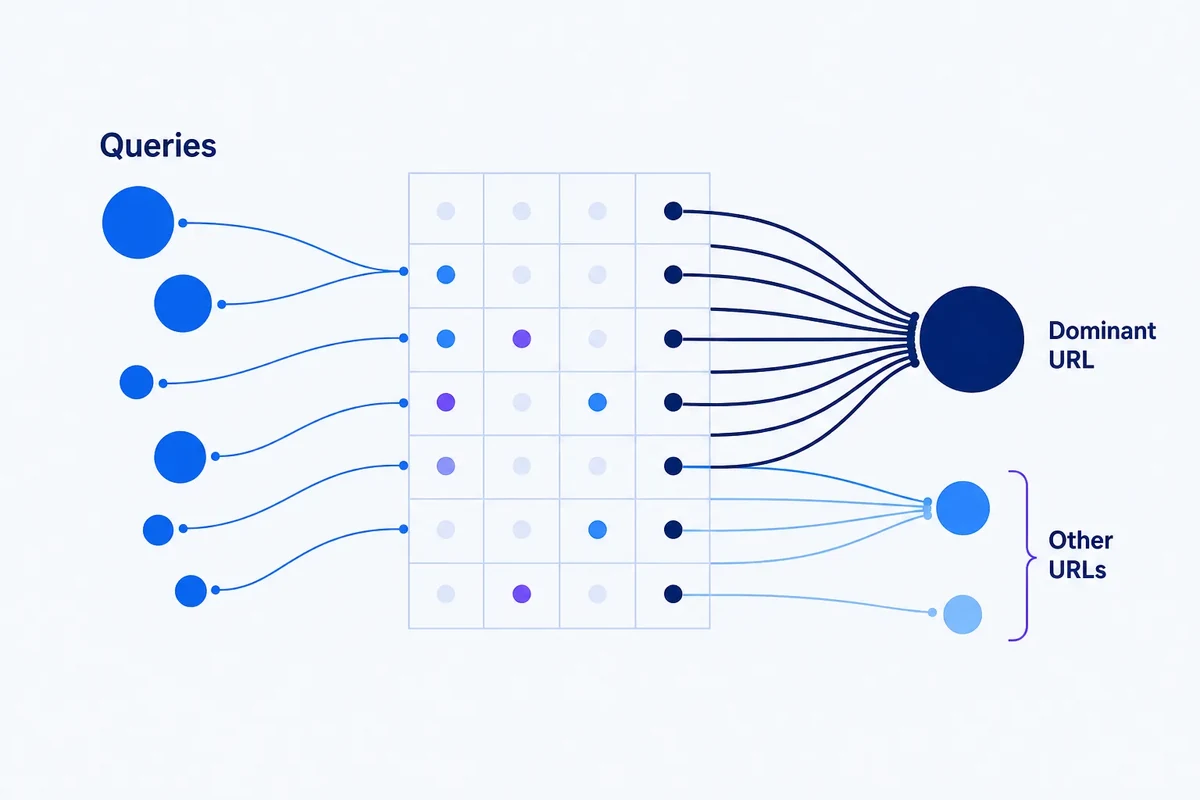
If a page's primary cluster starts shifting toward a different URL on your site, you need to investigate why. It could be that the newer page is a better fit for the intent, or perhaps internal linking changes have confused the hierarchy. Query-page ownership monitoring ensures your refresh queue is driven by how Google actually perceives your site architecture, helping you resolve keyword cannibalisation before it hurts rankings.
Refresh priority should include business consequence
Not all clusters are equal. A small informational topic can usually tolerate a stale page longer than a revenue-critical category page. When building your worklist, prioritise based on topic importance, current performance trends, the degree of drift, and the implementation effort required. This ensures you are spending your editorial budget where it will have the most impact on the bottom line.
Check sources, not only keywords
Research-led content requires factual maintenance. A page might still rank for the correct query cluster, but if the statistics, product details, or external citations are outdated, the quality is declining. ClusterIQ identifies the topical need for a review, while your editorial team performs the manual QA to verify that the facts remain accurate.
Internal links should evolve with the corpus
As your site grows, older articles should be updated to point toward newer, more specific pieces. A refresh is the perfect opportunity to add links to new child topics, remove links to retired content, and strengthen commercial pathways. This helps clarify the parent-child relationships within your content silos and keeps the user journey relevant.
Use stable cluster IDs to compare history
If your cluster labels change every time you run a report, tracking history becomes nearly impossible. You need a system that maintains a stable lineage so you can see if a current group is a continuation, a split, or a merge of a previous topic. Reproducible clustering provides the necessary foundation for this kind of long-term historical analysis.
Measure the refresh afterwards
Once the work is done, judge success by looking at cluster impressions, clicks, and the coverage of new subtopics. Check if the intended URL has regained its dominant share of the cluster and how the query mix has changed. Avoid judging a refresh solely on total page traffic if the specific goal was to capture a new subtopic or fix an ownership issue.
Maintain a reason for every refresh
Every item in your editorial queue should have a clear objective, such as fixing a coverage gap, addressing topic drift, or consolidating thin content. This makes your content programme auditable and prevents the "refresh everything" trap, where teams waste time on pages that are actually performing perfectly well.
Where ClusterIQ fits
ClusterIQ transforms content maintenance from a guessing game into a structured workflow. Instead of sorting by age, you can filter for high-value topics showing signs of drift or weak ownership. This allows you to apply the same sophisticated clustering logic to your existing content as you do when planning new campaigns.
Practitioner principle: refresh a page because the evidence or user need changed, not because the calendar says the content is old.
ClusterIQ Conclusion
Targeted refreshes are far more effective when keyword clusters provide the necessary context. By observing how topics and query footprints evolve, you can make informed decisions about whether to expand, narrow, or consolidate your content. This approach protects your site's quality and authority while ensuring you never waste time on unnecessary rewrites.
Use refresh scope to control editorial cost
Not every update requires a total rewrite. By classifying the scale of the change, you can match your effort to the actual need. A page with a stable core cluster might only need a quick factual update, whereas a page where the query footprint has split into three different tasks might require a full structural overhaul. This efficiency reduces the risk of breaking content that is already performing well just for the sake of making it look new.
Sources and further reading
Farky Rafiq
Founder of ClusterIQ
I've worked in digital marketing since 2005 and founded Liquid Silver in 2011. These articles are where I share the methods, experiments and practical SEO thinking behind ClusterIQ.
Put the idea into practice with your own keyword data
ClusterIQ helps turn raw SEO exports into clean, structured working datasets you can inspect, refine, report on and take into the next stage of your workflow.
Keep reading
Content decay vs topic decay: knowing whether the page got weaker or the demand moved
Keyword cannibalisation: how clustering helps find overlap without inventing a problem