Forecast uncertainty at keyword-cluster level: making SEO projections less falsely precise
Cluster-level forecasts are more useful when they show ranges, assumptions and scenario risk rather than one confident traffic number. Learn how ClusterIQ can report uncertainty.

Farky Rafiq
Founder of ClusterIQ
You have a keyword export, a content plan and a client asking what traffic the work will bring. A figure such as “18,430 visits next year” looks reassuring, but it hides assumptions about rankings, clicks, demand and delivery dates.
ClusterIQ can help make the topic cluster the forecasting unit, with uncertainty included in the output. The useful deliverable is a range that supports planning, not a precise-looking promise.
Why cluster-level forecasting helps
Forecasting individual keywords is noisy. If you have 800 keywords from Ahrefs or Semrush, grouping related queries gives you fewer, more useful units to assess. Those queries often rise, fall and map to pages together. Aggregation reduces reliance on any single estimate, but does not remove uncertainty.
Separate demand from capture
Start by separating the searches available from the share your site might win. Model these components individually:
- available search demand;
- current visibility;
- expected ranking improvement;
- click-through rate (CTR), or traffic capture;
- implementation timing.
Each needs its own assumptions. More demand does not automatically mean more visits.
Use scenarios rather than one path
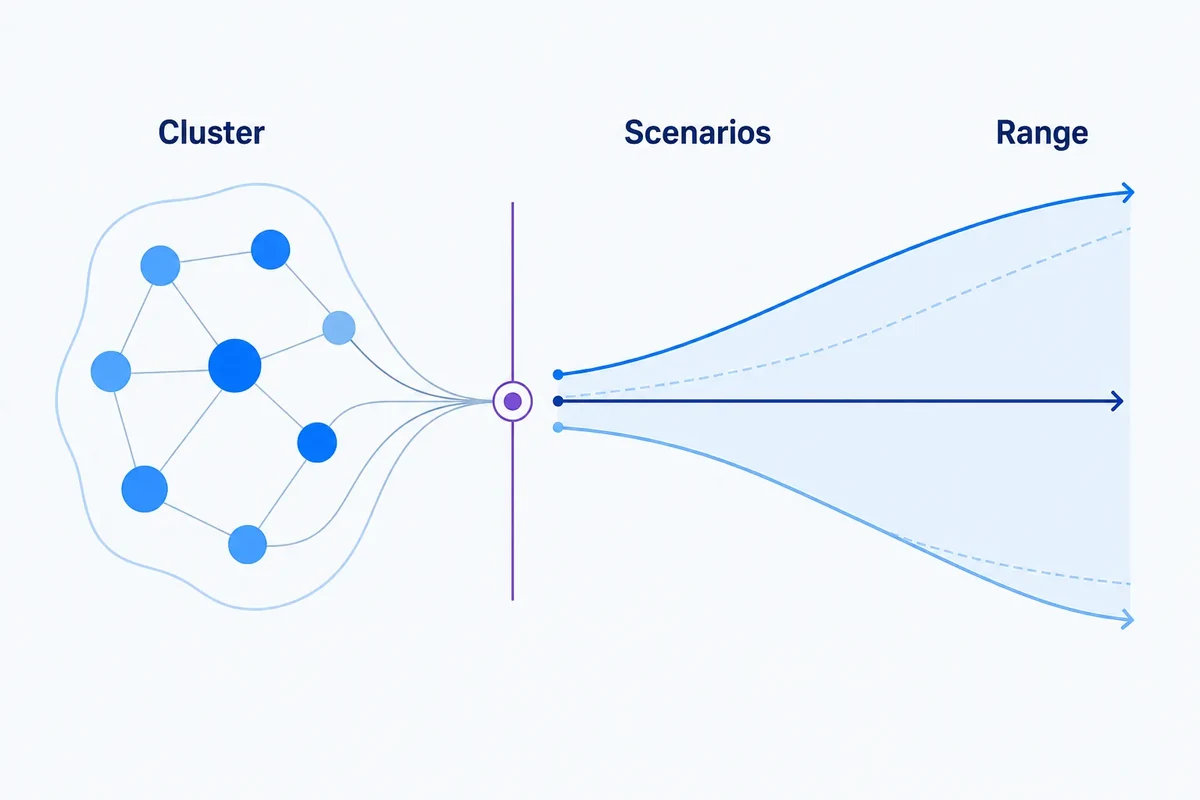
A practical forecast built around ClusterIQ clusters can show three scenarios:
- conservative;
- base;
- upside.
Make their differences explicit. An upside scenario might assume stronger ranking gains, rather than simply multiplying the base forecast by an arbitrary percentage.
Worked example: a category cluster
Suppose a product cluster contains 200,000 estimated monthly searches across its queries. The site captures little of that demand because its category page is weak.
Your content brief and page improvements are scheduled for month three. Model that launch date, gradual visibility gains, seasonal demand and three ranking/CTR scenarios. The result is a plausible traffic range, rather than a claim that all available searches will become visits.
Search volume is uncertain input
Third-party search volumes are modelled and rounded, so adding them together does not give an exact market size. Search Console impressions offer first-party context for queries where your site already appears, rather than a complete view of demand.
CTR models are conditional
The share of searchers who click varies with rank, query type, brand, search results page features, device, page title and market.
A universal position-to-CTR curve can make a spreadsheet manageable. Treat it as a modelling convenience, not a rule that every query follows.
Implementation timing matters
A twelve-month forecast usually becomes unrealistic if every recommendation supposedly launches on day one. ClusterIQ can connect roadmap dates with the model, so projected value starts only when the relevant page or change is expected to go live.
Seasonality belongs at cluster level
Related queries often share seasonal patterns. Use Seasonal cluster analysis to inform monthly demand, rather than spreading an annual average evenly across the year.
Show uncertainty bands visually
Show the base forecast on a chart with a plausible range around it. That range should reflect uncertainty in the model and the scenario assumptions. Decorative error bars add no useful information.
Use historical backtesting
Choose a past date and build a forecast using only information available then. Compare it with what happened afterwards. This check, called backtesting, reveals persistent overestimation or a model that handles seasonal changes poorly.
Do not forecast unimplemented work as delivered value
A worthwhile cluster opportunity may still be blocked by engineering capacity, inventory or legal approval. Keep its potential value separate from the committed forecast until implementation is sufficiently likely.
Confidence can vary by cluster
A mature category with stable historical data deserves a narrower range than a new topic with no ranking history. ClusterIQ can assign forecast-confidence states based on available evidence, rather than how optimistic the team feels.
Use forecasts for prioritisation, not promises
The most useful question is often comparative: under the same assumptions, do these five clusters offer a greater range of upside than those five?
That helps you choose a content roadmap without pretending to know exactly what will happen.
Report assumptions alongside the output
A board-ready forecast should state:
- demand source;
- ranking assumptions;
- CTR assumptions;
- implementation date;
- seasonality model;
- scenario definitions.
Keep these visible alongside the chart, not buried in a spreadsheet tab.
Update forecasts when evidence changes
As work launches, replace assumed timelines and ranking trajectories with observed performance. The forecast becomes a working model, not a one-off spreadsheet.
Practitioner principle: a forecast is a structured range of possibilities under stated assumptions. More decimal places do not create more certainty.
ClusterIQ Conclusion
Cluster-level forecasting connects topic opportunity with realistic delivery expectations. For ClusterIQ, ranges, scenarios and backtesting provide a more defensible basis for commercial prioritisation than a single traffic promise.
Separate model uncertainty from delivery uncertainty
Two different risks need attention: search performance may differ from expectations, and the organisation may not deliver on time. ClusterIQ can model the traffic range for a completed change separately from implementation probability or timing.
An internal-link change might have modest upside but high delivery confidence. A new platform feature could offer more value with a much wider delivery window. One combined number hides that operational difference.
Replace planned launch dates with actual dates as work progresses. The forecast can then narrow as delivery uncertainty reduces, giving stakeholders an updated evidence range rather than an old promise.
Record forecast error after the period closes
Compare the projected range with observed results once the forecast period ends, and store the error by cluster type. Repeated over- or underestimation should inform later assumptions, so each forecast benefits from previous work.
Sources and further reading
Farky Rafiq
Founder of ClusterIQ
I've worked in digital marketing since 2005 and founded Liquid Silver in 2011. These articles are where I share the methods, experiments and practical SEO thinking behind ClusterIQ.
Put the idea into practice with your own keyword data
ClusterIQ helps turn raw SEO exports into clean, structured working datasets you can inspect, refine, report on and take into the next stage of your workflow.
Keep reading
How deep should an SEO taxonomy be? Using keyword clusters without building endless category levels
Naming SEO categories from keyword clusters without turning navigation into keyword stuffing