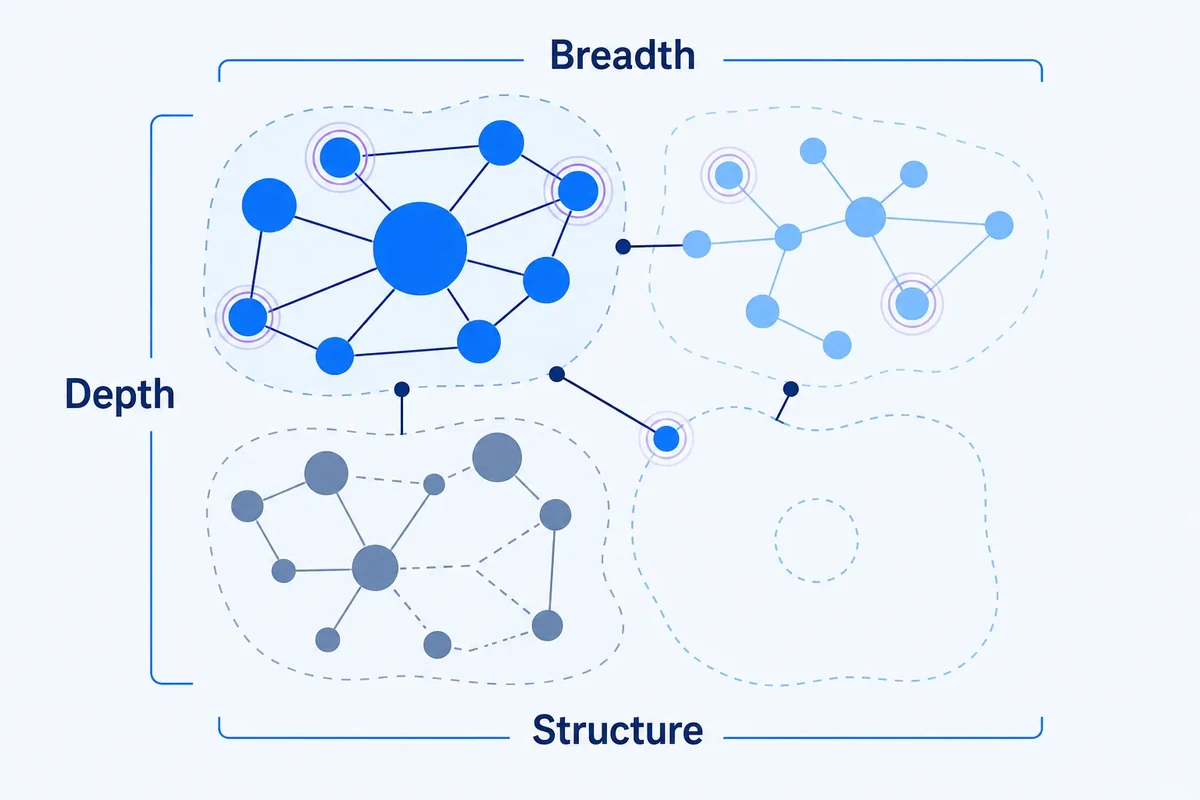
Pillar pages and topic clusters: when the classic content model breaks down
The pillar-and-cluster model is useful for organising broad subjects, but not every topic fits one hub with neat supporting articles. Learn when graphs and task-based structure work better.

Farky Rafiq
Founder of ClusterIQ
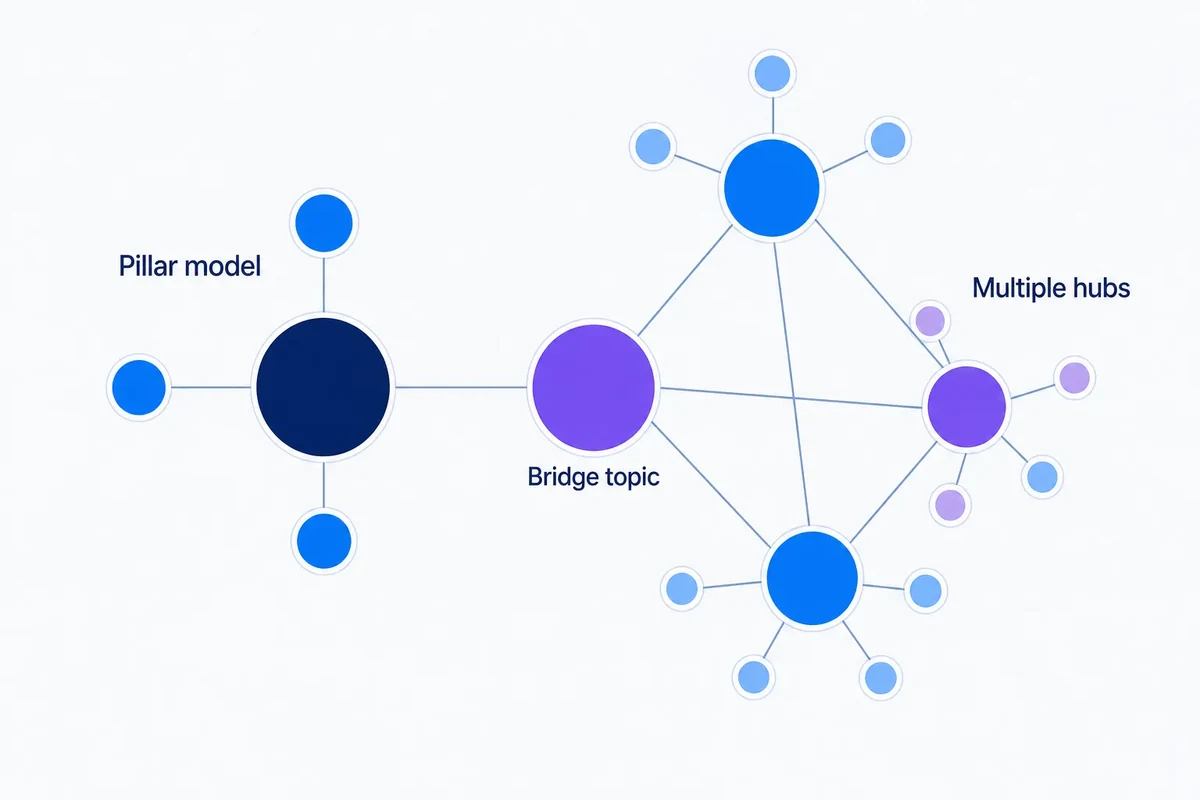
The pillar page model is popular because it is incredibly easy to visualise. You place one broad page in the centre, surround it with supporting articles, and use internal links to connect the spokes back to the hub. It is a tidy, logical way to organise a website.
While this structure works well for simple subjects, it often oversimplifies complex topics that involve multiple hubs, overlapping user tasks, product hierarchies, and bridge concepts. ClusterIQ uses graph theory and clustering evidence to help you decide when a simple pillar model is sufficient and when your content structure needs to be more sophisticated.
What the pillar model gets right
At its best, this model encourages marketing teams to think beyond isolated articles. It treats a broad subject as a cohesive system, typically featuring:
- A parent page or comprehensive overview;
- Specific supporting subtopics;
- Logical internal linking;
- Reduced content duplication;
- Clearer ownership of specific search intents.
These are all excellent principles for any SEO strategy, whether you are managing a few hundred keywords from Ahrefs or thousands of queries in Search Console.
The problem is the assumption of one centre
The main issue is that many topic systems do not have a single, obvious hub. Consider the subject of keyword clustering itself. It connects several distinct areas:
- Semantic similarity;
- Graph theory;
- Search intent;
- URL mapping;
- Content architecture;
- Clustering algorithms;
- Search Console analysis.
Several of these areas are substantial enough to act as hubs in their own right. Forcing them to all orbit a single pillar page can lead to a shallow content experience.
Graphs represent multiple relationships better
A graph structure allows an article to connect to several relevant neighbours without forcing every relationship through a central pillar. For ClusterIQ, this is a vital distinction. A bridge article, such as one on weighted keyword graphs, legitimately relates to semantic similarity, entities, SERP analysis, and graph construction.
If you insist on making one page the mandatory parent, you risk hiding these natural relationships and making the site harder for users to navigate.
Hierarchy still matters
Moving away from a strict pillar model does not mean abandoning hierarchy. Users and search engines still need clear navigation and category structures to make sense of a site. The more effective approach is to use hierarchy where the subject is naturally hierarchical, and use graphs where the relationships are many-to-many.
Worked example: ecommerce content
Imagine an ecommerce site with a "running shoes" category. This acts as a sensible parent for subcategories like trail, stability, and racing shoes. However, your editorial content often cuts across these silos:
- How to choose the right running shoes;
- A guide to running shoe sizing;
- Road vs trail running shoes;
- How long should running shoes last?
These articles relate to multiple commercial categories. If you treat each one as a spoke of only one pillar, you end up with unnatural linking that ignores how a runner actually thinks about their gear.
Topic clusters can also become too broad
There is a tendency for content teams to label every article remotely related to a subject as part of one giant "topic cluster". This dilutes the strategy. ClusterIQ uses semantic and graph evidence to identify:
- Strong local communities of keywords;
- Neighbouring topic communities;
- Bridge content that connects different areas;
- Peripheral content that sits on the edge of a topic.
This provides a much more useful roadmap for content planning than a single, oversized cluster label.
Pillars should have a clear page job
A pillar page should exist because users need a broad navigational or educational resource, not just to satisfy a framework. Before building one, ask yourself:
- What specific task does this pillar help the user complete?
- What does it cover that child pages should not repeat?
- Why would a reader on a supporting page actually want to click back to this hub?
- Does the site already have a category or parent page that serves this purpose?
Some topics need several entry points
Your audience is rarely uniform. A technical specialist might enter your site through a deep-dive article, a beginner through a high-level overview, and a buyer through a specific product page. A sophisticated content architecture supports all three entry points while maintaining the topical links between them.
Use ClusterIQ to identify candidate hubs
By looking at graph centrality, cluster size, and internal link positions, you can identify which pages naturally function as hubs. However, it is important to remember that centrality is not the same as SEO value. Data can highlight the candidates, but the final decision on which page acts as a hub should be an editorial one based on business goals.
Internal links should follow useful next steps
A supporting page does not always need to link back to a pillar. It is often more helpful to link to:
- A deeper technical explanation of a specific point;
- A comparison of two neighbouring concepts;
- A relevant tool or product;
- The logical next step in the user's journey.
This creates a web of content that feels helpful rather than a repetitive, mechanical pattern.
Use the model as a starting constraint, not a doctrine
For smaller sites or new content programmes, the pillar model is a great way to establish initial structure. As your site grows to include thousands of pages, ClusterIQ can show you where subtopics have become large enough to form their own communities, signalling that your simple hub model needs to evolve.
Measure overlap between supposed spokes
If you find that two supporting articles are constantly competing for the same query clusters, your content plan might be fragmented. Cannibalisation analysis helps you distinguish between legitimately related pages and redundant spokes that should be merged.
Practitioner principle: The pillar-and-cluster model is a useful pattern for organising content, but it is not a universal law of topic structure.
ClusterIQ Conclusion
Pillar pages remain effective when a subject follows a clear parent-child logic. ClusterIQ makes this model more flexible by revealing multiple hubs and bridge topics. This allows you to build a content architecture based on how topics actually relate to one another, rather than forcing every subject into a rigid diagram.
Use pillars where navigation benefits from a stable centre
The best candidates for pillar pages are not just the keywords with the highest search volume. They are the pages that provide a genuine overview and clear pathways into deeper subtopics. By comparing centrality and page purpose, ClusterIQ helps you identify these hubs, allowing several to coexist within a larger system. This results in a durable site structure that relies on more than just search volume data.
Sources and further reading
Farky Rafiq
Founder of ClusterIQ
I've worked in digital marketing since 2005 and founded Liquid Silver in 2011. These articles are where I share the methods, experiments and practical SEO thinking behind ClusterIQ.
Put the idea into practice with your own keyword data
ClusterIQ helps turn raw SEO exports into clean, structured working datasets you can inspect, refine, report on and take into the next stage of your workflow.
Keep reading
Building internal links from topic graphs without turning the site into a mesh
Content gap analysis with keyword clusters: finding missing coverage without manufacturing articles